
Guide · 18.11.2026
How to submit and track a business registration in France
Prepare documents for France’s Guichet unique, check the signature and fees, and respond if the reviewing authority asks for a correction.
Read storyUseful journalism to understand, manage and grow a business.
SearchCheck demand, organize costs and cash flow, and prepare for launch with a printable checklist of actions, evidence, and reviews. Includes official resources for the United States and North Carolina.
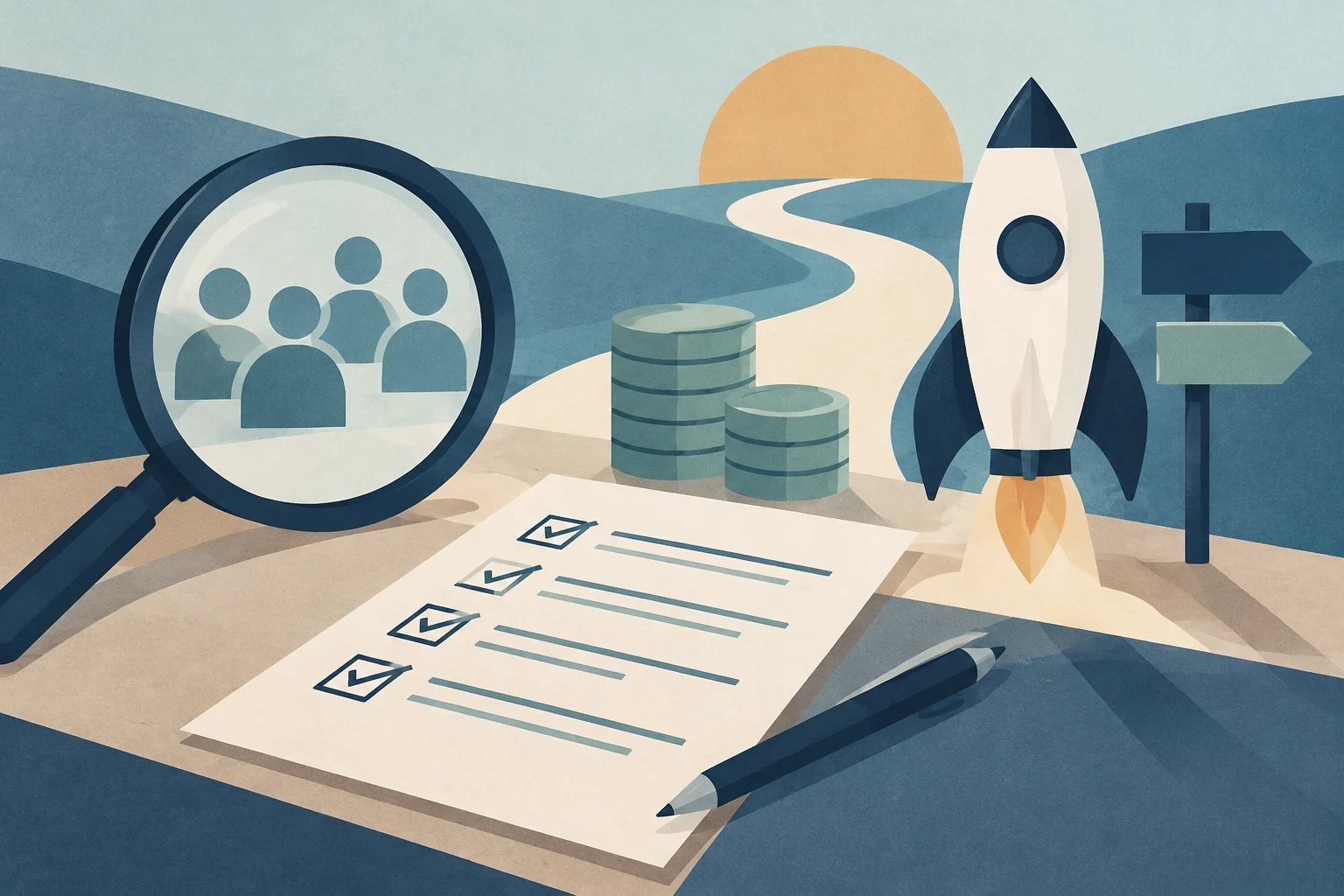
An attractive idea does not, by itself, prove that customers are willing to pay for it. Before committing significant resources, it is worth clarifying whom you want to serve, what problem you will solve, and what signals would help you decide whether the proposal deserves to move forward. That evidence can then be translated into figures, tasks, and specific checks to prepare for launch.
This guide proposes a flexible process: research the market, test assumptions, organize finances, and plan the launch. It does not guarantee sales or replace a review of professional or legal requirements applicable to each activity.
Start by defining your target customer. Instead of describing them as “everyone,” specify what type of person or organization might need the offer, in what situation, and where they are located. The more specific the description, the easier it will be to choose whom to interview, what data to look for, and which channels to use to reach potential customers.
Also formulate your value proposition: what need the product or service addresses, what outcome the customer seeks, and what alternatives are available today. An initial proposition can be expressed as a hypothesis, not as a proven claim: “We believe [type of customer] needs [solution] because of [problem or context].”
This formulation helps separate what is known from what is still assumed. For example, a group saying an idea “sounds good” does not prove that they will buy it. It is useful to find out what they currently do, what difficulties they encounter, how much it costs them to solve the problem, and what would have to change for them to consider an alternative.
Market research can combine existing sources with direct contact with potential customers. The U.S. Small Business Administration (SBA) recommends exploring issues such as demand, market size, customer locations, the saturation of similar offerings, and the prices of alternatives. General data can guide research, but may not describe a specific audience precisely enough.
To learn more about that audience, you can conduct interviews, surveys, or questionnaires. Interviews are often useful for understanding experiences and motivations; surveys can help collect comparable responses from more people. In either case, ask about specific behaviors and situations as well as opinions: what solution they use today, how often, what they find difficult, and what they have paid—if applicable—to solve the problem.
Also analyze direct and indirect competitors. The goal is not just to count similar businesses: identify what they offer, which segment they target, how they present their prices, and what strengths or shortcomings seem relevant to customers. An indirect alternative might be a do-it-yourself solution, another product category, or simply doing nothing. The objective is to understand the context and specify what difference would matter to the buyer—not to claim that the business will be unique without evidence.
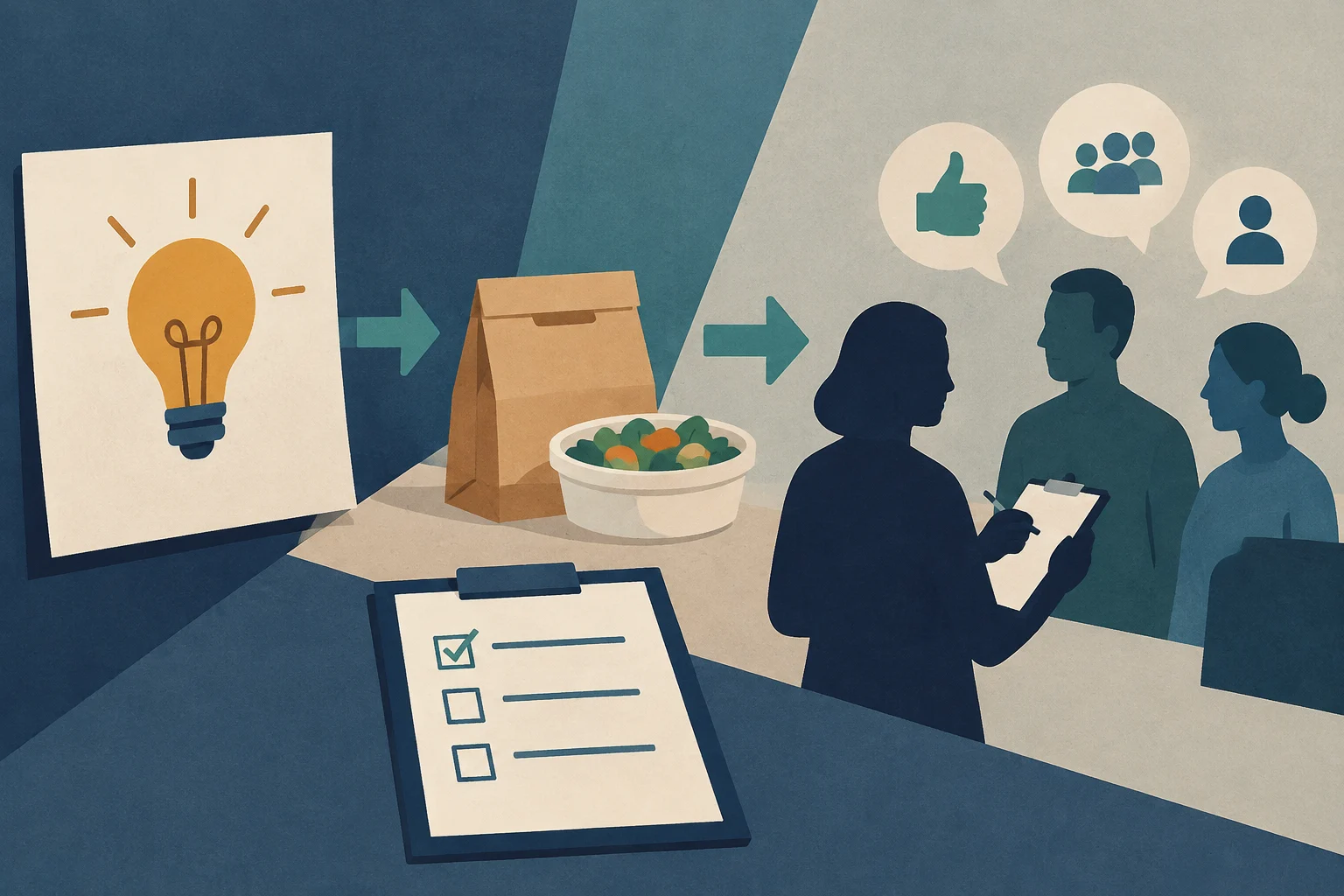
Before investing in a complete version, turn the main uncertainties into limited tests. A useful test has four components:
For example, a fictional business considering offering office lunches could interview purchasing managers, present a test menu, and measure how many people request information about availability and price. If interest does not meet the criterion set in advance, it could review the audience, offer, or channel before increasing spending. This example is fictional and is not a prediction of results.
Stated interest, sign-ups to a mailing list, and favorable comments are different signals from a purchase. If the test includes a presale, a pilot order, or another financial commitment, its terms must be clearly explained, and you should first check whether the activity is subject to specific rules. Whatever method you use, record results, issues, and differences between what people say and what they actually do.
Planning does not end with identifying potential customers. Describe how the offer will be delivered and what resources are needed to fulfill the promise. Depending on the business, these might include suppliers, inventory, equipment, physical or digital space, payment systems, customer service, and work hours.
Note the dependencies that could delay the launch: for example, receiving materials before production, having a tool available before accepting orders, or confirming a permit before operating from a premises. Assign someone to each task, even if that person is the founder at first. Distinguish the tasks required to open from improvements that can wait until more information is available.
The plan must be able to change. business.gov.au, the Australian government’s business portal, notes that planning helps set objectives, organize priorities, and identify risks, and that it should be reviewed as the business evolves. A short, up-to-date document may be more useful than a lengthy plan that nobody consults.
Separate startup costs from recurring costs. Depending on the activity, startup costs may include equipment, initial inventory, fitting out a space, or administrative procedures. Recurring costs may include rent, wages, utilities, purchases, insurance, marketing, and professional fees. Not all of these apply to every business: identify the costs specific to your operation and determine which amounts are confirmed and which are estimates.
Then project income and payments by period—for example, month by month—and include when you expect to receive the money, not just when you would make a sale. An unpaid invoice and a payment already made affect cash at different times. A cash flow statement or forecast helps show inflows, outflows, and balances, as well as possible periods when available funds would not cover expected payments. business.gov.au recommends labeling and explaining estimated figures and making clear whether they include or exclude applicable Australian taxes, such as GST; the specific tax treatment depends on the location and circumstances of each business.
Prepare scenarios using explicit assumptions, such as sales below, in line with, or above the initial estimate. These are not certain forecasts: they help show which assumptions have the greatest effect on cash needs and which costs or decisions might need review. Update projections when you obtain actual data from the test or the start of operations.
The break-even point estimates the level at which revenue and costs are equal, with neither a loss nor a profit under the assumptions used. For a single product or service, an indicative formula is:
Break-even units = fixed costs ÷ (price per unit − variable cost per unit)
The calculation requires estimates of fixed costs, price, and variable cost per unit. If there are several offerings, semi-variable costs, or seasonal changes in sales, the analysis needs more detail. It is therefore a planning tool, not a guarantee of profitability or a substitute for accounting based on actual transactions.
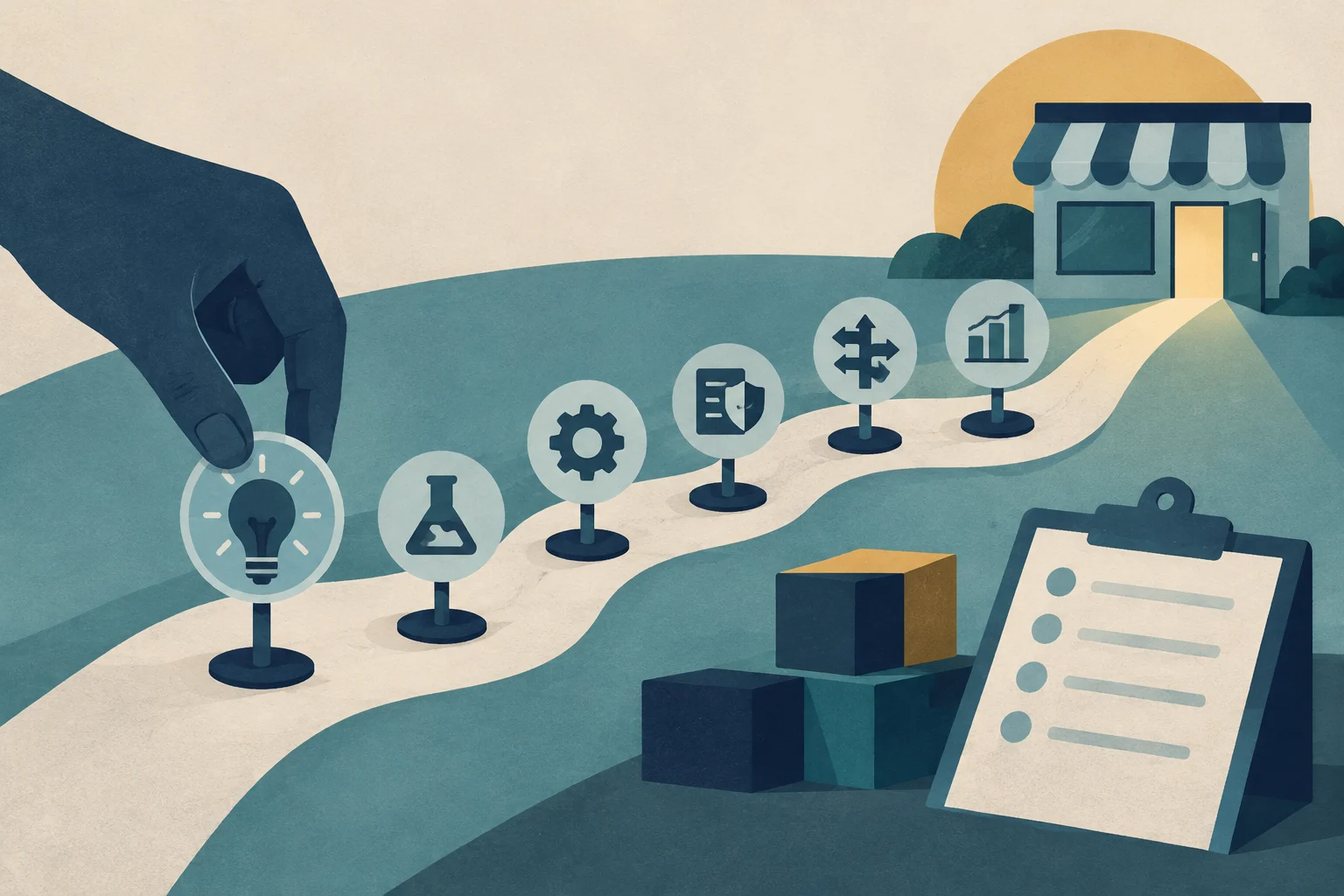
A useful schedule connects tasks with dependencies and decisions instead of merely setting an opening date. The following template is for illustrative purposes; it is not a real schedule and does not prescribe time frames. Adapt the milestones to the complexity of the business and local procedures.
| Milestone | What must be checked | Responsible person | Dependency or decision |
|---|---|---|---|
| Initial validation | Interviews, market data, and alternatives documented | Assigned person or team | Move on to a test or review the customer and proposition |
| Offer test | Hypothesis, resource limit, and success criterion defined before starting | Assigned person or team | Compare results with the agreed criterion |
| Operational preparation | Suppliers, resources, delivery process, and costs identified | Assigned person or team | Confirm that the planned offer can be fulfilled |
| Local verification | Registration, licensing, tax, location, and other obligations checked against official sources | Responsible person, with professional support if needed | Do not assume operations can begin until applicable requirements are verified |
| Launch decision | Projected cash, critical tasks, and risks reviewed | People with decision-making authority | Launch, postpone, or modify the scope |
| Post-launch review | Sales, receipts, costs, issues, and customer feedback recorded | Assigned person or team | Adjust the offer, operations, or projections |
Before opening, also prepare a short list of risks and assumptions: what could go wrong, what signals would help detect it, and what alternative would be considered. For example, a supplier delay may require changing the announced date or availability; the specific response will depend on the product, commitments to customers, and applicable obligations.
Requirements for starting and operating a business depend on the country, region, municipality, activity, and legal structure. The SBA describes how location in the United States can affect taxes, zoning, and regulation, and how business structure can affect liability, taxation, procedures, and financing capacity. This information relates to the U.S. context and should not automatically be applied to other territories.
Before committing to premises, hiring staff, or accepting orders, check official local sources to determine which registrations, licenses, permits, zoning rules, tax obligations, and industry-specific requirements apply. Also confirm whether renewals or post-registration conditions exist. Requirements can change and vary even within the same country.
Legal structure can have consequences for liability and tax or administrative obligations. The choice depends on local law and the circumstances of the business; general information cannot determine which option is right for each case. When a decision has significant legal, tax, or financial implications, it may be necessary to consult a qualified professional in the relevant jurisdiction. This guide does not replace that advice.
A good plan does not eliminate uncertainty: it makes uncertainty visible and manageable. After each test or milestone, record what was expected, what happened, and what changed in the assumptions. If the results do not support the initial proposition, revising it may be a reasonable decision; moving forward should not depend only on the effort already invested.
The practical sequence is straightforward: define the customer, research the problem and alternatives, test the offer within clear limits, project costs and cash, organize dependencies, and verify local rules. Each step then prepares for the next, and the launch becomes a decision based on available evidence, not a promise of success.
This worksheet is an original Business Edition working tool. You can copy it into a document or print it and complete it with your team. It turns the process in this guide into actions and evidence that can be reviewed; it does not reproduce a checklist from another institution, certify that a business may open, or provide an exhaustive list of obligations.
Business or project: ____________________
Planned activity and customer: ____________________
Country, state or region, and municipality of operation: ____________________
Coordinator and worksheet version: ____________________
Preparation date: ____________________
Leave each box unchecked until you have verified the corresponding action. In the evidence column, record the document, observation, or official source that supports it, along with its date. Add a responsible person, deadline, and next review. If something does not apply, write “Not applicable” and explain why: an empty box does not mean the matter has been resolved. If work is in progress, indicate what remains to be done.
A deadline organizes a task; the next review indicates when you will check its assumptions or validity again. A completed task may need another review if the activity, location, supplier, demand data, or a rule changes. Review dependencies before promising an opening date.
| Status | Action and verification criterion | Evidence and date | Responsible person | Deadline | Next review |
|---|---|---|---|---|---|
| ☐ | Customer, problem, and value proposition. Describe a specific segment, the problem observed, and the difference you want to test. Separate facts from hypotheses. | ____________________ | __________ | __________ | __________ |
| ☐ | Demand and alternatives. Gather relevant data, listen to potential customers, and compare direct and indirect offerings or current solutions. Note the sample’s limitations and the geographic scope. | ____________________ | __________ | __________ | __________ |
| ☐ | Test and hypothesis. Before starting, define what will be tested, with whom, for how long, using what resources, and what result would justify proceeding, changing, or stopping the test. Then compare the result with the criterion. | ____________________ | __________ | __________ | __________ |
| ☐ | Resources and dependencies. List the people, suppliers, equipment, systems, and steps needed to deliver the offer. Confirm availability, costs, and alternatives for critical dependencies. | ____________________ | __________ | __________ | __________ |
| ☐ | Costs and cash. Distinguish initial and recurring payments, confirmed and estimated amounts, sales, and collection dates. Review scenarios and check which payments might go uncovered. | ____________________ | __________ | __________ | __________ |
| ☐ | Milestones and responsible people. Link each milestone to evidence, a person, a date, and its dependencies. Identify what decision must be made if a critical condition remains unmet. | ____________________ | __________ | __________ | __________ |
| ☐ | Applicable requirements. Check official sources for registrations, permits, location, taxes, and industry-specific or staffing obligations that apply to the activity and jurisdiction. Record questions, renewals, and any necessary professional consultations. | ____________________ | __________ | __________ | __________ |
Complete this section for each important assumption. The team should decide on the criterion based on the context; there is no universal number of interviews, sign-ups, or orders that guarantees viability.
A favorable response, a sign-up, and a paid order are different forms of evidence. Do not turn a preliminary signal into a sales forecast. If the test involves money or commitments to customers, check the terms and any rules that may affect it first.
For each period chosen, record the opening balance, expected receipts, expected payments, and closing balance. As an arithmetic check, projected closing balance = opening balance + expected receipts − expected payments. Identify which figures are estimates and which taxes or other items are included or excluded. Estimated profit and available cash are not the same: a sale that has not yet been paid does not provide cash at that time.
If the schedule shows a deficit or an unconfirmed dependency, record the issue, who must resolve it, and when it will be assessed again. The worksheet does not recommend a specific form of financing or decide on its own whether taking on debt is advisable. Adapt the time horizon to the business and extend it when obligations or seasonality require it.
The SBA’s planning and launch resources offer a U.S. starting point for identifying decisions about location, structure, registrations, licenses, and other requirements. These are pathways for research; they do not mean that every obligation applies to every business or that a decision valid in the United States is valid in another country.
For an activity in North Carolina, the state’s official “Start My Business” portal helps users find resources about structure and registration, licenses, taxes, and other matters. The state itself warns that there is no single generic license that guarantees compliance with all requirements. Check what applies to the activity, state, and municipality; do not assume that local verification is complete just because you have completed a registration.
The North Carolina Department of Revenue (NCDOR) “Business Registration” page explains its tax registration pathways. The applicable pathway and required information depend on the type of tax and the relevant circumstances. Use the official source to determine which registration applies and what proof you should keep; this worksheet does not determine your tax obligations. Also consult the relevant authority or qualified professionals when a legal, tax, or financial question affects the decision to operate.
In the evidence column, it is enough to refer to the proof stored securely. Do not copy tax identification numbers, bank details, or personal information about customers or workers into a shared worksheet.
Critical outstanding conditions and their effect on launch: ____________________
Team decision and reasons: ____________________
Responsible person and date: ____________________
Next review or change that will trigger it: ____________________
Checking boxes organizes the work, but does not guarantee demand, profitability, or legal compliance. Keep track of questions and evidence limitations, and update the worksheet when new information becomes available.
Prepare documents for France’s Guichet unique, check the signature and fees, and respond if the reviewing authority asks for a correction.
Read story
A first guide to starting a business in Germany. Check which steps may apply, make a cash forecast and find advice in Mössingen and Unterallgäu.
Read story
A practical guide for site directors and prevention technicians on the drafting, approval, and updating of the Health and Safety Plan (HSP) in Spain. It analyzes the difference from the Safety Study, the legal requirements of Royal Decree 1627/1997, and protocols for serious risks.
Read story