
Guide · 18.11.2026
How to submit and track a business registration in France
Prepare documents for France’s Guichet unique, check the signature and fees, and respond if the reviewing authority asks for a correction.
Read storyUseful journalism to understand, manage and grow a business.
SearchA practical guide for site directors and prevention technicians on the drafting, approval, and updating of the Health and Safety Plan (HSP) in Spain. It analyzes the difference from the Safety Study, the legal requirements of Royal Decree 1627/1997, and protocols for serious risks.
In the construction sector, safety is not a mere bureaucratic procedure, but the central axis of preventive management. The Health and Safety Plan (HSP) is the operational document that develops, adapts, and specifies the preventive measures foreseen in the project, adjusting them to the reality of execution. Its correct drafting and application are essential to prevent accidents, comply with current regulations, and avoid serious consequences such as economic sanctions, suspension of activities, or criminal liabilities.
A frequent error is treating the HSP as a static or generic document. In practice, a plan that does not adapt to the actual machinery, specific construction methods, or subcontractors present on the site can lead to the precautionary suspension of work. Spanish regulations, primarily Royal Decree 1627/1997 and Law 31/1995 on Occupational Risk Prevention, establish a strict framework that requires the plan to be dynamic, specific, and coherent with the technical complexity of each project.
To ensure regulatory compliance, it is fundamental to distinguish between the two main preventive documents in construction, which respond to different phases and authors:
This distinction is crucial because the HSP cannot be a copy of the S&HS; it must reflect the operational reality of the contracting company and its subcontractors.
In accordance with Royal Decree 1627/1997, a rigorous plan must include the following fundamental sections, adapted to the complexity of the work:
Additionally, the plan must contemplate the assessment of specific risks (work at height, excavations, load handling), the organization of the site (access, storage, circulation), and emergency and first aid protocols.
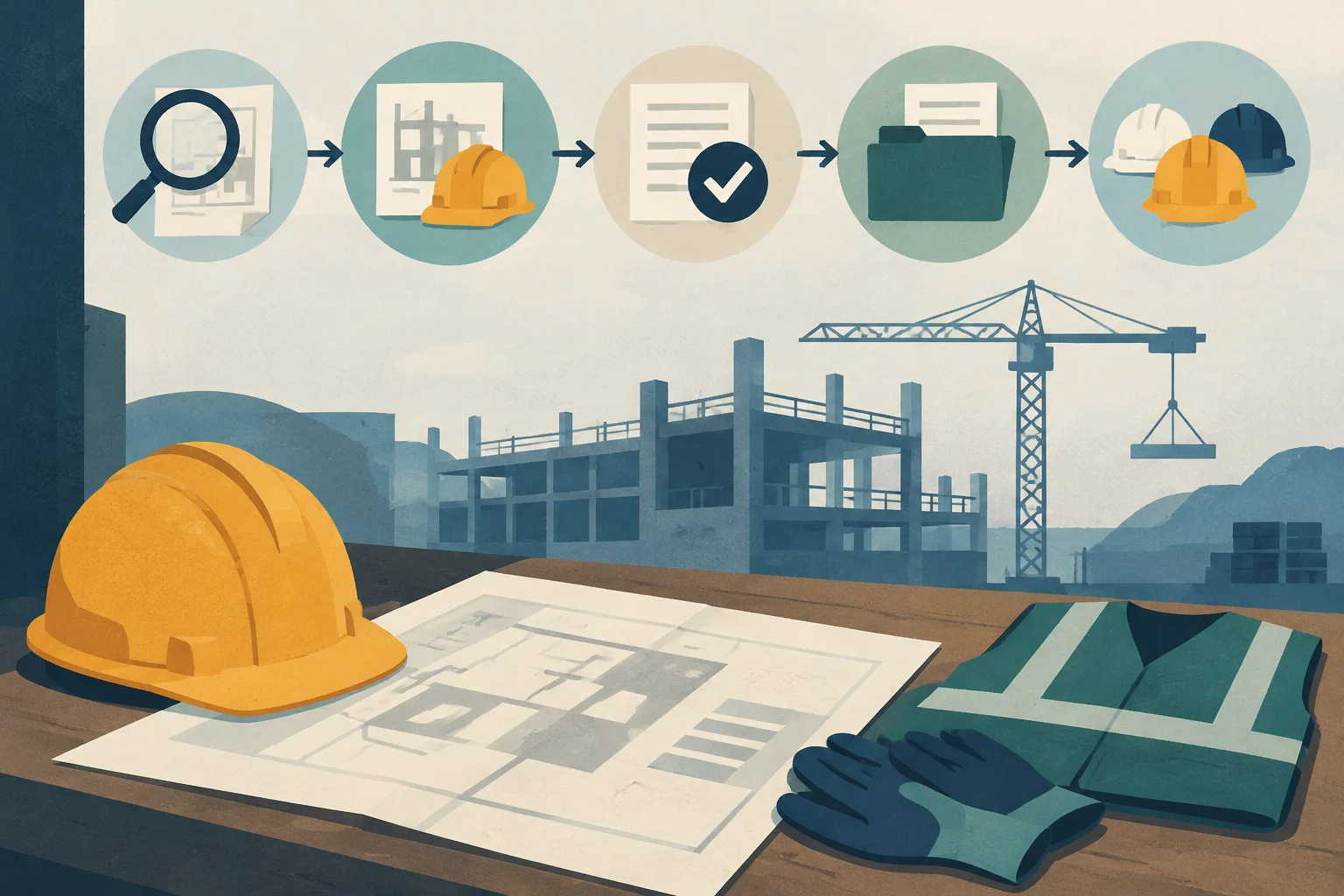
The validity of the HSP requires following a logical and coordinated sequence among all intervening agents:
The Safety and Health Coordinator is a key figure designated by the promoter, who acts in the general interest and not as mere representation of the promoter. Their functions during execution, regulated in Article 9 of Royal Decree 1627/1997, include:
The required qualification to be a coordinator is that of architect, technical architect, engineer, or technical engineer, according to their competencies, and it is recommended to have specific training in occupational risk prevention in construction.
The HSP is not a static document. Every time construction procedures, on-site machinery, or subcontractors with new roles change, an annex to the safety plan approved by the coordinator must be drafted. The lack of plan updating after changes in the phases of the work can entail significant penalties and legal liabilities.
Furthermore, the presence of personnel requires rigorous document management: the validation of training diplomas, medical fitness, and the delivery of PPE are indispensable requirements. The lack of validation of this documentation invalidates the safety framework of the site.
Minor construction works, generally defined as technically simple and of low constructive and economic entity, usually lack an execution project and, therefore, do not require the drafting of an HSP in the strict terms of Royal Decree 1627/1997. However, this does not imply that they are exempt from risks.
According to an analysis by the National Commission on Safety and Health at Work (CNSST) on accident rates in minor works (2010-2014), more than 60% of serious and fatal accidents investigated were caused by falls from height. The "typical accident" in these works usually involves a worker from a small company who suffers a fall from a roof, scaffold, or ladder during renovation or rehabilitation work.
Therefore, although a formal HSP is not mandatory, minor works must be managed following the same preventive criteria as works with a project, integrating prevention in all phases and guaranteeing the safety of workers. The absence of a formal plan does not exempt from the responsibility to apply basic preventive measures, especially in work at height.
Many companies commit recurring errors in the drafting and management of the HSP that can lead to sanctions and stoppages:
To avoid these errors, it is recommended to have professional support in occupational risk prevention, which can adapt plans to each work, carry out prevention audits, and offer specialized training to workers and middle management.
Prepare documents for France’s Guichet unique, check the signature and fees, and respond if the reviewing authority asks for a correction.
Read story
A first guide to starting a business in Germany. Check which steps may apply, make a cash forecast and find advice in Mössingen and Unterallgäu.
Read story
Starting prices alone aren’t enough to choose a platform: compare billable contacts, monthly sending volume, features, add-ons, and billing terms. This guide compares Constant Contact with Mailchimp, AWeber, and Brevo using published prices and a hypothetical example.
Read story