How to Distinguish Real Buying Signals Before Scaling an Offer
Praise and verbal interest can help explore an idea, but they do not equal demand. Combining interviews, real-world use, and purchasing commitments helps identify what early customers value and what to adjust before investing in growth.
During the validation phase, one of the most important decisions is to distinguish what people say from what they do. A potential customer may find an offer appealing, which can be a useful starting point for a conversation, but that alone does not prove that the problem is a priority or that they will pay to solve it. The strongest buying signals appear when someone makes an observable commitment: booking, paying, starting and using a trial, or incorporating the solution into their work.
This does not mean that a single sale confirms the existence of a large market. Each signal reduces some uncertainty, but its significance depends on who provides it, under what conditions, and with what sales effort. The goal is to gather enough evidence to decide what to change, what to keep testing, and when it makes sense to increase investment.
From opinions to behavior
Interviews and surveys help you understand how customers describe their problem, what alternatives they use, and what outcomes they expect. They are especially useful for developing hypotheses and identifying patterns; they are less conclusive when they ask whether someone would buy a future solution. Hypothetical answers may be polite, optimistic, or influenced by how the question is phrased.
A practical evidence scale can help organize what you learn:
Observed signal
What it may indicate
What it does not prove on its own
Positive opinion or verbal interest
The offer sparks curiosity or seems understandable
Actual willingness to pay or continued use
Sign-up or request for information
Willingness to take a low-cost step
That the user will become a customer
Reservation, agreed trial, or request for a proposal
More concrete intent and a possible priority
A definitive purchase or repeatable demand
Payment and real-world use
Financial commitment and interaction with the solution
That the product works for other segments or can scale
Renewal, repeat purchase, or recurring use
Sustained perceived value over time
Profitability or scalable growth without further evidence
This table is not a universal ranking: a reservation may be more or less meaningful depending on the industry, price, and conditions. In business-to-business sales, for example, the buying cycle may be long and require approvals; in other models, a brief trial may quickly provide information about the user experience. Interpret each signal in context rather than turning it into an automatic score.
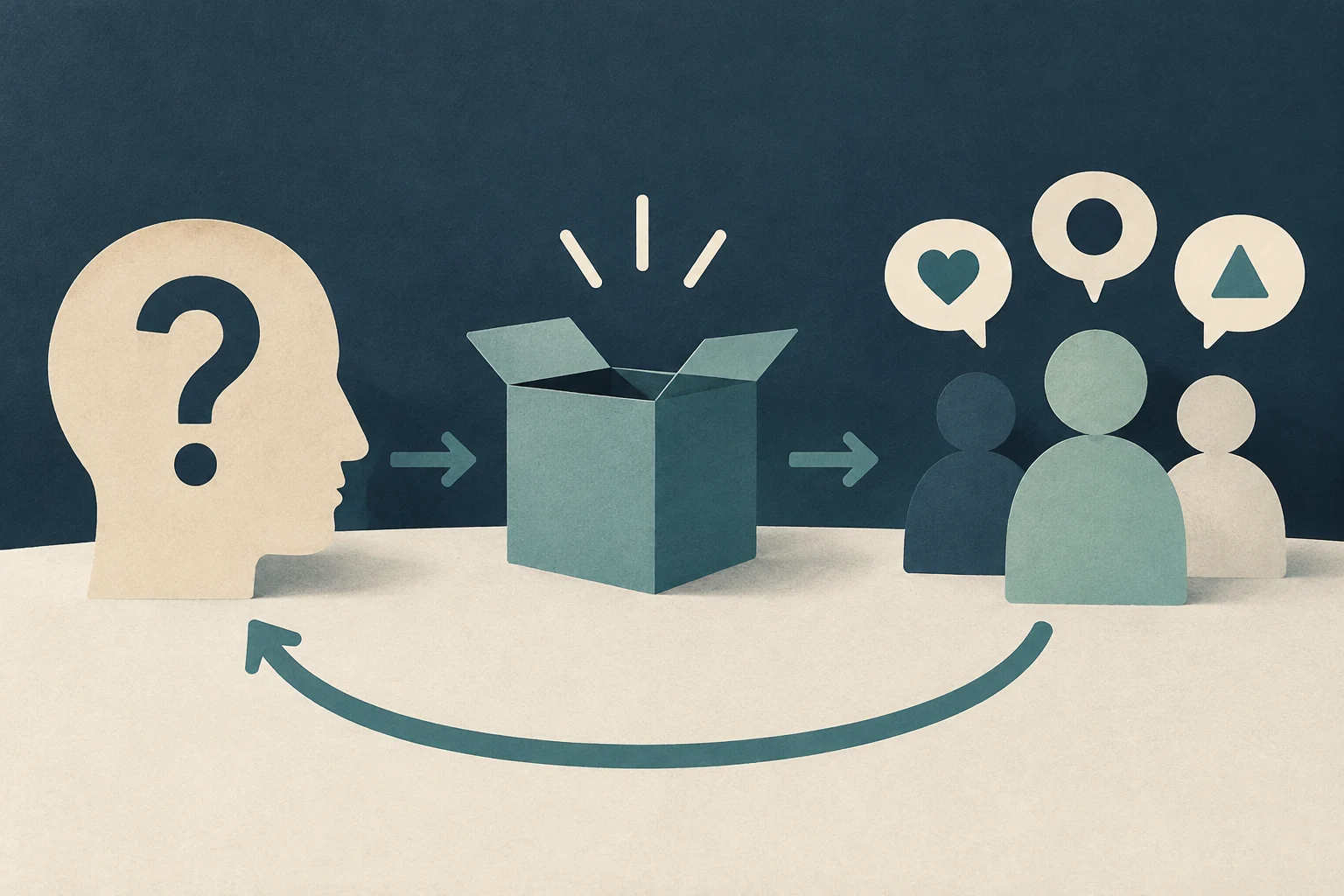
Editorial illustration · Edition Business
Design tests that answer specific questions
The Lean Startup and Customer Development approaches share a useful logic: formulate assumptions about the problem, the customer, and the offer; test them with people in the intended segment; and adapt the solution based on what you learn. A minimum viable product—or a simpler test, if it can provide the same learning—serves to generate knowledge, not to produce a scaled-down version without a clear question.
Before launching a test, define which uncertainty you want to resolve. For example: Does the problem occur often enough? Is the offer easy to understand? Would the current customer switch from their existing method? Would they accept this price? Then choose an observable action that will let you assess the hypothesis. A landing page with a reservation option can measure initial interest; a pilot involving real tasks lets you observe use; and a commercial offer with explicit terms provides evidence about willingness to pay.
It is also important to record who participated and what happened. If the first users are early adopters, their responses can be valuable for refining the product, but they do not necessarily represent customers who are less willing to try new solutions. Record the segment, acquisition channel, offer presented, conditions, and outcome. This makes it easier to distinguish a pattern from an anecdote.
Measure willingness to pay without confusing it with liking the offer
Willingness to pay is best observed when customers know what the offer entails: what they receive, at what price, under what conditions, and within what timeframe. Asking “Would you buy it?” can open a dialogue, but a reservation or purchase provides a more direct signal. If charging is not yet possible, a pilot with clear criteria and contracting steps can make the learning more realistic, although it does not replace a transaction.
Price is also part of the value proposition. If someone uses the product but does not pay, there may be an issue with price, priority, budget, purchasing authority, or perceived value. Do not immediately attribute the outcome to a single cause: ask what prevented them from moving forward, then compare their answer with other cases and with observed behavior.
In business-to-business sales, it is useful to distinguish the user from the buyer and the person who authorizes spending: these may be different people. A trial that excites the user team does not necessarily confirm that a budget or approval is available. Exploring the decision-making process can reveal what is missing for interest to turn into a purchase.
Turn feedback into offer adjustments
Feedback is more actionable when linked to a specific part of the experience: the problem chosen, the segment, the message, the channel, the features, the price, or the purchasing process. If several users fail to complete the same step, observe where they drop off and ask what they expected to happen. If they buy but do not use the solution, the sale confirms a transaction, not necessarily a lasting fit.
One simple way to organize findings is to separate:
What is observed: actions, usage, payments, drop-offs, and specific requests.
What is interpreted: why it may have happened and which hypothesis seems most likely.
What will be tested next: a defined change and the evidence that would make it possible to evaluate.
For example, if several interviews suggest that the main problem is planning a task rather than carrying out a specific function, the company can test an offer focused on planning before expanding development. This is a hypothesis that must be tested with customers, not a conclusion guaranteed by the interviews.
When to increase investment and when to keep learning
An isolated signal does not justify scaling. Before increasing investment in development, marketing, or staff, check whether the pattern appears with more than one customer and whether the evidence comes from the segment the offer targets. It is also important to see whether the solution delivers a valuable outcome and whether the sales and delivery processes can be repeated under similar conditions.
Funding can provide resources to accelerate, but it does not replace demand validation. Customers and their behavior help answer questions that a funding round cannot: whether the problem is a priority, whether the offer is understood, and whether anyone is willing to change their behavior or pay. Even so, initial sales do not automatically prove that the model is profitable or that growth can be repeated.
The most useful question is rarely “Has the idea worked?” but “What uncertainty have we reduced, and what should we test next?” By moving through stages—from conversation to trial, and from trial to purchasing commitment and recurring use—a company can refine its offer using evidence closer to the market and avoid confusing enthusiasm with sustained demand.
A well-structured onboarding process helps each client understand what to expect, start getting value, and move toward independent use. These seven stages help organize the process without losing the personal touch.
Women’s Business Centers provide training and advising for small businesses in the United States. Learn how to find one, confirm its terms, and arrive at your first appointment with clear questions and goals.
A practical guide to structuring, writing, and reviewing a small business plan. Compares traditional and lean models, explains the connection between business assumptions and finances, and provides hypothetical examples for applying the method.