How to Write a Business Plan for a Small Business: A Practical Guide to Traditional and Simplified Models
A practical guide to structuring, writing, and reviewing a small business plan. Compares traditional and lean models, explains the connection between business assumptions and finances, and provides hypothetical examples for applying the method.
Writing a business plan is a strategic exercise that goes beyond simply applying for financing. According to the U.S. Small Business Administration (SBA), this document serves as the foundation of a business, acting as a roadmap for structuring, operating, and growing it. It is not a bureaucratic formality, but a tool for thinking critically about key elements of the venture, identifying risks, and setting measurable goals.
Choosing a format: Traditional or Lean?
There is no single correct way to write a business plan. The format you choose depends on the audience and the project's stage. The SBA identifies two prevalent categories:
The traditional model
This is the most common format when seeking external financing. It is detailed and comprehensive, and can run to dozens of pages. Traditional lenders and investors often request this type of document because it allows them to assess a project's viability in depth.
When applying for a bank loan or equity investment.
When the entrepreneur is detail-oriented and wants a long-term reference document.
When the business has a complex legal and financial structure.
The Lean Startup model
Less common in traditional financing, this model focuses on summarizing the most important points in a visual format, often on a single page. Its goal is to quickly visualize the value proposition, infrastructure, customers, and finances.
When should you use it?
To quickly validate a business idea.
When the business is relatively simple.
When the business model is expected to change and be refined frequently.
To communicate the essence of the project to partners or mentors in a short time.
Structure of a traditional business plan
Although you are not required to follow a rigid outline, the SBA suggests nine common sections for a traditional plan. Each serves a specific purpose in convincing the audience that the project is sound. You can adapt these sections to your business's specific needs.
1. Executive summary
This is the first section an investor will read, but it is recommended that you write it last. Once you have completed the rest of the plan, write this summary to capture attention with the mission, product, team, and key financial information. It should be concise and persuasive without making excessive promises.
2. Company description
This section explains what problem the business solves and whom it serves. It is where you highlight competitive advantages: the team's experience, a strategic location, or proprietary technology. Specificity is key: it is not enough to say “we sell to everyone”; define the target consumers or organizations.
3. Market analysis
This requires in-depth research into the industry and the competition. It is not just a matter of listing rivals, but of understanding their strengths and weaknesses. Key questions include: What do successful competitors do well? Why does their model work? How can your company do better or do things differently?
4. Organization and management
Describe the legal structure (limited company, sole proprietor, etc.) and the organizational chart. It is essential to show how each team member's unique experience contributes to success. Including résumés of key executives adds credibility.
5. Product or service line
Explain what you sell, how it benefits the customer, and its life cycle. If there is intellectual property (patents, copyrights) or ongoing research and development, detail it here.
6. Marketing and sales
Describe the strategy for attracting and retaining customers. This section is critical because the financial projections will be based on these assumptions. It should detail how the sale will be closed and which channels will be used.
7. Funding request
If you are requesting money, specify the amount, how it will be used (equipment, salaries, marketing), and the type of financing (debt or equity). You should also include future strategic plans, such as repaying debts or selling the company.
8. Financial projections
The financial heart of the plan. It should include projected income statements, balance sheets, and cash flows. For the first year, a monthly or quarterly breakdown is recommended. Consistency between the projections and the funding request is vital.
9. Appendices and supporting documents
This is where you include supplementary information that supports the plan, such as detailed résumés, contracts, additional market studies, or technical specifications.
Editorial illustration · Edition Business
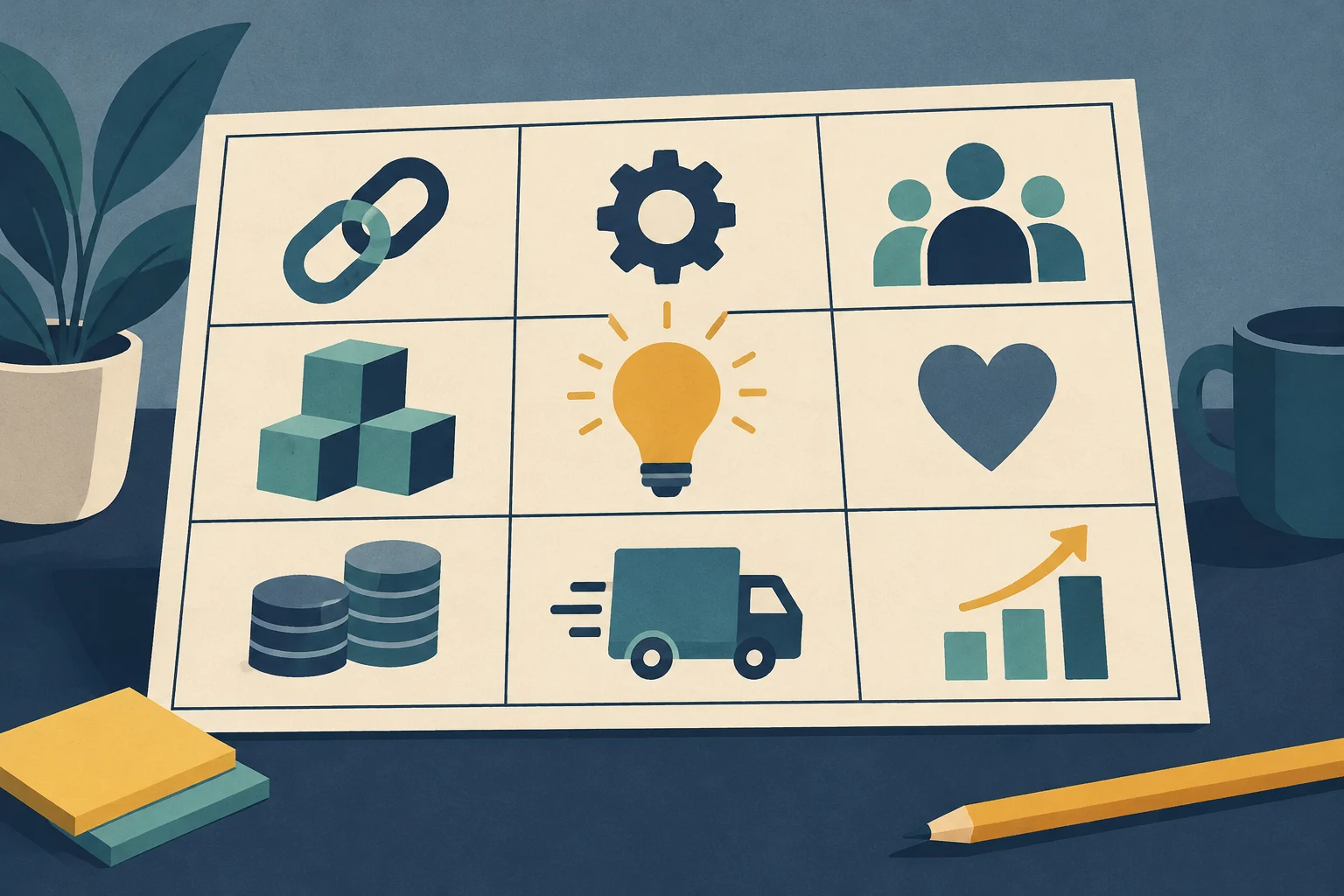
The Lean model: nine building blocks of value
The Lean plan is organized into nine components that describe the business logic visually. It is ideal for quickly identifying weaknesses or opportunities for improvement.
Key partners: Suppliers, manufacturers, and strategic allies needed to operate.
Key activities: Actions that create a competitive advantage (e.g., direct sales, use of technology).
Key resources: Assets needed to create value (staff, capital, intellectual property).
Value proposition: A clear and compelling statement of the unique advantage the company offers.
Customer relationships: How the company will interact with its customers (automated, personal, online, in person).
Customer segments: A specific definition of whom the business targets. It is not for everyone; there should be a clear niche.
Channels: The main ways to reach and communicate with customers.
Cost structure: Cost strategy (minimizing costs or maximizing value) and the most significant expenses.
Revenue streams: How the business makes money (direct sales, subscriptions, advertising).
Finances: Connecting assumptions to numbers
One of the most common mistakes in business plans is a disconnect between business strategy and the numbers. The Australian government (business.gov.au) emphasizes the importance of preparing realistic financials.
Distinguishing revenue, profit, and cash
Revenue: The value of sales of products or services. It does not necessarily mean the money has been collected.
Operating result: Revenue minus the operating costs included. To calculate net profit, all other applicable items must be taken into account; the operating result is not the same as immediate liquidity.
Cash (cash flow): The actual money coming into and going out of the bank account during a period. It is what allows a business to pay wages, suppliers, and taxes. The cash balance depends on the opening balance, receipts, and payments.
Common mistake: A company may show a profit on paper but go bankrupt because it lacks cash if customers are slow to pay and suppliers demand immediate payment. The plan should model this timing gap.
Realistic projections
Investors want to see that the entrepreneur knows their numbers. You should be able to answer three questions:
How much money is currently available?
How much is needed?
How much is expected to be earned in the short term?
It is better to be conservative and not request more financing than necessary. Justifying the need for funds and how they will be used with realistic forecasts increases the plan's credibility.
Editorial illustration · Edition Business
Complete fictional case: a small design studio
This original case is a Business Edition exercise. The company, orders, prices, and amounts are invented; they do not describe a real business or market research. U.S. dollars (USD) are used solely as a teaching unit. The example connects business decisions to cash flow, but it is not a ready-to-submit funding request.
Executive summary and value proposition
The studio would provide presentation design services to small businesses that need to explain a business proposal clearly. It would offer a package with an agreed scope and schedule: one presentation, one round of changes, and final files. The promise would be a defined process; no sales or results are promised for the client.
The founder would handle sales, design, and management. They would contribute 5,000 USD, of which 1,200 would be spent on equipment and 300 on setup before operations begin. This would leave 3,500 USD in cash to start month 1. No loan or external investment is assumed.
Customers, market, and competition: questions to verify
The customer hypothesis is a small business without an in-house designer that is preparing a business presentation. Before investing, potential customers should be interviewed about frequency, budget, timelines, and alternatives. Independent studios, agencies, in-house hiring, and self-service tools would be compared using prices and terms actually observed.
The assumption of 4, 6, and 8 projects per month does not establish demand or market share. The plan should record the date, source, and result of each check. If interviews do not support the problem or the price, the offer should be revised before expenses are increased.
Marketing, organization, and operations
The studio would test its own portfolio and professional referrals as customer acquisition channels. Inquiries, quotes, confirmed projects, and hours worked would be recorded without inventing conversion rates. A written quote would define deliverables, revisions, price, and dates.
The operating process would be: receive the assignment, confirm the content provided by the client, prepare a draft, revise, and deliver. The founder would manage production and collections. Before accepting eight projects in a month, they would check that their available hours allow them to meet that volume. Hiring, licensing, and local obligations would be studied separately; they are not assumed to have been resolved.
Financial assumptions and initial payments
All the following values are assumptions in the same exercise:
Assumption
Value used
Initial contribution from the founder
5,000 USD
Equipment paid for before month 1
1,200 USD
Setup paid for before month 1
300 USD
Cash at the start of month 1
3,500 USD
Projects completed and invoiced in months 1, 2, and 3
4, 6, and 8
Price per project
500 USD
Direct cost per project, paid in its month
100 USD
Fixed operating costs, paid each month
800 USD
Collection of each invoice
50% in its month and 50% in the following month
Invoices outstanding before month 1
None
The collection schedule is an assumption, not a universal industry term. The 1,500 USD in prior payments has already been deducted when calculating the opening cash balance and is not deducted again in subsequent months.
Sales and simplified operating result
Item (USD unless projects)
Month 1
Month 2
Month 3
Projects
4
6
8
Sales: projects × 500
2,000
3,000
4,000
Direct costs: projects × 100
400
600
800
Fixed costs
800
800
800
Simplified operating result
800
1,600
2,400
This result subtracts only the costs included in the table. It is not net profit: it does not include the founder's compensation, equipment depreciation, interest, taxes, or other items not modeled. Therefore, it does not demonstrate full economic profitability or allow taxes to be calculated.
Receipts, payments, and cash
The business.gov.au methodology for cash flow forecasts helps separate inflows and outflows from the available balance. Applied to the invented assumptions above:
Item (USD)
Month 1
Month 2
Month 3
Cash at the start of the month
3,500
3,300
4,400
Receipts from current-month sales
1,000
1,500
2,000
Receipts from invoices from the previous month
0
1,000
1,500
Total receipts
1,000
2,500
3,500
Payments: direct and fixed costs
1,200
1,400
1,600
Change in cash
-200
1,100
1,900
Cash at the end of the month
3,300
4,400
6,300
Invoices outstanding at the end of the month
1,000
1,500
2,000
How to check it: ending cash = opening cash + receipts − payments. Month 1 shows a simplified operating result of 800 USD, but cash falls by 200 USD because only half of its sales are collected.
Over the three months, 9,000 USD is invoiced, 7,000 USD is collected, and 2,000 USD remains outstanding. Operating payments total 4,200 USD: 3,500 + 7,000 − 4,200 = 6,300 USD in ending cash. The cumulative simplified operating result is 4,800 USD, while the increase in cash is 2,800 USD; the difference is the outstanding invoices.
This is an illustrative three-month horizon, not an annual forecast or complete financial statements. To use it in a business, each assumption would need to be replaced with verifiable data, all applicable costs and obligations would need to be included, and the schedule would need to be extended. A collection delay or fewer orders would require recalculating the tables; positive cash in this exercise does not guarantee viability.
The same business in Lean format
The traditional plan would develop the evidence, operations, risks, and appendices. The Lean version summarizes the same decisions for quick review:
Block
Assumption for the fictional studio
Key partners
Software and equipment suppliers to be selected; no existing agreements are assumed
Key activities
Acquire projects, design, revise, deliver, and collect payment
Key resources
The founder's time, equipment, and initial cash of 3,500 USD after prior payments
Value proposition
Presentations with a defined scope and schedule
Customer relationships
Direct service and one agreed round of changes
Customer segments
Small businesses without an in-house designer; segment to be validated
Channels
Portfolio and referrals, whose effectiveness would be checked
Cost structure
100 USD in direct costs per project and 800 USD in monthly fixed costs, subject to the stated exclusions
Revenue streams
Projects at 500 USD; 4, 6, and 8 projected, with payment split across two months
The summary does not eliminate the cash table or turn assumptions into facts. If the price or collection period changes in one format, it must also change in the other.
Reusable outline and review checklist
This original outline can be copied as a starting point. It does not reproduce an official template or replace documents requested by a lender.
Section
What to complete
Purpose and reader
The decision the plan should support and who will use it
Summary
Problem, customer, offer, resources, and funding needs
Customer and value
Specific segment, need, and scope of the product or service
Market and alternatives
Dated evidence, observed competitors, and outstanding assumptions
Marketing
Channels, sales process, price, and collection terms
Organization and operations
Responsibilities, capacity, suppliers, and schedule
Investment and financing
Contributions, initial payments, additional needs, and uses of funds
Forecasts
Units, prices, costs, sales, receipts, payments, and balances by period
Risks and checks
What could change the outcome and how it will be checked
Appendices and review
Supporting documents, date, owner, and next review
For each assumption, add value, source, date, owner, and pending check. If there is no evidence yet, write “assumption to be validated.”
Before sharing the plan, check:
Does the summary match the business and the detailed figures?
Are verified observations, estimates, and assumptions distinguished?
Does the sales volume fit the production capacity?
Do price and units explain the revenue, and is each cost counted only once?
Does the schedule of receipts and payments explain every cash balance?
Are excluded costs and outstanding invoices visible?
Has a scenario with fewer orders or later collections been recalculated?
Have the currency, time horizon, local obligations, and recipient's requirements been adapted?
Is there a person and a date assigned to review what is still missing?
Reviewing and protecting the plan
A business plan is not a static document. Business.gov.au recommends reviewing and updating it regularly as the business changes and grows. Keeping previous versions in the records makes it possible to analyze how strategic decisions have evolved.
Protecting information
If the plan contains innovative practices or unique products or services, it is prudent to protect the information. It is recommended that you:
Assess what information is sensitive and, where appropriate, agree on confidentiality measures suited to the recipient and applicable regulations.
Include a clause in the document asking the reader not to disclose the details.
Frequently asked questions
How many pages should a traditional business plan be?
There is no set limit. The SBA indicates that plans can run to dozens of pages, but the key is the clarity and relevance of the information, not its length. A concise, well-structured plan is more effective than a lengthy one with redundant information.
Can I use a Lean plan to apply for a bank loan?
It depends on the lender. Some traditional banks prefer a detailed plan to assess risk, while other investors or funds may accept a Lean plan if the team is strong and initial traction can be demonstrated. It is always advisable to ask the lender about its specific requirements.
What should I do if I don't have historical financial data?
If the business is new, projections are based on market assumptions. It is important to document where those assumptions come from (market studies, customer interviews, industry benchmarks). Being transparent about the sources of the data increases the plan's credibility.
Praise and verbal interest can help explore an idea, but they do not equal demand. Combining interviews, real-world use, and purchasing commitments helps identify what early customers value and what to adjust before investing in growth.
A well-structured onboarding process helps each client understand what to expect, start getting value, and move toward independent use. These seven stages help organize the process without losing the personal touch.
Women’s Business Centers provide training and advising for small businesses in the United States. Learn how to find one, confirm its terms, and arrive at your first appointment with clear questions and goals.