How to Calculate Unit Production Cost in a Small Industrial Business
Break down raw materials, labor, and overhead to find out how much it costs to manufacture each unit, assess margins, and make pricing decisions with more complete data.
Unit production cost estimates how much it costs to manufacture one unit of a product over a specific period. To calculate it, add up the costs associated with manufacturing and divide them by the units produced during that same period. It is best to calculate this by product or homogeneous batch: combining items with different processes or resource consumption can obscure which product lines generate a margin and which do not.
The basic formula is:
The three components to include
1. Direct raw materials: more than the purchase price
Direct raw materials (DM) comprise the materials incorporated into the product. To estimate their actual cost, consider the purchase price and the expenses required to get the materials to the plant, such as inbound freight. Also include waste: if some material is lost during storage or production, that amount should not be treated as though it became part of the saleable product.
For example, if 100 kg of a material is purchased but only 90 kg is usable, the cost of the material consumed must be allocated across those 90 usable kilograms, not the 100 kg purchased. The waste rate varies by process; measuring it using your own data is more reliable than applying a generic estimate.
When input prices change rapidly, it is also important to state which valuation method is used—for example, the recorded purchase cost or an updated valuation—and apply it consistently when comparing periods. This helps distinguish a change in efficiency from a change in the material price.
2. Direct labor: the full labor cost
Direct labor (DL) is the time spent by employees who are directly involved in manufacturing. It is not enough to add up net wages: the calculation should reflect the labor cost borne by the business, including social contributions and other applicable items in its territory and under its employment regime.
To allocate that cost to each product, record the hours actually spent on production and use an hourly cost that incorporates the relevant labor items. If applicable contributions are omitted or paid hours are accounted for inconsistently, unit cost may be distorted. Specific obligations depend on the jurisdiction and terms of employment; there is no universal percentage that applies to every business.
3. Manufacturing overhead: production also uses shared resources
Manufacturing overhead (MOH) is necessary for production but cannot be directly identified with a specific unit. It may include plant energy, rent, maintenance, insurance, supervision, and depreciation of machinery and equipment.
Because these costs are shared across products, they must be allocated using a reasonable and consistent method. Some businesses use machine hours; others use labor hours or another basis that better reflects resource usage. The method chosen should be related to the activity that generates the cost: allocating all MOH equally across units may favor simple products and overburden those that use more machine time.
Depreciation deserves attention even though it does not require a cash payment in every period. It represents the consumption of an asset used in manufacturing, and omitting it can make costs appear lower than they are over the equipment’s useful life.
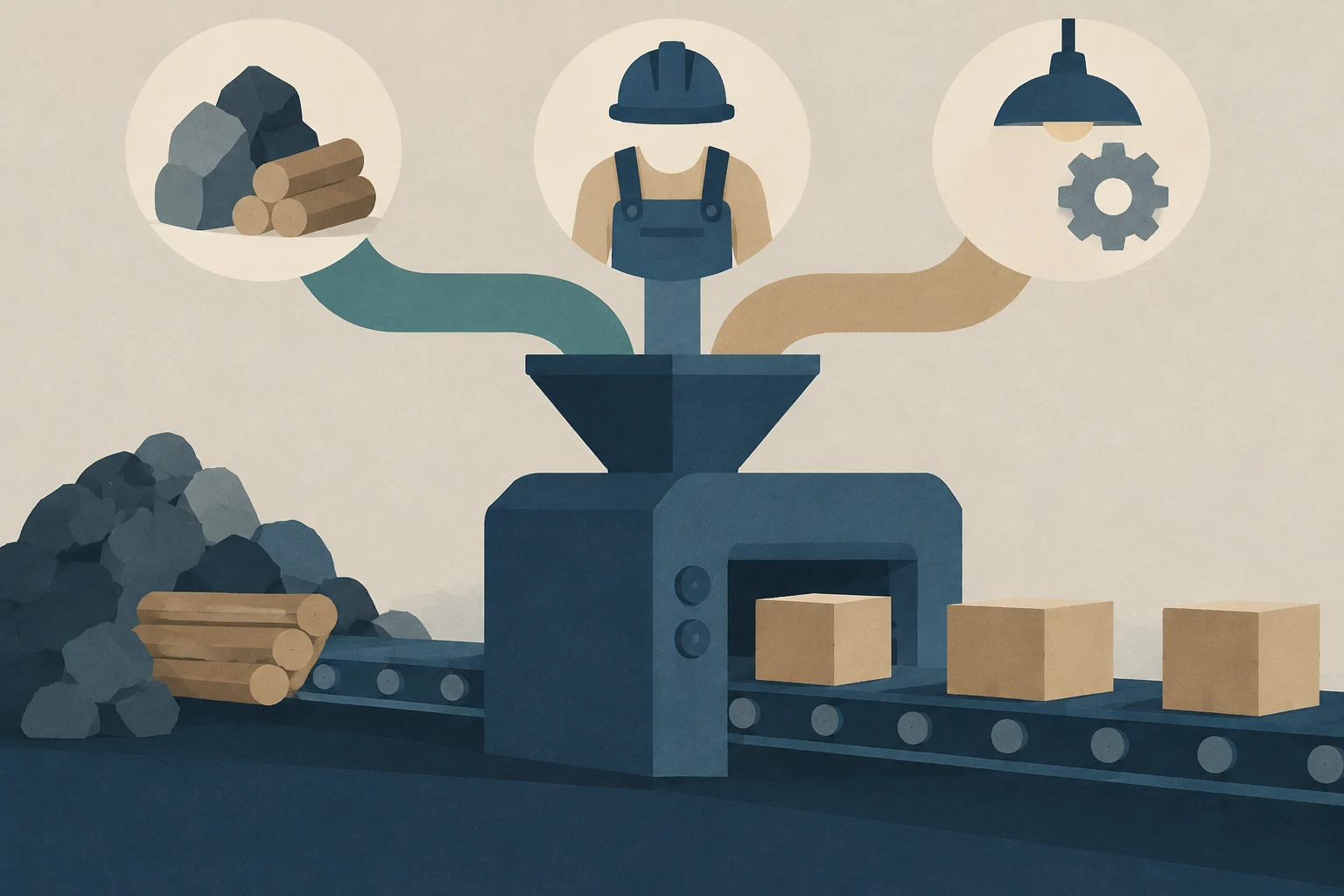
AI-generated conceptual illustration · Edition Business
A simple calculation example
Suppose that, in one month, a small business records the following manufacturing costs for a product:
Component
Cost for the period
Direct raw materials, including freight and waste
€6,000
Direct labor, including applicable labor costs
€3,000
Allocated manufacturing overhead
€1,000
Total production costs
€10,000
If 2,000 units are manufactured during that period, unit cost is €10,000 ÷ 2,000 = €5 per unit. This is an illustrative example: in a real operation, the quality of the result depends on whether costs are complete, relate to the same period, and have been allocated using appropriate methods.
The €5 represents the estimated manufacturing cost per unit, not necessarily the total cost of selling it. Commercial packaging, distribution, administration, commissions, and other expenses may require additional analysis. Therefore, comparing the selling price only with manufacturing cost does not always reveal the operation’s total margin.
Fixed costs, variable costs, and break-even point
In addition to classifying costs by component, it is useful to separate them according to how they respond to production volume. Variable costs usually rise or fall with the number of units manufactured; materials are a common example. Fixed costs remain relatively stable within a period and a range of activity, as rent may do. Classification depends on the situation: some costs have both a fixed and a variable component, and a fixed cost may change if production exceeds available capacity.
This distinction makes it possible to analyze the break-even point—the level of sales at which revenue covers the costs included in the analysis, with neither a profit nor a loss under its assumptions. A basic way to express it, when working with a single product and a simple cost structure, is:
Break-even units = fixed costs ÷ (selling price per unit − variable cost per unit)
The denominator is the unit contribution margin: the amount left from the price after covering variable costs, which contributes toward paying fixed costs. The result depends on assumptions such as price, product mix, and cost stability; it should not be interpreted as a guaranteed sales forecast.
Errors that often distort margins
Counting only the purchase price of materials: this leaves out freight and yield losses where applicable.
Using incomplete wage costs: omitting applicable labor contributions artificially reduces the cost allocated to each unit.
Excluding depreciation or maintenance: this makes resources needed to sustain production capacity invisible.
Allocating MOH without a method related to resource consumption: this may shift costs between products in a way that does not accurately represent their use.
Dividing by planned units instead of units actually produced: this can undervalue the observed cost if actual production was lower. It is also important to define how to account for defective units, rework, and work in progress.
Comparing periods using different methods: changes in valuation or allocation methods may appear to be improvements or declines that do not reflect the operation.
Turning the calculation into a management tool
To make unit cost useful for decision-making, a business can record material usage, labor hours, machine hours, and overhead by product and period. It is then worth comparing expected costs with actual costs and investigating significant variances: higher material consumption, more machine time, or an increase in energy costs may have different causes and require different data to understand.
A rigorously calculated cost helps assess whether a price covers the costs analyzed, compare products, and identify inefficiencies. It does not, by itself, determine a competitive price: the decision may also depend on demand, the market, available capacity, and commercial objectives. Its main contribution is to provide a more transparent basis for evaluating those decisions, rather than relying on an incomplete cost or an inherited figure.
Discover how to evaluate the total cost, liquidity, risks, and administrative burden of different business financing options in Spain. This article breaks down public and private sources, analyzes their advantages and limitations, and offers clear criteria for choosing the alternative that best fits your business.
How to verify objectives, eligible expenses, and obligations of a grant before applying and during execution, differentiating financial instruments and avoiding common errors in justification.
A structured framework for financial SMEs and payment entities seeking to identify, prevent, and audit money laundering risks in international flows, integrating identity verification, continuous monitoring, and sanctions management.