How to Calculate the Total Cost of Ownership of Enterprise Software
TCO goes beyond licenses and fees: it includes implementation, infrastructure, maintenance, staff time, and exit costs. Learn how to estimate it over the full lifecycle and compare it with expected value.
Total cost of ownership (TCO) estimates how much it will cost to acquire, implement, operate, maintain, and retire software over a defined period. It is not the same as the license price or monthly fee: it also includes indirect costs, such as the hours the team spends migrating data or learning a new tool.
For a small or medium-sized business, calculating TCO makes it possible to compare alternatives with different payment models—for example, a SaaS subscription and a solution installed on its own servers—and anticipate expenses that may arise after purchase. The result depends on the software, architecture, usage, and time horizon; therefore, there is no universal percentage that applies to every project.
Five categories to organize the calculation
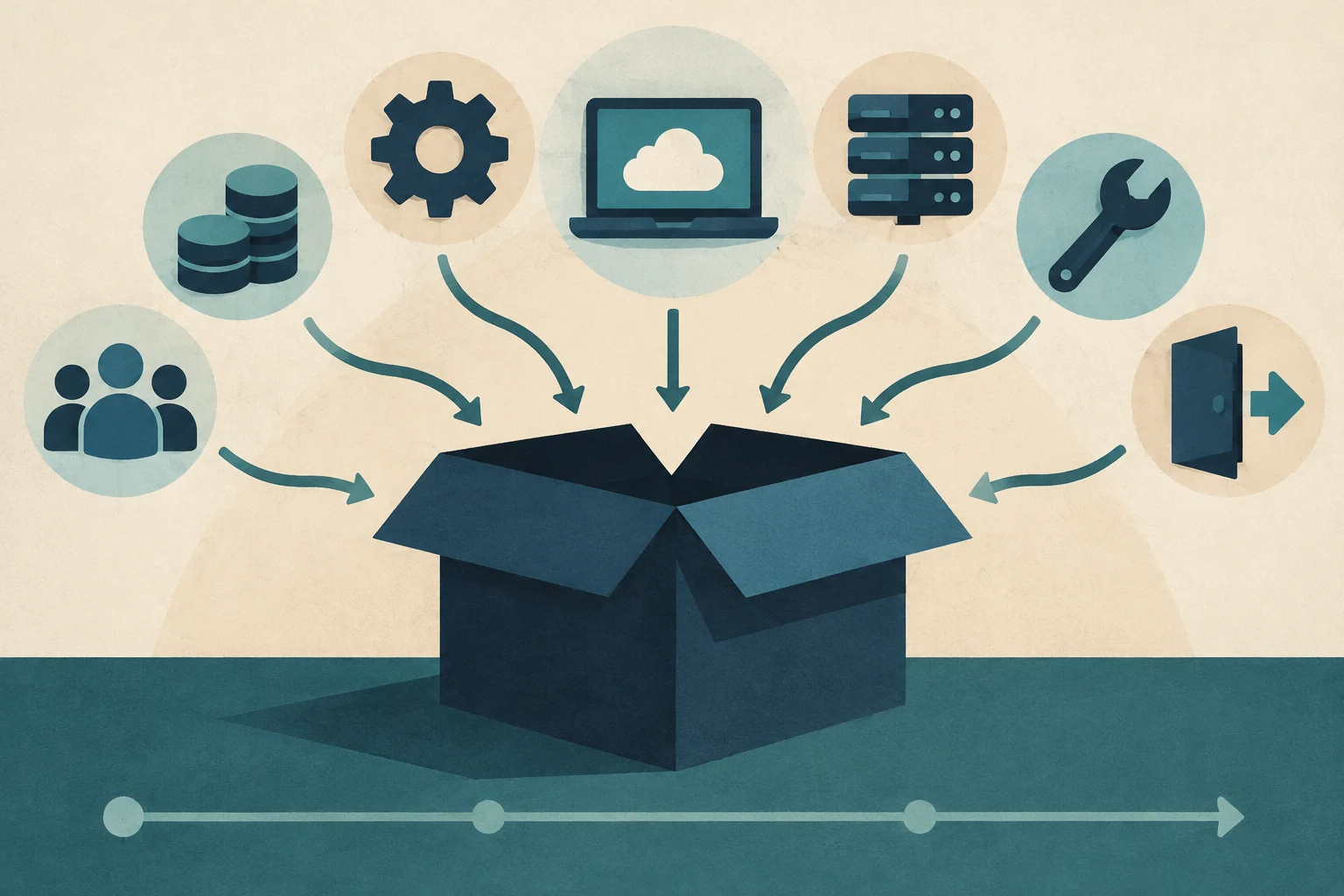
A practical way to prepare the budget is to group items into five categories. The ranges below, published by BigBoc for a five-year horizon, are indicative and describe a typical distribution in certain projects; they are not a rule that applies to every company. Compare them with quotes and your own costs.
Category
Items to include
Indicative range over five years
Development and implementation
Design, development or configuration, testing, deployment, and integrations
40–55%
Maintenance and enhancements
Fixes, updates, support, and improvements
25–35%
Infrastructure and third parties
Cloud or servers, storage, databases, and connected services
8–15%
Internal adoption
Training, data migration, and staff time
5–12%
Exit
Data export, system replacement, or retirement
3–8%
The percentages do not necessarily add up to an exact budget: they are approximate ranges and may vary depending on how each category is defined. Use them as a checklist, not as a substitute for a detailed estimate.
1. Development and implementation
Include the cost of acquiring or developing the solution and getting it operational. Consider initial licenses, configuration, testing, integrations, migration, and any new hardware. For a custom project, add design and development; for a commercial solution, also review setup charges and license terms.
Estimate how many people will need access at the outset and how that number might change. A per-user subscription may grow with headcount, while a perpetual license may involve other support and upgrade costs. Do not assume a purchase quote covers the entire installation: ask for a breakdown of what is included and what is excluded.
2. Maintenance and enhancements
Budget for support, updates, bug fixes, and changes needed to keep the software compatible with evolving processes, systems, and requirements. BigBoc gives an annual maintenance cost of 10–25% of the initial investment as a reference for several types of applications, with variations depending on the solution. This is not a standardized or guaranteed rate: the contract and service level are the basis for estimating actual expenditure.
Separate recurring maintenance from optional enhancements. Also check whether support is included in the subscription or charged separately, how long the contract lasts, and what terms govern renewals.
3. Infrastructure and third-party services
For an on-premises solution, include servers, storage, networking, electricity and, where applicable, cooling and space. For cloud services, estimate fees based on expected usage, storage, and data transfers. Add external services the system needs, such as email, messaging, or payment processing.
Costs may vary: usage, architecture, and data growth affect the bill. IBM notes that cloud services may also involve usage or data-egress charges, as well as costs to improve connectivity between on-premises systems and the cloud. Ask the provider for a breakdown of billable units and model different usage scenarios rather than projecting an initial fee without checking its limits.
4. Adoption and team time
Training and migration are only part of the internal cost. There may also be hours spent by managers defining requirements, validating deliverables, cleaning data, and helping colleagues during the transition. If the old operation must continue while the new one is being implemented, include this period of parallel work.
To estimate the cost, identify the roles involved, how many hours they will spend, and for how long. Multiply those hours by an appropriate internal labor cost for planning purposes. Even if it does not generate a vendor invoice, staff time uses capacity the company is committing to the project.
5. Exit and replacement
The lifecycle does not end with the final maintenance invoice. Consider how data will be exported, what transition assistance the provider offers, and what work may be required to replace or retire the system. If services charge for data transfer or extraction, include those terms in the calculation.
Reviewing exit arrangements in advance helps with contract comparisons and clarifies the options available if needs change. Costs depend on data portability, integrations, and the degree of dependence on the provider; the available sources do not support assigning a general figure to this category.
AI-generated conceptual illustration · Edition Business
A simple formula to get started
First, define the time horizon—for example, three or five years—and the scope of the calculation. Then add up the direct and indirect costs expected over that period:
TCO = implementation + licenses or subscriptions + maintenance + infrastructure and external services + internal costs + exit
Avoid counting the same item twice: for example, confirm whether support is already included in the subscription or whether migration is part of the contracted implementation. For each item, record the amount, frequency, period, and assumption used. If an expense depends on usage, document the estimated volume and prepare low, expected, and high scenarios.
Illustrative five-year example
BigBoc presents the case of a custom web platform with a development cost of USD 60,000. In its example, maintenance totals USD 48,600, infrastructure USD 21,000, third-party services USD 12,000, and internal adoption USD 13,000. The calculated total is USD 154,600 over five years.
The figure illustrates how cumulative costs can differ from the development budget, but it is not a forecast for other companies. It depends on the maintenance, infrastructure, third-party, and adoption assumptions used in that case. Before using an example as a benchmark, replace each amount with data from your contract, quotes, and expected operations.
From cost to value: incorporating ROI
TCO estimates cost; on its own, it does not determine whether a purchase is worthwhile. To assess the investment, compare it with justifiable benefits, such as hours saved, less duplication of work, or productivity improvements. TIC Portal describes return on investment (ROI) as a measure that relates costs to benefits. How those benefits are quantified will depend on the project and the available data.
Separate measurable benefits from expectations. If savings depend on the team adopting the tool or processes being redesigned, state that condition and the estimated time frame. A useful assessment shows both the full cost and the assumptions on which the expected value depends.
Checklist before approving the budget
Define the analysis horizon and which services or teams are included.
Request a breakdown of licenses, implementation, support, and renewals.
Estimate users, cloud usage, storage, and integrations.
Count internal hours for planning, testing, training, and migration.
Include maintenance, updates, and potential transition costs.
Record assumptions and review the calculation when usage or the contract changes.
Compare alternatives using the same horizon and scope, and compare TCO with verifiable benefits.
A transparent calculation does not eliminate uncertainty, but it makes it possible to identify where costs come from and which questions remain to be resolved before committing the budget.
68% of Spanish SMEs spend more than 10 hours a week on repetitive tasks. Identifying the highest-impact processes, such as invoicing and payment follow-up, can save €25,000 to €40,000 a year and reduce errors without having to change software.
Unifying technical and commercial language is essential for SME managers to understand provider specifications. This glossary explains concepts such as ERP, SaaS, API, and BI to facilitate informed decision-making in technology adoption.
The decision depends on mobility, devices, and how critical each operation is. Private 5G may suit mobile or demanding processes; Wi-Fi 6E is often a more accessible option for connecting equipment within a plant. For many SMEs, combining them makes it possible to assign each technology to the use it serves best.