Private 5G or Wi-Fi 6E: How to Choose Connectivity for an Industrial SME
The decision depends on mobility, devices, and how critical each operation is. Private 5G may suit mobile or demanding processes; Wi-Fi 6E is often a more accessible option for connecting equipment within a plant. For many SMEs, combining them makes it possible to assign each technology to the use it serves best.
Choosing an industrial wireless network is not about finding a universal winner. Private 5G and Wi-Fi 6E can connect sensors, terminals, and machinery, but they differ in how they manage access, which equipment they require, and how much they cost to deploy. The choice depends on the operating environment and the requirements of each application.
An important distinction: Wi-Fi 6E is an extension of Wi-Fi 6 that can also operate in the 6 GHz band, in addition to the traditional 2.4 and 5 GHz bands. It is not equivalent to the entire Wi-Fi family, nor does it guarantee any particular coverage or speed on its own. Actual performance depends on the configuration, access points, devices, and conditions at the site.
A private 5G network, in turn, is designed to provide cellular connectivity with restricted access to an organization or a specific site. Its deployment may include antennas, a network core, and compatible devices; requirements and operating models vary according to the solution and available spectrum.
Practical comparison for a plant
Criterion
Private 5G
Wi-Fi 6E
Mobility
May suit equipment and assets moving across large areas or between indoor and outdoor spaces.
Often works well in defined indoor spaces, with coverage designed through access points.
Devices
Terminals need a compatible modem and, depending on the system, a SIM or eSIM.
Can make use of a wide variety of Wi-Fi equipment, although devices must support Wi-Fi 6E to use the 6 GHz band.
Deployment
May require more components and specialized expertise, as well as addressing spectrum access and integration with existing systems.
Access points connected to the local network can make deployment simpler; the final cost depends on the number of devices, coverage, and management.
Traffic management
May offer traffic control and prioritization tools, depending on the architecture and deployed configuration.
Allows access management and network segmentation using enterprise mechanisms, but the result depends on the design and configuration.
Typical use
Mobile processes or applications requiring controlled, reliable connectivity across a large area.
Connecting equipment, terminals, and applications within a plant or building.
These differences are indicative, not performance guarantees. Latency, availability, and capacity depend on the network design, coverage, load, equipment, and application. Although some sources describe sub-millisecond latency as a possibility with 5G, it should not be assumed as an automatic outcome of any private network or compared with Wi-Fi without equivalent measurements under actual operating conditions.
What may tip the decision
If assets move between areas
Warehouse vehicles, mobile robots, or equipment operating outdoors may make private 5G worth evaluating, especially when connectivity must be managed across an extensive area. Before choosing it, check coverage along actual routes and verify that each terminal is compatible. Wi-Fi can also cover large areas, but may require careful planning of access points and transitions between them.
If existing Wi-Fi devices predominate
When operations already rely on laptops, scanners, sensors, or Wi-Fi terminals, an enterprise Wi-Fi 6E network may reduce the need to replace equipment, provided those devices are compatible with the bands and capabilities the organization wants to use. The 6 GHz band can provide additional spectrum, but not all existing Wi-Fi equipment supports it, and its range may differ from that of lower-frequency bands.
If the application is critical
A wireless connection does not automatically replace safety controls, redundancy, or validation of an industrial application. For machinery control or communications that affect process continuity, evaluate latency and its variability, interruptions, coverage, segmentation, and integration with control systems. A test using the actual application and devices is more informative than theoretical maximum speeds.
If the budget is tight
Wi-Fi is often a lower-infrastructure-cost option for indoor deployments and may make use of equipment and expertise the company already has. Private 5G may involve more complex investment and operation, although the specific cost depends on the architecture, site size, spectrum, and service model. To compare options, consider total cost: installation, devices, licenses or services, administration, and maintenance.
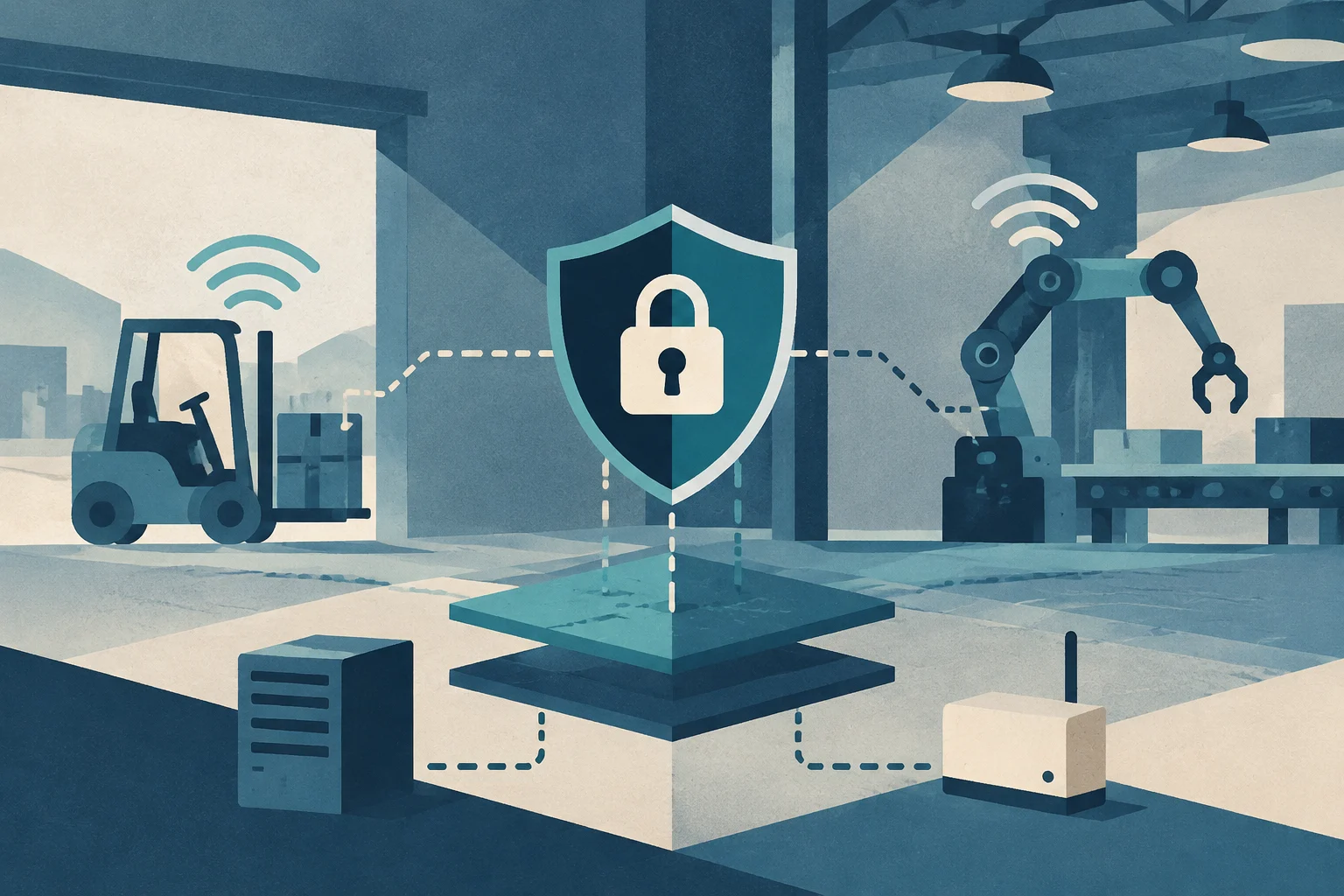
AI-generated conceptual illustration · Edition Business
Security: compare the architecture, not just the label
Private 5G can control access through cellular credentials and a dedicated architecture. Enterprise Wi-Fi can use WPA3-Enterprise, 802.1X authentication, and segmentation into networks or VLANs, when the infrastructure supports them and they are properly configured. Neither technology guarantees a secure network on its own: identity management, updates, separation between operational technology and corporate networks, and control of connected devices also matter.
Spectrum availability also affects deployment. Mobile networks use bands subject to allocation or authorization frameworks that vary by country; Wi-Fi operates in unlicensed bands, which are also governed by rules that depend on the jurisdiction. Since no country is specified for this comparison, it cannot be assumed that an SME can use any 5G band or be assigned a specific regulatory framework.
Why combining them can make sense
In the same plant, Wi-Fi can serve terminals and office equipment, while private 5G is reserved for mobile assets or applications that justify its architecture. This coexistence avoids treating a complete migration as a binary decision, although it requires defining which traffic uses each network and how security, coverage, and service continuity are managed.
The complementarity of cellular and Wi-Fi networks also features in industry analyses of private networks. However, the fact that both can coexist does not mean every SME needs to deploy both: the additional cost and complexity are justified only if they address different needs that a single network cannot adequately cover.
A concrete decision process
Inventory the devices, their radios, and their connectivity requirements; identify which support Wi-Fi 6E or 5G.
Classify the applications by mobility, required coverage, and tolerance for interruptions or delays.
Map the site, including indoor and outdoor areas, obstacles, critical zones, and vehicle routes.
Compare the total cost of the options, including equipment, deployment, management, and maintenance.
Test under real conditions: measure coverage, latency, packet loss, and stability using the expected load and devices.
Review security and local regulations, especially spectrum management for a private 5G network.
A useful rule, with limits
If the priority is connecting devices already equipped with Wi-Fi in a plant and controlling upfront investment, Wi-Fi 6E may be the simpler starting point. If extensive-area mobility predominates, a private cellular network is needed, or control requirements cannot be met by the Wi-Fi design, it is worth evaluating private 5G. For critical applications, the decision should be based on testing and measurable requirements, not solely on the capabilities advertised for each standard.
TCO goes beyond licenses and fees: it includes implementation, infrastructure, maintenance, staff time, and exit costs. Learn how to estimate it over the full lifecycle and compare it with expected value.
68% of Spanish SMEs spend more than 10 hours a week on repetitive tasks. Identifying the highest-impact processes, such as invoicing and payment follow-up, can save €25,000 to €40,000 a year and reduce errors without having to change software.
Unifying technical and commercial language is essential for SME managers to understand provider specifications. This glossary explains concepts such as ERP, SaaS, API, and BI to facilitate informed decision-making in technology adoption.