Tesla cuts profits by 43% in the third quarter and starts Optimus robot production
Tesla's profitability fell to 2.6% in the third quarter of 2026 due to a 69% increase in R&D and double the capital investment. The company begins production of the humanoid robot Optimus in Fremont and plans to deliver Cybercab autonomous taxis before year-end, although the financial impact is not expected until 2027.
Financial results: the pressure of technological investment
Tesla reported an attributed net profit of $787 million in the third quarter of 2026, representing a year-on-year drop of 43% compared to the $1.373 billion recorded in the same period of 2025. Despite this decline in profitability, the company's total revenues remained practically stable at $28.046 billion, a figure very similar to the $28.095 billion of the previous year.
The deterioration of margins is mainly due to the company's strategy to transform its business model towards artificial intelligence and robotics. Operating profit fell by 56%, standing at $718 million, while the operating margin was drastically reduced from 5.8% to 2.6%. This pressure on the accounts is also reflected in adjusted EBITDA, which decreased by 8% to $3.9 billion, placing the margin at 13.9%, one percentage point less than in the previous year.
Revenue and delivery breakdown
The stagnation of total revenues hides a mixed dynamic among the company's different segments. Automotive sales decreased by 3% year-on-year, to $20.56 billion, while the energy generation and storage segment fell by 16%, to $2.881 billion. In contrast, the services and other revenue area grew by 33%, reaching $4.605 billion, which helped partially offset the decline in traditional businesses.
In terms of volume, Tesla delivered 486,532 vehicles between July and September, 2% less than a year earlier. However, production increased by 4%, to 464,391 units. Vaibhav Taneja, the company's chief financial officer, noted that the order book reached its highest level in four years and that deliveries are mainly limited by manufacturing capacity, not by demand.
AI-generated conceptual illustration · Edition Business
The cost of the bet on AI and robotics
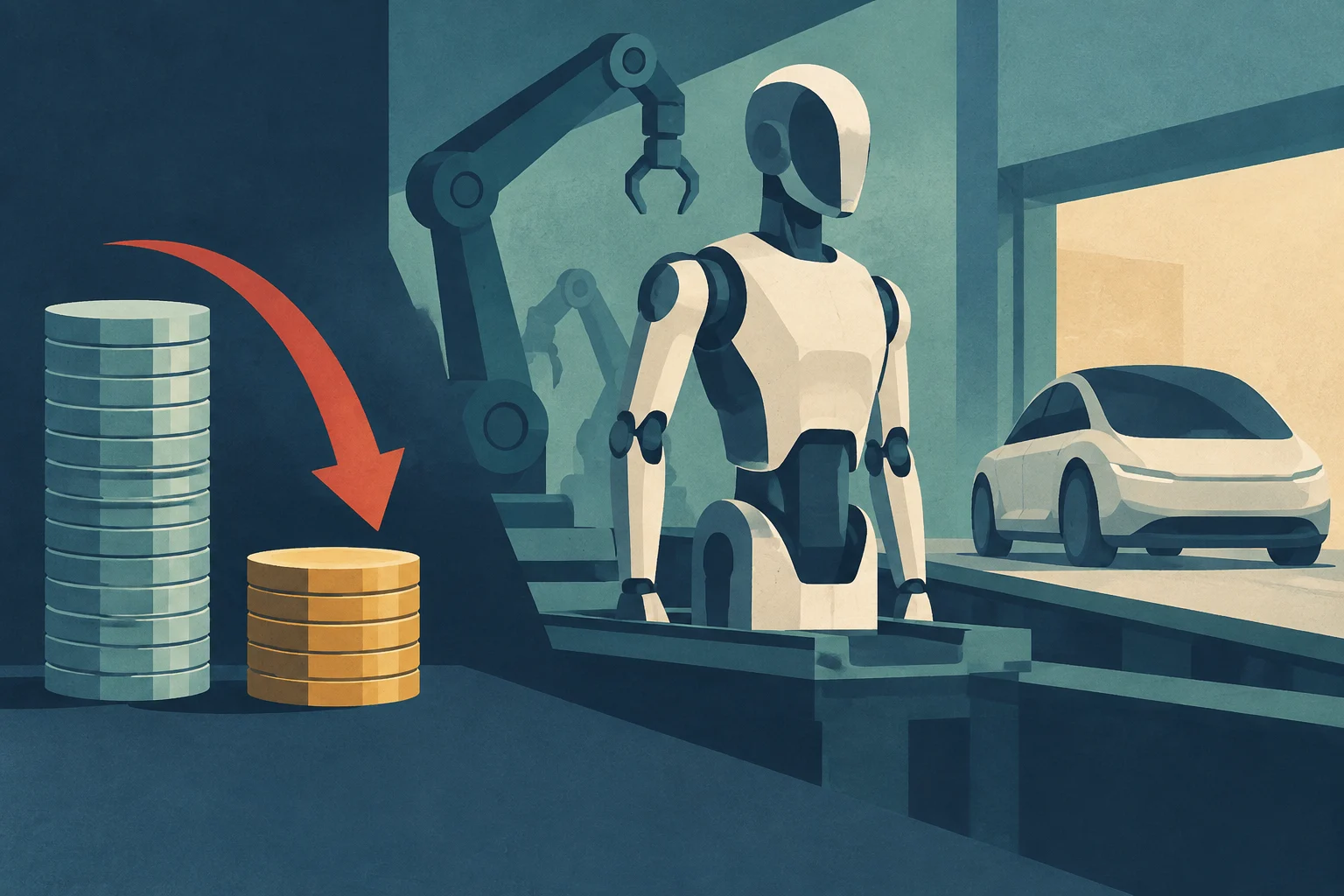
The main cause of the profit drop is the significant increase in operating expenses. In the first nine months of 2026, these reached $12.908 billion, 41.2% more than in the same period of the previous year. Within this item, research and development spending soared by 53% to $7.078 billion in the annual cumulative, and by 69% in the third quarter, to $2.76 billion.
Additionally, capital investments (spending on factories and equipment) more than doubled in the third quarter, reaching $4.73 billion. This massive investment is destined for two key projects: the production of the humanoid robot Optimus and the development of the autonomous taxis Cybercab.
Concept
Q3 2026
Q3 2025
Variation
Net profit
$787 M
$1.373 B
-43%
Total revenues
$28.046 B
$28.095 B
Stable
R&D spending
$2.76 B
~$1.633 B
+69%
Capital investment
$4.73 B
~$2.365 B
+100%
Optimus: start of production in Fremont
Tesla has confirmed the start of production of the humanoid robot Optimus at its Fremont, California factory. The company has indicated that the units coming off the assembly line are the first of production quality. Elon Musk has set an ambitious goal of reaching a capacity of 20,000 units per week, although he has warned that reaching that pace will take at least a year due to continuous changes in the design.
Deliveries to external customers are scheduled for late 2027. Musk has pointed out that the robot's hand represents the biggest hardware challenge, along with long-term reliability. The first buyers will probably be industrial companies interested in automating dangerous or repetitive tasks. The company aims in the long term for a capacity of one million robots per year per manufacturing line.
Cybercab and the robotaxi business
In parallel, Tesla plans to deliver its autonomous taxis Cybercab to customers before the end of the year. Lars Moravy, vice president of vehicle engineering, stated during the earnings conference that the company is trying to achieve this milestone in 2026. These two-seater vehicles dispense with a steering wheel, pedals, and mirrors, a configuration that poses regulatory challenges.
The robotaxi service began operating in Austin (Texas) on September 3, 2026. At the close of the quarter, the fleet had accumulated nearly two million miles traveled without supervision. Tesla plans to extend the service to Dallas in November and to other US cities before the end of the year. However, Elon Musk has acknowledged that the financial impact of this business will not be significant until the second quarter of 2027, when he expects it to acquire considerable importance in the company's accounts.
Other initiatives and liquidity
In addition to Optimus and Cybercab, Tesla is advancing in other technological projects. The company has started production of the electric truck Semi in Nevada and is developing the Terafab project in Austin, a semiconductor factory. Musk expects to obtain the first test chip in May or June 2027 and to start industrial production towards the end of 2028. This initiative will require investments of tens of billions of dollars.
Regarding the financial situation, Tesla ended September with $45.447 billion in cash, cash equivalents, and short-term investments, 9% more than a year earlier. However, the free cash flow of the third quarter decreased by 62%, to $1.531 billion. The company has secured credit lines of up to $30 billion to support its future investments, although it does not expect to draw on them during this year.
The transaction, still subject to approvals and expected to close in 2027, would create a company with a pro forma enterprise value of about C$72 billion and nearly six million customers. The companies say their greater scale would facilitate investment in electricity networks and energy infrastructure.
The organization says parental alerts, crisis responses, and study controls did not reliably meet their stated promises. OpenAI disputes the methodology and maintains that some tests may have been conducted before the controls were fully activated.
The San Isidro facility will, according to the company, enable real-time monitoring of eight transmission projects in Peru, with more than 1,000 kilometers of lines and 28 substations.