
Glossary · 25.10.2026
Glossary of performance metrics for software development teams
A guide to interpreting flow, productivity, quality, and business metrics—and combining them without confusing activity with value—in software teams.
Read storyUseful journalism to understand, manage and grow a business.
SearchA practical guide in three phases to transform the weekly meeting into a decision-making space. Learn to define objectives, manage the agenda, and record agreements with clear owners and deadlines to avoid drift and maximize team productivity.

Weekly follow-up meetings are the pulse of any operational team. When they work, they align priorities and accelerate execution; when they fail, they become the biggest time thief on the agenda. The analyzed material indicates that the difference between a productive and an unproductive session does not lie in technology or duration, but in preparation, facilitation, and follow-up.
This checklist is designed for team leaders who seek to close each encounter with defined priorities and clear owners, eliminating the ambiguity that usually accompanies task review sessions.
The effectiveness of the meeting is decided before attendees connect or arrive in the room. The first question the organizer must answer is whether the meeting is really necessary or if it can be resolved via email or a direct call. If the answer is affirmative, the foundations of the meeting must be established.
Every meeting must have a "reason for being" expressible in a single sentence. Vague objectives like "catch up" or "talk about the project" are the main cause of thematic drift. In a follow-up meeting, the objective is usually to review progress, resolve blockers, or adjust priorities. If you cannot clearly formulate the desired outcome, the meeting probably should not be held.
63% of meetings are held without clear agendas, which causes the conversation to drift and time to drag on. For a weekly session, the agenda must include:
Sharing this agenda in advance allows participants to arrive prepared, reducing introduction time and increasing commitment.
Inviting too many people or irrelevant individuals dilutes the focus and reduces participation. In a follow-up meeting, only those with relevant information, those who will make decisions on blockers, or those who need to know the result to act should be present. Avoiding attendee overload is key to maintaining agility.
Once the meeting has started, the moderator's role is to maintain focus and facilitate an orderly dynamic. The structure must be strict to respect everyone's time.
Start by briefly reminding attendees of the session's objective and the total time available. This establishes the mental framework of urgency and focus. Designate someone to take notes if you are not the moderator, especially if complex decisions are expected.
Use visual tools, such as a shared document or a digital whiteboard, to center ideas and avoid repetitions. If the conversation drifts from the central topic, the moderator must intervene to return to the agenda. It is important to allow space for participation, but without losing direction toward the objective defined in the preparation phase.
In follow-up meetings, the value is not in recounting everything that has been done (which can be read in a prior report), but in identifying what prevents progress. Questions like "What do you need to unblock this task?" or "What decision requires approval today?" are more useful than generic status reports.
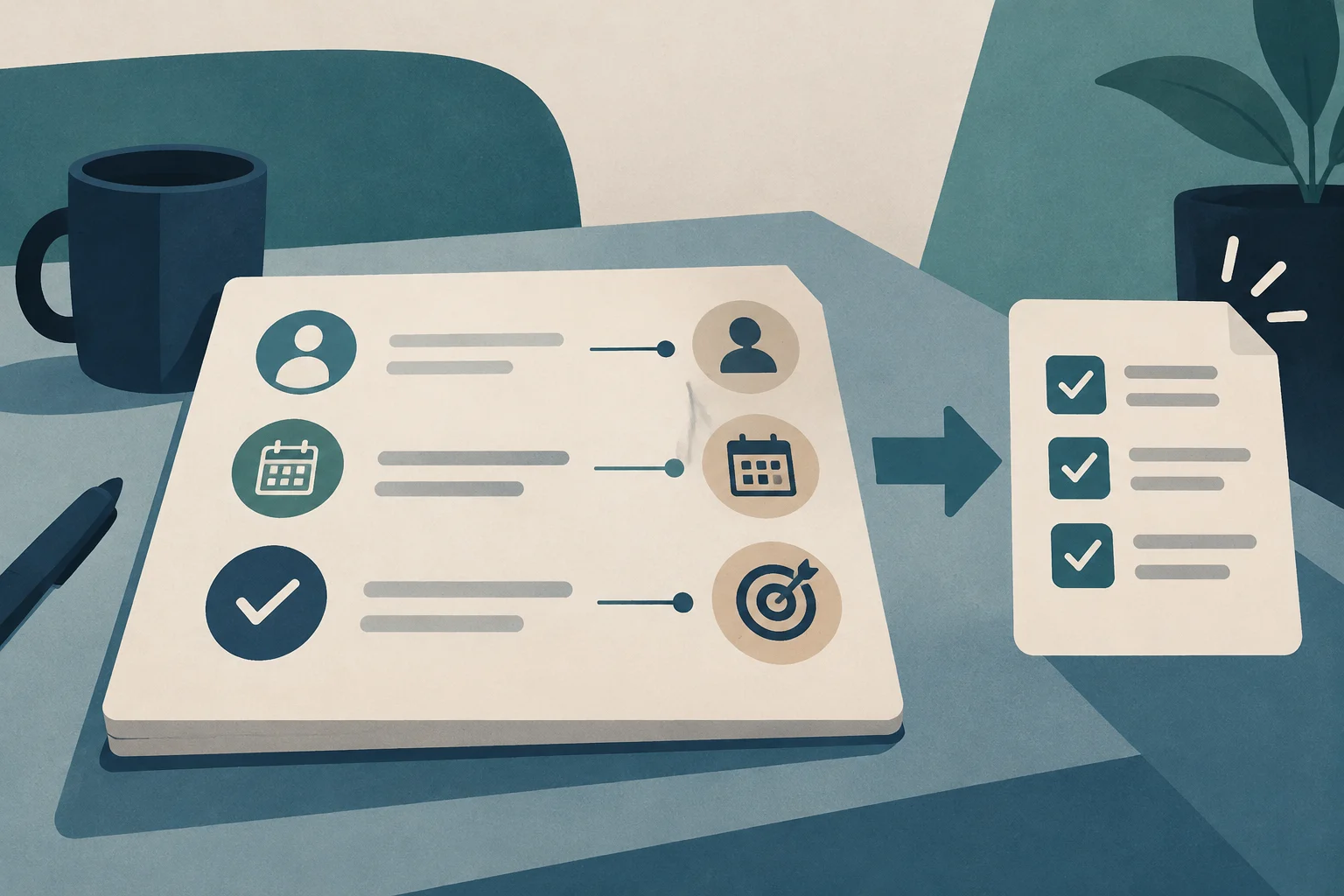
The closing is the most critical phase to ensure follow-up. A meeting without clear next steps and assigned responsibilities is, in practice, an operational failure that will force the same topics to be revisited in the next session.
Before finishing, review the key points and ensure that each action has:
After the meeting, send a brief summary (operational minutes) to the attendees. This document should serve as an action guide and future reference. It should not be a transcription of the conversation, but a checklist of what was agreed. This practice reinforces commitment and allows non-attendees to know the project status.
Identifying common traps helps prevent inefficiency. The analyzed documents highlight three recurring errors:
There is no universal duration, but the trend is toward brevity. If the objective is to review progress and resolve blockers, 30 to 45 minutes are usually sufficient for small teams. If the meeting systematically runs long, it is a sign that the agenda is not well defined or that topics requiring specific problem-solving sessions are being addressed.
It can be the moderator or a designated team member. The important thing is that someone is responsible for recording agreements and actions. If the moderator is facilitating the conversation, it is preferable for another member to take notes to avoid losing control of the dynamic.
The follow-up meeting is the space to identify the blocker, not to assign blame. If a task is not fulfilled, you must ask what obstacle prevents its progress and decide if support, reassignment, or deadline adjustment is needed. The objective is to maintain workflow, not to generate conflict.
A guide to interpreting flow, productivity, quality, and business metrics—and combining them without confusing activity with value—in software teams.
Read story
Specific jargon in the construction sector can generate costly misunderstandings between site teams, administration, and clients. This glossary unifies key terms in planning, estimation, agile methodologies, and technical vocabulary to improve communication and efficiency in project execution.
Read story
A practical guide to transforming contingency planning into real operational capacity: map dependencies, define decision thresholds, and validate alternative routes before the crisis occurs.
Read story