Essential Glossary: Unifying Technical and Administrative Language in Construction Project Management
Specific jargon in the construction sector can generate costly misunderstandings between site teams, administration, and clients. This glossary unifies key terms in planning, estimation, agile methodologies, and technical vocabulary to improve communication and efficiency in project execution.
In the construction sector, precision in communication is as critical as accuracy in blueprints. Technical jargon, acronyms, and industry-specific expressions can act as a linguistic barrier for new hires, administrative teams, and clients. A misused term or ambiguity in the definition of a task can lead to delays, cost overruns, or contractual conflicts.
Unifying language is not just a matter of vocabulary, but a management tool that facilitates collaboration between disciplines. This glossary compiles the fundamental concepts ranging from pre-construction and estimation to site execution and risk management, offering clear definitions to align the expectations of all stakeholders.
Planning and Schedule Fundamentals
The foundation of any construction project is temporal and logistical planning. Without a clear structure, coordination between resources becomes chaotic.
Time Plan and Gantt Chart
The construction time plan is the detailed schedule that establishes all activities and milestones of the project. Its most common visual tool is the Gantt chart, which represents tasks over time, showing their duration, sequence, and dependencies. This chart allows site supervisors to monitor progress in real time and detect deviations before they become major problems.
Milestones and Dependencies
Milestones are key reference points that mark the completion of important phases. They act as control signals for project progress. On the other hand, dependencies define the logical relationship between tasks. A crucial concept here is blocking: a task cannot start until a previous one is completed. For example, in a renovation, cabinet installation is "blocked" until demolition is finished. Ignoring these dependencies is one of the main causes of workflow interruptions.
Bottlenecks
A bottleneck is a point of congestion where progress stops because a specific element has not been resolved. It can be due to a lack of materials, inadequate equipment, or delays in approvals. Identifying these points in time allows resources to be redirected and prevents the delay from spreading to the rest of the schedule.
Management Methodologies: Waterfall vs. Agile
The way work is organized has evolved. Although construction has traditionally followed linear models, agile methodologies are gaining ground due to their flexibility.
Waterfall Management
Waterfall (or traditional management) is characterized by a sequential flow: one task is completed before the next begins. This linear structure requires exhaustive planning and a precise calendar from the start. It is ideal for projects with a defined scope and minimal changes, but it is vulnerable to delays, as a failure in an initial phase directly impacts subsequent ones.
Agile Management and Scrum
Agile management recognizes uncertainty and complexity. It divides the project into short cycles called sprints (generally one to two weeks). In each sprint, the team works on a set of prioritized tasks from the backlog (list of pending items). At the end of each cycle, results are reviewed and the plan is adjusted according to feedback.
Scrum is the most common framework within the agile methodology. It promotes collaboration, visual tracking through boards, and incremental delivery of value. Although it was born in software development, its application in construction allows for greater adaptability to unforeseen events such as weather conditions or design changes.
AI-generated conceptual illustration · Edition Business
Estimation and Cost Vocabulary
Accuracy in costs determines the viability of the project and profitability for the contractor.
Bill of Quantities (BOQ)
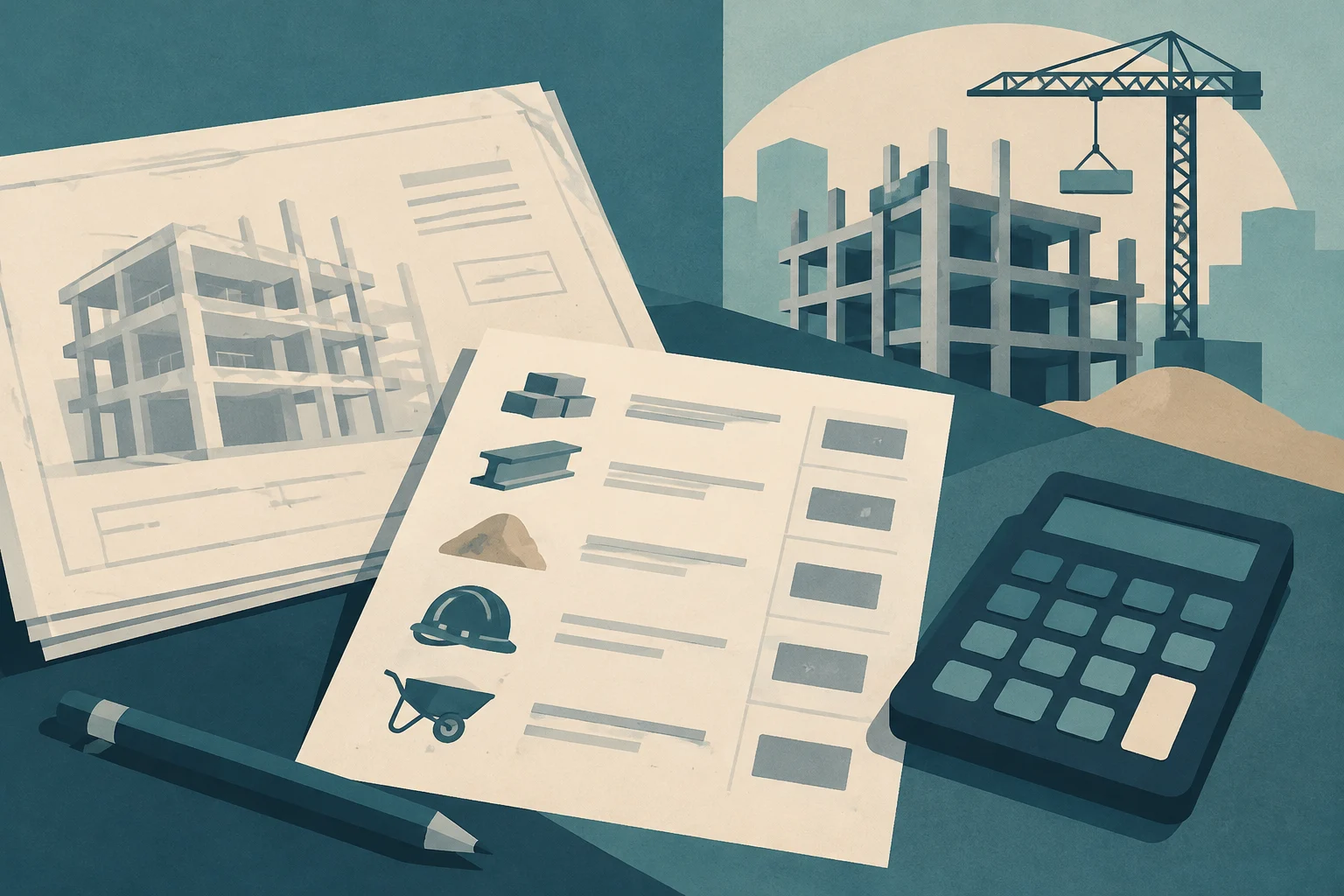
The BOQ (Bill of Quantities) is a detailed document that lists all the labor and materials necessary to complete the work according to the plans. It is the basis for setting the project price and comparing supplier offers. A precise BOQ reduces uncertainty in the bidding process.
Lump Sum
The lump sum summarizes the total cost of a project or specific element, including both direct costs (materials, labor) and indirect costs (transport, supervision, permits). It offers a consolidated view of the budget, useful for high-level decision-making.
Preliminary Design
The preliminary design is the set of initial documents that define the work and provide a budget advance. Although it is sufficient to define the general scope, it does not contain the detail necessary to carry out the construction. It serves as a basis for initial approval and the search for financing.
Site Technical Terminology
Beyond management, it is essential to understand the technical vocabulary that describes the physical elements of construction. These terms are frequent in plans, specifications, and contracts.
Structural and Finishing Elements
Bond: Arrangement of materials (brick or stone) in construction. Variants exist such as stretcher (brick parallel to the wall face) or header (brick perpendicular).
Reinforcement: Set of steel bars placed in concrete to resist tensile stresses.
Coping: Upper finishing of a wall intended to protect it from the action of wind and water.
Sill: Horizontal plane that crowns the window apron, directing water outward.
Insulation: Protection system against thermal or acoustic transmission, fundamental for energy efficiency and comfort.
Water and Sanitation
Blackwater: Fecal waters from sanitation installations.
Stormwater: Waters from rain, which must be managed separately to avoid overloads in the sewer network.
Connection: Point of connection between the fluid (water, gas) supply line and the main network.
Cistern: Underground tank for storing rainwater, useful in areas with supply restrictions.
Digital Tools and Communication
Digitalization has transformed information management on site. Construction software integrates project management, cost control, and communication. These platforms allow:
Centralizing documentation: Storing plans, contracts, and specifications in a single access point.
Improving communication: Integrating direct messaging between supervisors, workers, and clients, reducing information loss.
Real-time tracking: Monitoring project progress and performance, facilitating informed decision-making.
Frequently Asked Questions
What is the difference between a preliminary design and an executive project?
The preliminary design defines the scope and preliminary budget, but it does not have the technical detail to build. The executive project (or construction project) includes all the plans, specifications, and measurements necessary for the physical execution of the work.
Why is it important to define dependencies in the schedule?
Defining dependencies prevents tasks from starting prematurely, which can generate rework, damage to finishes, or space conflicts. For example, a wall cannot be painted before the masonry and plastering have been completed.
Is the agile methodology applicable to traditional construction?
Yes, especially in design phases and in projects with frequent changes. It allows adapting the plan to unforeseen events without restructuring the entire schedule, although the physical execution of the work usually maintains a more rigid sequence for safety and constructive logic reasons.
A practical guide to transforming contingency planning into real operational capacity: map dependencies, define decision thresholds, and validate alternative routes before the crisis occurs.
Clear definitions of scope, milestones, risks, and methodologies like Waterfall or Agile to improve coordination between teams and suppliers in small and medium-sized enterprises.
Clear definition of the three key indicators for manufacturing: OEE, TEEP, and OPE. Discover their formulas, sector benchmarks, and how to avoid measurement errors to optimize your equipment efficiency.