Practical Glossary: Key Terms for Planning Projects in SMEs
Clear definitions of scope, milestones, risks, and methodologies like Waterfall or Agile to improve coordination between teams and suppliers in small and medium-sized enterprises.
Project management in an SME does not require the complexity of large corporations, but it does demand a common language to avoid misunderstandings between the internal team and external suppliers. Mastering the basic concepts allows moving from improvisation to structured planning, facilitating resource allocation and deadline control.
This glossary compiles the essential terms for daily coordination, distinguishing between planning elements and execution methodologies. The objective is to provide a useful reference that helps define expectations, measure progress, and manage changes without losing sight of the final goals.
Fundamental Planning Concepts
Before choosing a methodology, it is necessary to define what will be done and how success will be measured. These terms constitute the foundation of any project, regardless of its sector.
Scope and Deliverables
Scope defines the parameters and limits of a project. It answers critical questions: what does the project include?, what is left out?, and how will success be defined? Documenting the scope is the first line of defense against uncontrolled work expansion. Deliverables are the specific products or results that must be presented at the end of a phase or the entire project. In an SME, agreeing in writing on what is considered an acceptable deliverable avoids subsequent disputes with clients or partners.
Tasks, Milestones, and Dependencies
A project is broken down into tasks, which are individual units of work. Milestones are significant control points that mark the completion of an important phase, such as the approval of a design or the launch of a product. Dependencies describe the relationship between tasks: a task cannot start until another finishes (finish-to-start dependency) or until another begins. Identifying critical dependencies is vital for anticipating delays, as a delay in a dependent task can affect the entire schedule.
Schedule and Gantt Chart
The schedule is the temporal representation of activities. The most common tool to visualize it is the Gantt chart, which displays tasks as horizontal bars along a timeline. This chart allows you to see at a glance the start and end dates, the duration of each activity, and the overlaps between tasks. For an SME, the Gantt chart is especially useful for communicating the project status to stakeholders who do not participate in the day-to-day operations.
Resources, Budget, and Control
Planning is not only temporal but also economic and capacity-based. These concepts ensure that the project is viable with the available means.
Resources and Allocation
Resources include not only the budget but also the personnel, tools, and facilities required. Resource allocation consists of determining who or which team is responsible for each task. In SMEs, where staff are often versatile, it is crucial to monitor workload to avoid overloading certain team members, which can compromise quality and deadlines.
Budget and Costs
The budget is the estimate of the total costs associated with the execution of the project. Distinguishing between planned cost (what was estimated to be spent) and actual cost (what has effectively been spent) is fundamental for financial control. The variation between these two indicators alerts about deviations that require corrective action, such as renegotiating with suppliers or adjusting the scope.
Risks and Plan-Actual Tracking
Risk management involves identifying potential threats (delays, overruns, changes in requirements) and planning responses before they occur. Plan-actual tracking is the practice of constantly comparing what was planned with what was executed. It is not just about recording hours, but about interpreting deviations to make informed decisions. An audit trail or a status board helps maintain transparency about who made which change and when.
AI-generated conceptual illustration · Edition Business
Execution Methodologies: Waterfall vs. Agile
Once the parameters are defined, the SME must choose how to organize the work. There is no universally superior methodology; the choice depends on the nature of the project and the uncertainty involved.
Sequential Approach: Waterfall
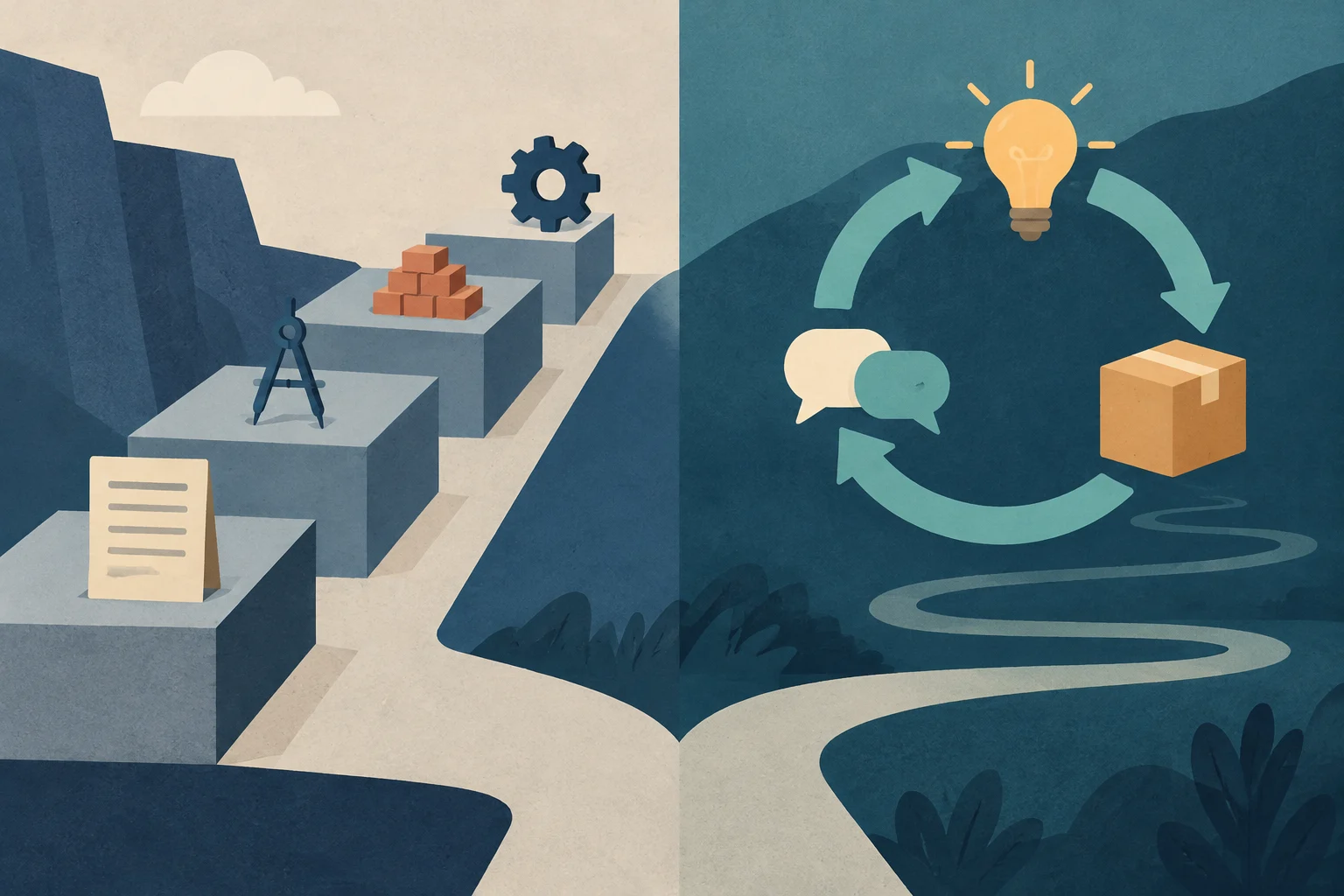
The Waterfall (or traditional) methodology is characterized by a linear and sequential flow. Each phase (planning, design, execution, testing) must be completed before starting the next. This approach requires detailed planning and a precise calendar from the start. It is suitable for projects with well-defined requirements that are unlikely to change, such as the construction of infrastructure or the implementation of a system with fixed specifications. Its main risk is rigidity towards changes, which can be costly to incorporate in advanced phases.
Adaptive Approaches: Agile, Scrum, and Kanban
Agile methods recognize complexity and uncertainty. Instead of planning the entire project at once, it is divided into short work cycles. This allows integrating client feedback regularly and adjusting the course if necessary.
Scrum: Divides the work into fixed cycles called sprints (typically one or two weeks). At the end of each sprint, a value increment is delivered, and progress is reviewed. It is ideal for software development or product projects where iteration is key.
Kanban: Focuses on visualizing the workflow through a board with columns (To Do, In Progress, Done). It limits work in progress to improve efficiency and continuous delivery. It is more flexible than Scrum and does not require fixed cycles, making it useful for support or maintenance teams.
Digital Tools: Means, Not Ends
Software tools (such as Asana, Trello, OneDesk, or OpenProject) are facilitators, not substitutes for communication. A digital tool can automate task assignment, visualize the Gantt chart, or record time, but it cannot define the scope or resolve team conflicts if there are no clear prior agreements.
For an SME, investment in technology must be accompanied by a culture of transparency. The value of these tools lies in their ability to centralize information, reduce the need for status meetings, and allow each team member to know what they must do and when. However, the adoption of a tool does not guarantee success if the team does not share a common understanding of the terms and processes described in this glossary.
Frequently Asked Questions
What is an agile point?
An agile point is an estimated unit of measure of the effort required to complete a task. It is used in Agile methodologies to compare the team's capacity with the pending work, allowing for more realistic planning than the use of absolute hours.
What is the difference between a milestone and a task?
A task is a unit of work with an estimated duration. A milestone is a zero-duration control point that marks the completion of a phase or an important event. Milestones do not consume resources, but they are crucial for progress tracking.
Do I need a formal methodology for a small project?
Not necessarily. For small projects, it is enough to clearly define the scope, deliverables, and deadlines. However, using basic concepts such as dependencies and plan-actual tracking helps avoid surprises, even without adopting a complete framework like Scrum.
A practical guide to transforming contingency planning into real operational capacity: map dependencies, define decision thresholds, and validate alternative routes before the crisis occurs.
Clear definition of the three key indicators for manufacturing: OEE, TEEP, and OPE. Discover their formulas, sector benchmarks, and how to avoid measurement errors to optimize your equipment efficiency.
An effective marketing calendar is not just a list of dates, but an operating system that translates strategy into assigned, budgeted, and measurable tasks. This guide explains how to structure the annual plan, define concrete work units, and use management tools to ensure real execution in small teams.