Checklist for Preparing a Transport Company for Route Disruption
A practical guide to transforming contingency planning into real operational capacity: map dependencies, define decision thresholds, and validate alternative routes before the crisis occurs.
Contingency planning in the transport sector has evolved. It is no longer just about having an alternative route on the map, but about understanding the complete operational network that supports that alternative. The reviewed documents indicate that modern resilience requires a mindset shift: moving from just-in-time logistics to a just-in-case approach, where the diversification of modes, routes, and suppliers is the highest-impact strategy.
This checklist is designed to help transport and logistics companies structure their preparation across three time horizons: immediate response (stabilize), short term (restore supply), and long term (change sourcing or routes). The goal is to prevent a single disruption from becoming a systemic crisis.
1. Dependency Mapping and Impact Analysis
The first step is to identify which flows are critical and where hidden vulnerabilities reside. Most traditional plans stop at the direct supplier, but real exposure is often in second and third-level suppliers (tier 2/3), where visibility is almost non-existent.
Key actions:
Identify the 5 critical transport corridors for revenue and confirm that there is at least one qualified alternative carrier for each.
Map dependencies beyond tier 1: Review the supplier list and mark those that have never been analyzed beyond the direct level. Ask: What happens if my supplier's supplier's port closes?
Calculate the real cost of the stoppage: Not just the freight price, but production loss, idle labor, contractual penalties, and reputational damage. This helps justify the use of premium transport when necessary.
Identify non-obvious bottlenecks: A supplier may have stock but no pickup capacity; a route may be open but with delayed border crossings; a part may be available but blocked by export documentation or hazardous goods approval.
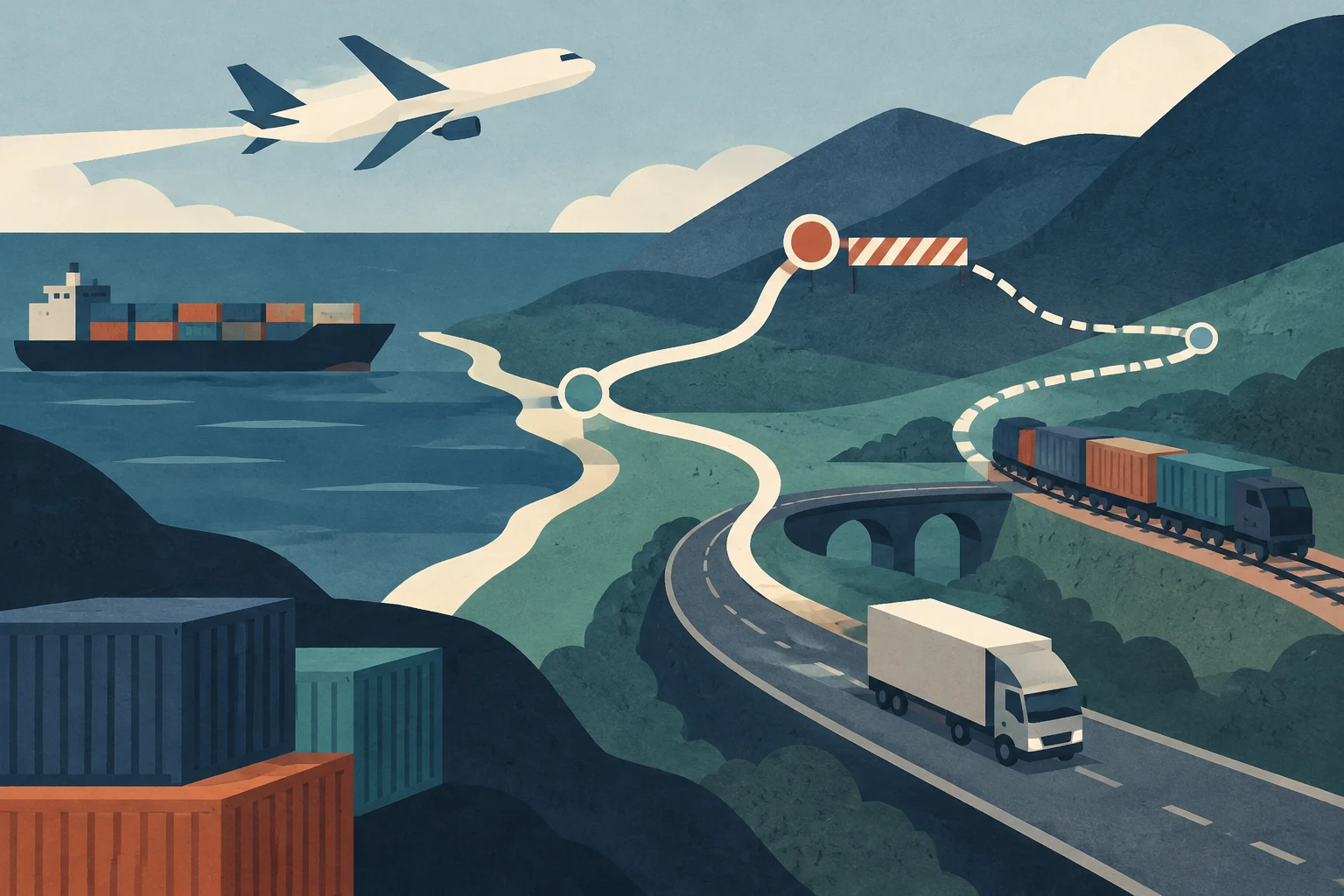
AI-generated conceptual illustration · Edition Business
2. Design of Alternative Routes and Operational Capacity
Identifying an alternative route is only the starting point. The central challenge is determining whether the organization understands the operational network necessary to use it. A route may exist on paper but not be ready to absorb the required critical volume.
Capacity Validation:
Current capacity: How much capacity is available under current service conditions?
Activation time: How quickly can the route be activated?
Operational requirements: What contracts, customs approvals, and operational relationships are needed?
Confirmed access: Does the organization have confirmed access, or would it have to compete for spot capacity after the disruption intensifies?
New bottlenecks: Where would the next bottleneck appear if the diverted volume increased?
Multimodal Diversification:
Diversification of transport modes (multimodal) is the highest-impact crisis strategy according to risk management research. Combining maritime, air, land, and rail allows switching to an alternative solution that meets needs in case of emergency. For example, the use of Sea-Air services can offer routes relatively unaffected by certain maritime disruptions.
3. Decision Thresholds and Spending Authority
A plan needs authority as much as analysis. Defining clear decision thresholds before the incident occurs is crucial to avoid analysis paralysis during the crisis.
Definition of Triggers:
Projected line stoppage: For example, if a production stoppage is forecast in less than 12 hours.
Connection failure: Loss of a critical air or maritime connection.
Customs retention: Delay in customs that exceeds an agreed limit.
Inventory variation: Stock falling below the minimum coverage level.
Role Assignment:
Spending authority: Name the person authorized to approve additional expenses, release stock, contact the supplier, and instruct the transport partner.
Out-of-hours escalation: The protocol must function outside normal working hours, including weekends and holidays.
Communication tree: Confirm that someone is responsible for the crisis communication tree, with backup contacts listed.
4. Communication Protocols and Visibility
Clear communication is often diluted in contingency planning conversations, but it is indispensable for transparency and the smooth transition of roles and responsibilities.
Communication Strategy:
Official channels: Define which channels will be used (web, email, social media, direct contact from the operations team).
Transparency with clients: Commit to providing timely updates on the status of shipments and recovery timelines.
End-to-end visibility: Use advanced digital tools to monitor goods at all times. This transparency allows detecting potential challenges and responding quickly, making data-based decisions even in stressful circumstances.
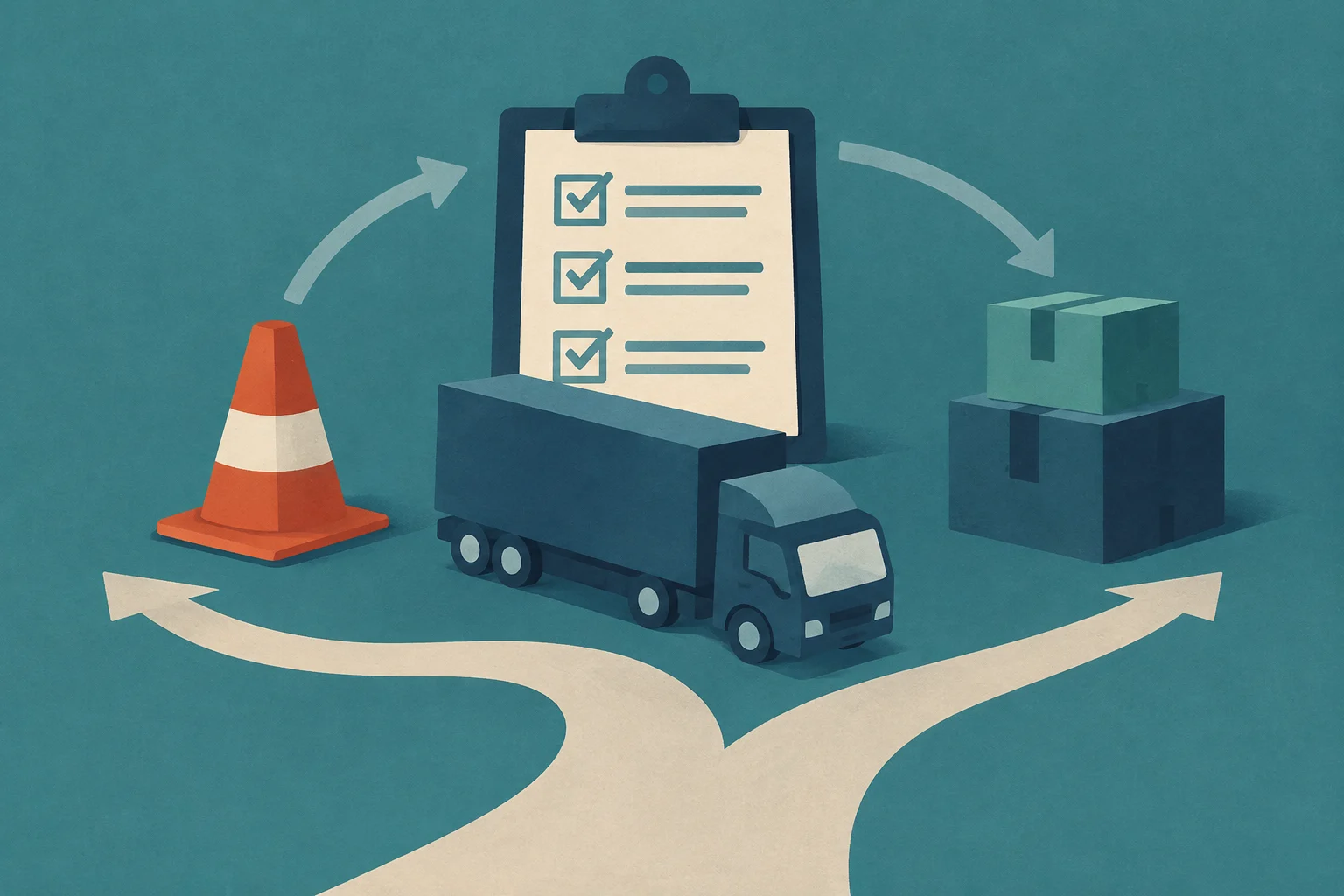
AI-generated conceptual illustration · Edition Business
5. Tests, Drills, and Plan Maintenance
A continuity plan is not a static document. It must be tested periodically to ensure it remains valid against changing operational conditions.
Recommended Testing Frequency:
Quarterly: Plan review and tabletop exercises.
Semi-annual: Specific functional exercises.
Annual: Joint war games with key suppliers.
Continuous Maintenance:
Post-event update: The plan must be updated after any major event.
Assumption validation: Capacity, service patterns, supplier commitments, and customs requirements can change. A contingency arrangement must be validated against present operational conditions, not assumed to remain available in its original terms.
6. Essential Components of the Logistics Continuity Plan
A complete plan must cover eight integrated components. Omitting any of them leaves critical gaps:
Business Impact Analysis (BIA): Quantify the cost of the disruption.
Multi-level dependency mapping: Identify risks in tier 2 and 3.
Contingency routing: Validated alternative routes.
Pre-qualified alternative suppliers: Lists of backup carriers and suppliers.
Communication plan: Internal and external protocols.
IT and cybersecurity recovery: Procedures for system failures (TMS, ERP).
Prior inventory positioning: Safety stock in strategic locations.
Continuity clauses in contracts: Contractual terms that obligate partners to maintain continuity plans.
Frequently Asked Questions
Why is route diversification the highest-impact strategy?
Research based on AHP (Analytic Hierarchy Process) in crisis management classifies route diversification as the highest-impact strategy that logistics teams can deploy, ahead of most other studied mitigation tactics. This is because it reduces exposure to single chokepoints and allows proactive switching to alternative solutions.
What distinguishes a logistics continuity plan from a standard business continuity plan?
A standard plan protects buildings, servers, and payroll systems. A logistics plan protects the flow of goods through partners, ports, and carriers that respond first to their own crisis plans. The key difference is that recovery time depends on the partners' recovery time, not just the company's own, and SLA (Service Level Agreement)-driven service impacts convert technical delays into financial penalties in hours, not days.
How is transferred dependency managed when using an alternative route?
Using an alternative route transfers operational dependency. For example, diverting cargo through a different port may require additional feeder services, customs processes, truck capacity, and terminal handling. A landbridge reduces exposure to a maritime chokepoint but increases dependence on road networks, border procedures, and land operators. Resilience depends on knowing where the dependency has moved and how much capacity is available.
Clear definitions of scope, milestones, risks, and methodologies like Waterfall or Agile to improve coordination between teams and suppliers in small and medium-sized enterprises.
Clear definition of the three key indicators for manufacturing: OEE, TEEP, and OPE. Discover their formulas, sector benchmarks, and how to avoid measurement errors to optimize your equipment efficiency.
An effective marketing calendar is not just a list of dates, but an operating system that translates strategy into assigned, budgeted, and measurable tasks. This guide explains how to structure the annual plan, define concrete work units, and use management tools to ensure real execution in small teams.