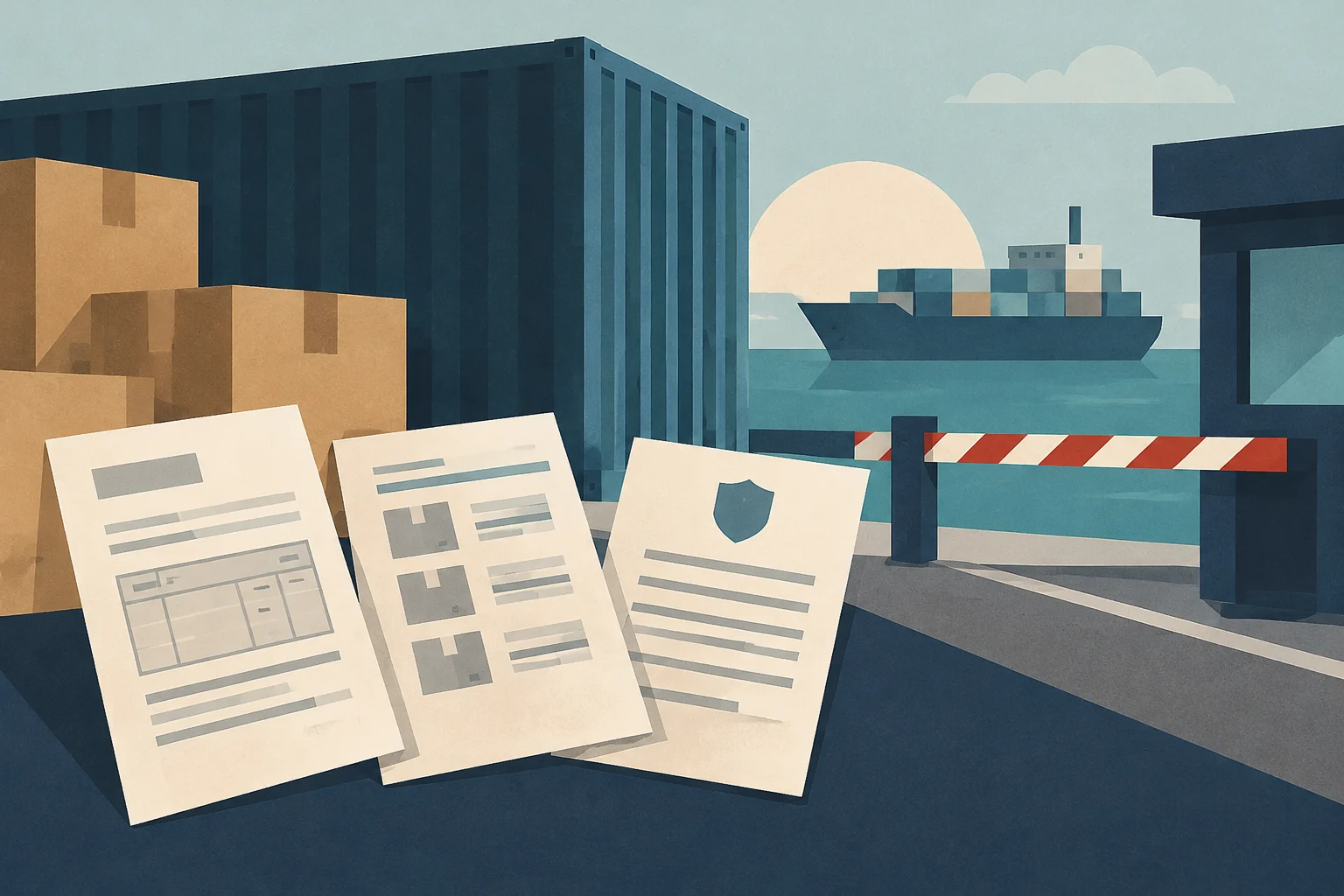
Practical guide to export documentation: checklist for SMEs
Discover the essential documents such as the commercial invoice, the packing list, and the DUA that every SME must coordinate to avoid customs blocks and ensure correct HS classification in its first international order.
The international expansion of an SME depends not only on product quality, but on documentary precision. Exporting requires rigorous coordination among commercial, customs, and transport documentation. An error in a single field can stop the goods at the port, generate fines for discrepancies, or prevent the application of preferential tariffs.
This guide details the documents that a company must identify and verify before sending its first international order, with special attention to data consistency and tariff classification.
The three pillars of export documentation
For a shipment to leave the country and reach its destination without incidents, the correct interaction of three documentary blocks is required. The absence of any of them usually results in the detention of the cargo.
1. Commercial documentation: the economic basis
Commercial invoice (Commercial Invoice): It is the central document of the operation. It identifies the seller and the buyer, describes the goods, sets the values, the currency, the Incoterm, and the payment terms. It serves as the tax basis for the assessment of taxes and tariffs at destination.
Packing list (packing list): It complements the invoice with physical information. It details the contents package by package: number of packages, gross and net weight, dimensions, marks, and numbering. It is crucial for customs control and logistics traceability.
2. Transport documentation: the movement contract
The transport document varies according to the mode, but it always acts as a contract between the shipper and the carrier:
Bill of Lading (B/L): For sea transport. It is a negotiable document of title. It can be issued as an original or in Telex Release format for telematic release.
Air Waybill (AWB): For air transport. It is not a title of ownership, but a receipt and contract of carriage.
CMR (Consignment note): For road transport.
3. Customs documentation: legal compliance
DUA (Administrative Single Document): Standardized form in the European Union to declare goods to the authorities. It collects data on origin, destination, value, and classification. It is processed by the customs broker.
Certificates of origin: They determine the applicable tariff.
EUR.1: For countries with preferential agreements with the EU, it allows reducing or eliminating customs duties.
Third-country certificate of origin: For countries outside the EU without preferential agreements, the standard tariff applies.
The Packing List: more than a simple list
The packing list is the "physical index" of the shipment. Its function goes beyond listing products; it is the tool that allows customs to carry out an efficient selective examination.
Mandatory data in the Packing List
To avoid rejections, the document must include:
Header: Full details of the exporter and importer (company name, address, CIF/VAT), reference number, date, and reference to the associated commercial invoice.
Package details: Package number, type (box, pallet), dimensions (length × width × height), gross and net weight, and detailed description of the contents.
Totals: Total weight of the shipment, total volume in m³, and special notes (dangerous goods, temperature-controlled).
AI-generated conceptual illustration · Edition Business
HS classification: the code that defines the tariff
Each product must be identified with its HS code (Harmonized System), an international classification of 6 to 10 digits. This code determines:
The type of applicable tariff.
Import/export restrictions or prohibitions.
The need for specific certificates (sanitary, phytosanitary, etc.).
An error in HS classification can result in the payment of incorrect tariffs, fines, or the return of the goods. SMEs must verify the code in databases such as TARIC (Community Customs Tariff) before issuing the documentation.
Sectoral certificates: when the product requires them
In addition to general documentation, certain products require specific certificates issued by competent authorities:
Health certificate: For food suitable for human consumption.
Veterinary certificate: For live animals, products of animal origin, or feed.
Certificate of conformity (CE): For products that must comply with European technical regulations.
MSDS (Safety Data Sheet): Mandatory for dangerous goods.
The need for these certificates depends on the product and the destination country. It is the exporter's responsibility to verify the specific requirements of the entry market.
Pre-shipment verification checklist
To minimize risks, it is recommended to carry out a final review of the documentation before loading:
Data consistency: Do the weights, quantities, and descriptions match in the invoice, packing list, and B/L/AWB?
HS classification: Is the HS code correct and verified in TARIC?
Certificates of origin: Has the EUR.1 or appropriate certificate of origin for the destination been issued?
Sectoral certificates: Have the required health, veterinary, or conformity certificates been obtained?
Incoterm: Is it clearly defined in the invoice and consistent with the contract of carriage?
Digital copies: Has a digital copy of the documentation been sent to the importer and the carrier?
Frequently asked questions
Is the packing list mandatory for intra-Community shipments?
It is not always mandatory, but it is highly recommended. It facilitates traceability, warehouse management, and incident resolution. In domestic shipments, a delivery note is usually sufficient.
What is the difference between a Bill of Lading and a Sea Waybill?
The Bill of Lading (B/L) is a negotiable document of title, useful for operations with financing or sale in transit. The Sea Waybill is a non-negotiable contract of carriage, faster and simpler, ideal for trust relationships between known parties.
Who issues the EUR.1 certificate of origin?
Generally, it is issued by the Chamber of Commerce of the country of origin. It is necessary to benefit from preferential tariffs in countries with trade agreements with the EU.
Transform sales from a manual effort into a predictable system: define your ICP with data, standardize the process, and measure the real ROI of each channel to grow without losing profitability.
Your own website, marketplaces, direct sales, or distributors: compare each option against your customers, costs, operational capacity, and access to data before expanding your channels.
A practical guide for small and medium-sized businesses looking to professionalize their after-sales service. Learn how to define metrics, integrate channels, and standardize processes to ensure retention from the very first interaction.