Legal checklist for publishing content on social media: images, music, data and advertising
A practical guide for businesses in Spain: how to verify intellectual property licences, manage image rights and personal data under the GDPR, and meet advertising transparency obligations before publishing commercial content.
Publishing commercial content on social media in Spain requires reviewing the assets used and the applicable legal obligations. Using music, images or personal data without a valid legal basis or authorisation may, depending on the circumstances, lead to third-party claims, penalties or reputational damage. This checklist, organised into four sections, helps businesses and agencies check the relevant points before launching a campaign.
Before including a creative element in a post, it is advisable to check its legal status. Not every work available online is free to use.
Types of licences and how they apply
Public domain: Works whose copyright has expired. Use does not require authorisation on the basis of those rights, but it is advisable to verify the expiry date and whether other rights apply.
Creative Commons (CC): Open licences that permit use subject to specific conditions (attribution, non-commercial use or a prohibition on derivative works, among others). It is essential to read and comply with the exact terms of each licence.
Commercial licences: These can be obtained from image, music or video libraries. It is advisable to check the scope of the licence—for example, permitted uses, territory and duration—and keep its terms and the relevant documentation.
Using these elements may require the rights holder’s authorisation, unless an applicable licence exists, the rights have expired, or the use is covered by a legal limitation or exception. Whether an exception applies depends on its requirements and the specific use; it should not be assumed that an exception, such as quotation, covers a commercial advertising campaign.
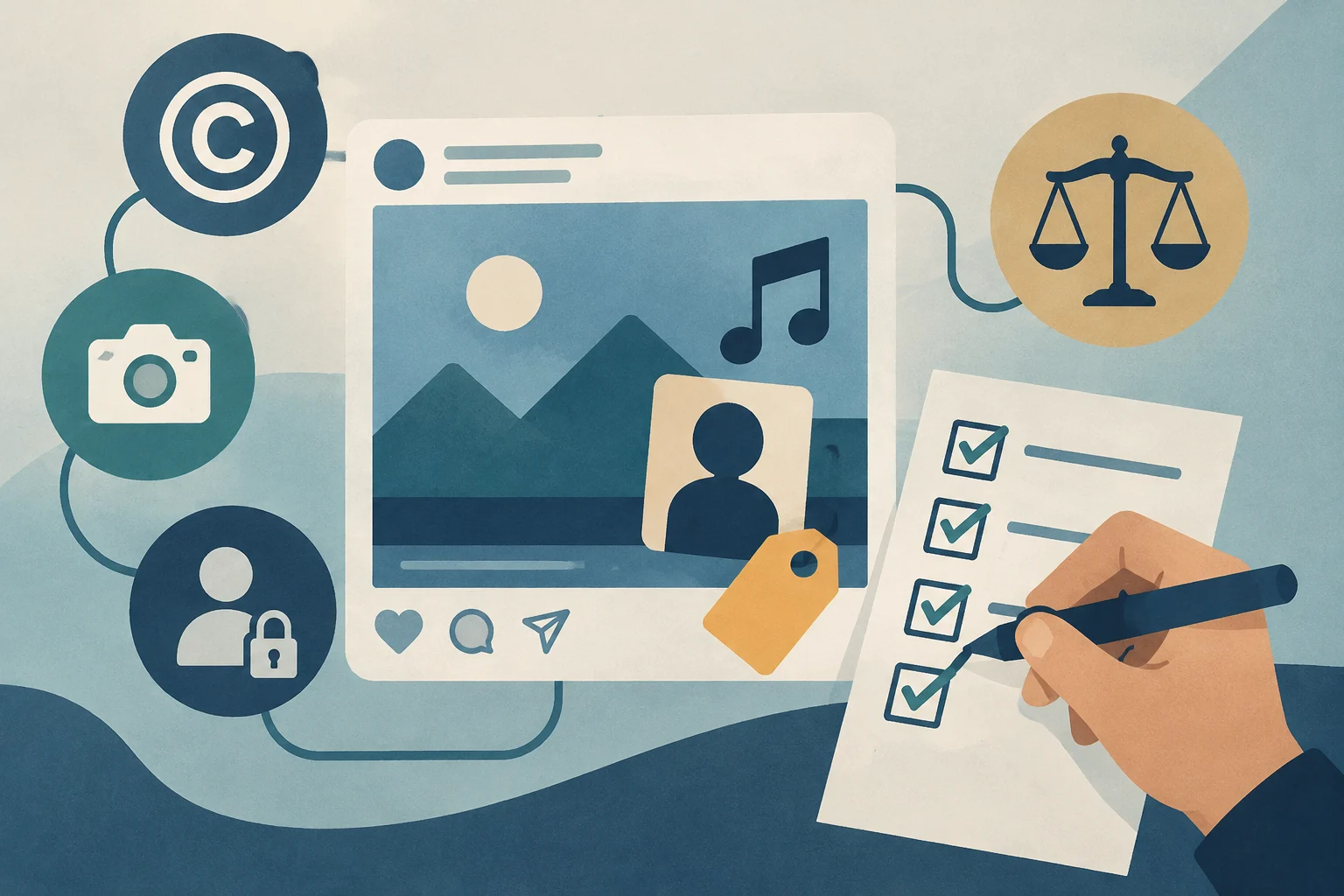
AI-generated conceptual illustration · Edition Business
2. Image rights and data protection (GDPR)
The processing of personal data and the use of people’s images must comply with the General Data Protection Regulation (GDPR) and applicable Spanish law. The legal basis and any required authorisations depend on the intended use and the circumstances of the case.
Managing image rights
People appearing in the content: Before using someone’s image commercially, check that the use is lawful. Depending on the circumstances and the applicable rights, consent or another authorisation may be required. Agreeing and documenting in writing the scope, purpose and duration of the use is a recommended preventive measure, although there is no single formality that applies to every situation.
Minors: If minors appear, the rules applicable to their image and data, as well as their interests and enhanced protection, must be taken into account. Who can authorise the use and what requirements must be met depend on the circumstances and applicable law; authorisation from parents or guardians should not automatically be treated as a substitute for any other requirement.
GDPR compliance
Legal basis: Determine an appropriate legal basis for each processing of personal data; consent, a contract or legitimate interests may be relevant, depending on the circumstances, and must meet their legal requirements.
Transparency: Inform the people concerned about what data is collected, for what purpose and who the data controller is, in accordance with the applicable obligations.
Data minimisation: Collect only the data necessary for the intended purpose.
The General Advertising Act (LGP), the Unfair Competition Act (LCD) and the General Act for the Protection of Consumers and Users (LGDCU) establish requirements for identifying commercial content. How to meet them may depend on the content, context, medium and applicable rules.
Identification criteria
Clear and understandable disclosure: When the commercial purpose is not already clear from the content and its context, identify it unequivocally. Terms such as “Advertising” or “Commercial collaboration” may help if they are appropriate to the medium and understandable to the audience.
Placement and visibility: The disclosure must be visible and appropriate to the format so that the audience can recognise the commercial nature of the content in a timely manner. Specific guidelines may vary depending on the medium and format; also check the platform’s requirements and, where applicable, relevant codes of conduct. Do not assume that a disclosure in the description is always sufficient or that it must remain in the same place throughout a promotion, regardless of format.
Self-regulatory codes: The Code of Conduct on Advertising through Influencers (promoted by AUTOCONTROL, IAB Spain and the Spanish Association of Advertisers) provides practical identification criteria, including criteria adapted to platforms, for the entities and individuals to whom it applies.
4. Special cases: minors and regulated sectors
Some sectors and audiences require an additional review of the applicable rules.
Minors as an audience or creators
Sector-specific restrictions: Promotion of certain products and services—for example, alcohol, tobacco or gambling—may be restricted or prohibited, particularly in relation to minors. Check the rules specific to the sector and medium.
Promotional content involving minors: If a minor takes part in promoting a product, the commercial nature of the content must be clearly identified in accordance with the applicable obligations. The Observatory of Children guide recommends stating whether the content was sponsored, gifted or paid for by the brand.
Lifestyle habits: Avoid promoting unhealthy eating habits or lifestyles to minors, in accordance with applicable recommendations and rules.
Regulated sectors
Health and food: Claims about health benefits must be supported by appropriate evidence and comply with specific labelling and advertising regulations.
Finance and gambling: These may be subject to licences and additional transparency obligations regarding risks and probabilities. Check the requirements for the relevant product, service and audience.
Practical guide for SMEs: how to establish a reliable baseline with Google Search Console and GA4, distinguish early from late signals, and manage attribution uncertainty without falling into premature conclusions.
Influencer marketing demands more than seeking followers. This guide provides Spanish SMEs with a decision framework based on audience affinity, compliance with Law 13/2022 and Royal Decree 444/2024, contractual management of rights, and the definition of KPIs to maximize return on investment.