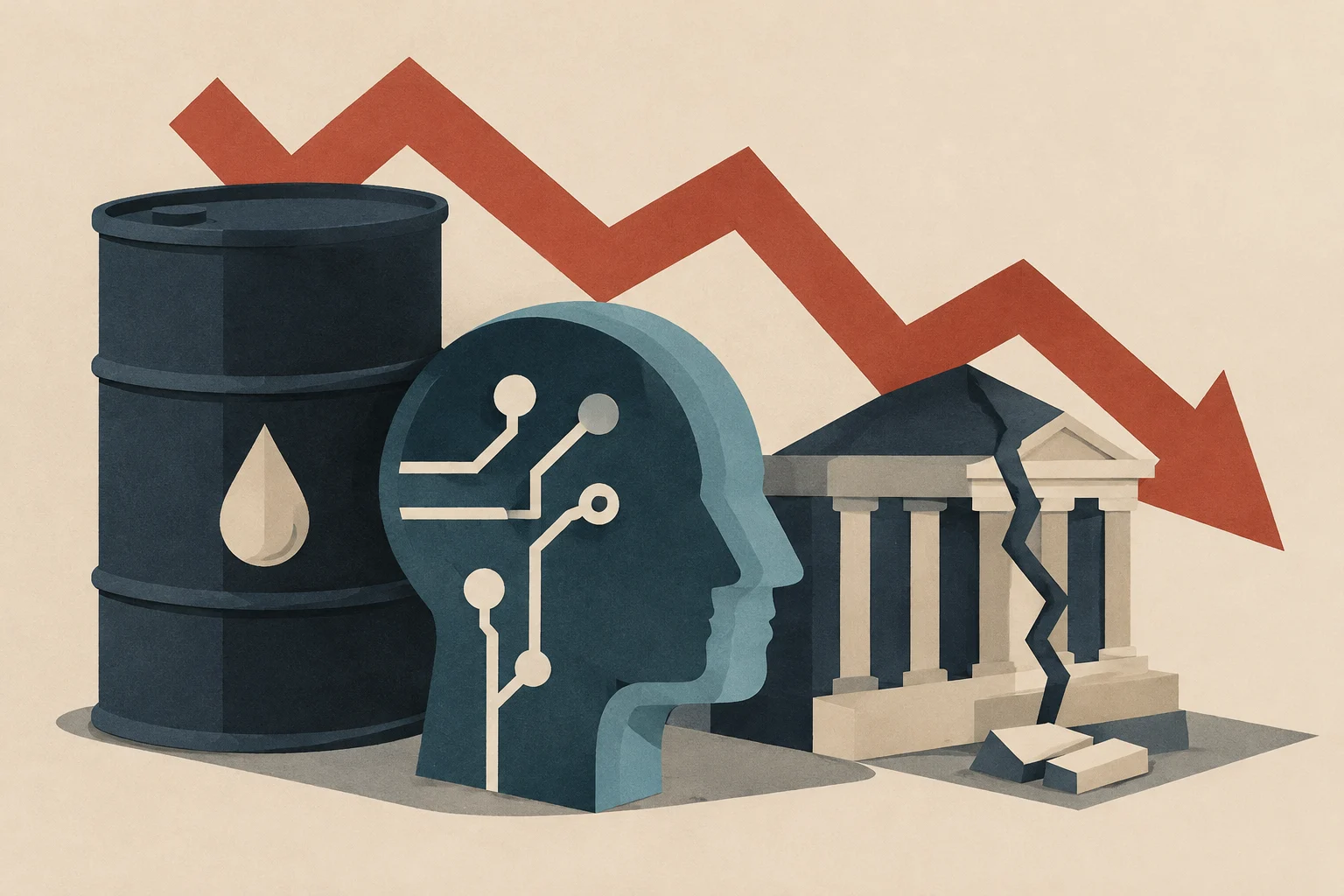
Global stock markets ended a week of losses marked by rising oil prices and uncertainty over the returns on artificial intelligence (AI) investments. Brent reached $117 a barrel, its highest level since April, while tensions in the Middle East and reported damage to oil tankers in the Strait of Hormuz rekindled concerns about supply and inflation.
Higher energy costs coincided with unease about financing large technology projects and tensions in the European sovereign debt market. The combination led investors to reduce their exposure to risk assets and seek safety in U.S. and German bonds.
Oil revives inflation concerns
Crude oil’s movements were closely linked to news about the conflict in the Middle East. According to coverage during the week, prices temporarily fell after reports that negotiations between the United States and Iran might resume—reports that were later denied—and then rose again amid concerns about an escalation and its effects on supply.
More expensive oil can feed into companies’ transportation, production and energy costs. It can also make it harder to contain inflation. That possibility concerns markets because it could limit central banks’ room to cut interest rates or keep them stable. It does not, by itself, mean that an interest-rate increase will occur: it is a risk that investors are factoring into their expectations.
AI concerns focus on financing
Another source of pressure was the scale of investment needed to build data centers and acquire chips. Markets are assessing how long it might take for such spending to generate sufficient returns, and how it will be financed if companies cannot cover it with operating cash flow.
Attention turned, among other cases, to Meta. The company announced an increase in capital expenditure and, according to published reports, expects to need hundreds of billions of dollars over several years to finance its infrastructure. Coverage also pointed to negative quarterly cash flow—the first time since 2013 that operating cash flow had not covered its investments. That figure fueled doubts about the ability of major technology companies to sustain their spending pace with their own resources.
Signals from other companies also weighed on markets: Tesla reported lower profit and a reduced investment forecast, while CoreWeave, which has used debt to acquire Nvidia chips, experienced volatile trading sessions. These cases do not prove that AI is a bubble, but help explain why the market is paying more attention to the cost of capital and cash generation, as well as the sector’s expected growth.
French debt adds to market tensions
Rising European sovereign bond yields were another source of concern. France’s 10-year bond yield exceeded 5% during the week, a level that reports put at a 24-year high. The spread over German bonds widened, reflecting a greater difference between the two countries’ borrowing costs.
In Spain, the risk premium also widened slightly. Globally, investors sought safety in U.S. and German debt. The move reflects caution about the economic and political environment, but it does not amount to a prediction that France will default: analysts cited in the coverage described a structural risk and a possible prolonged drag, not an imminent default.
Stock-market declines and a flight to safety
The Ibex 35 fell 1.7% for the week, to around 18,800 points, despite a rebound in the final session that moderated the decline. European markets also recorded weekly losses: Germany’s Dax fell 2.3%, Italy’s Mib 3.5% and France’s Cac 2.8%. In the United States, the S&P 500 ended the week virtually unchanged, while the Nasdaq recorded one of its weakest sessions since June.
The response varied across asset classes. U.S. and German bonds attracted demand as safe havens, while gold failed to play that role during the week and fell below $4,000 an ounce. Among stocks, technology companies and some financial stocks were among those under the greatest pressure in various sessions.
What to watch in the coming weeks
For companies, the episode underscores the importance of monitoring both energy-cost trends and financing conditions. In the technology sector, the debate is not limited to how much is being invested in AI: it also concerns whether projects can generate the cash flow and returns needed to justify the spending. Meanwhile, oil prices and bond yields will continue to shape inflation expectations and risk appetite.
The weekly correction, on its own, is not enough to conclude that a bubble has begun or to predict the future direction of markets. It does show that when geopolitical uncertainty, expensive energy and substantial financing needs coincide, investors can rapidly reassess risk and valuations.