Checklist for auditing the security of in-house applications before launch
Practical guide to verifying critical vulnerabilities in the software development lifecycle (SDLC), covering authentication, token management, secure storage, and server-side permission validation.
Application security is not a final add-on but a discipline that must be integrated from design through implementation. Every application that accepts inputs, stores data, or connects to other systems becomes an attack surface. Protecting it requires assuming responsibility for its behavior under normal conditions, stress, and active exploitation. This checklist offers a technical verification based on standards such as OWASP Mobile Top 10 and OAuth 2.0 to identify critical risks before deployment.
Secure architecture fundamentals
Before addressing the code, it is necessary to establish a security foundation aligned with compliance requirements and industry standards. This involves classifying data according to its sensitivity and applying consistent labels across all involved systems. Classification directly influences design, implementation, and the prioritization of protective measures.
Network segmentation is another fundamental pillar. Intentional perimeters must be created in the architecture to isolate, filter, and control inbound and outbound traffic. This applies to both north-south (external) and east-west (internal) flows, reinforcing defense in depth. Additionally, application secrets must be protected through hardened storage, restricted access, and reliable and regular rotation processes.
Authentication and identity management
Authentication is the first line of defense against credential theft and phishing. According to industry data, 83% of mobile applications tested present security vulnerabilities, with incorrect authentication being the most frequent. Therefore, multifactor authentication (MFA) is not optional; it must be integrated from the initial architectural design. This implies defining which factors are combined (password + physical token, biometrics + PIN, or Passkeys) to drastically reduce the attack surface.
OAuth 2.0 and PKCE flow validation
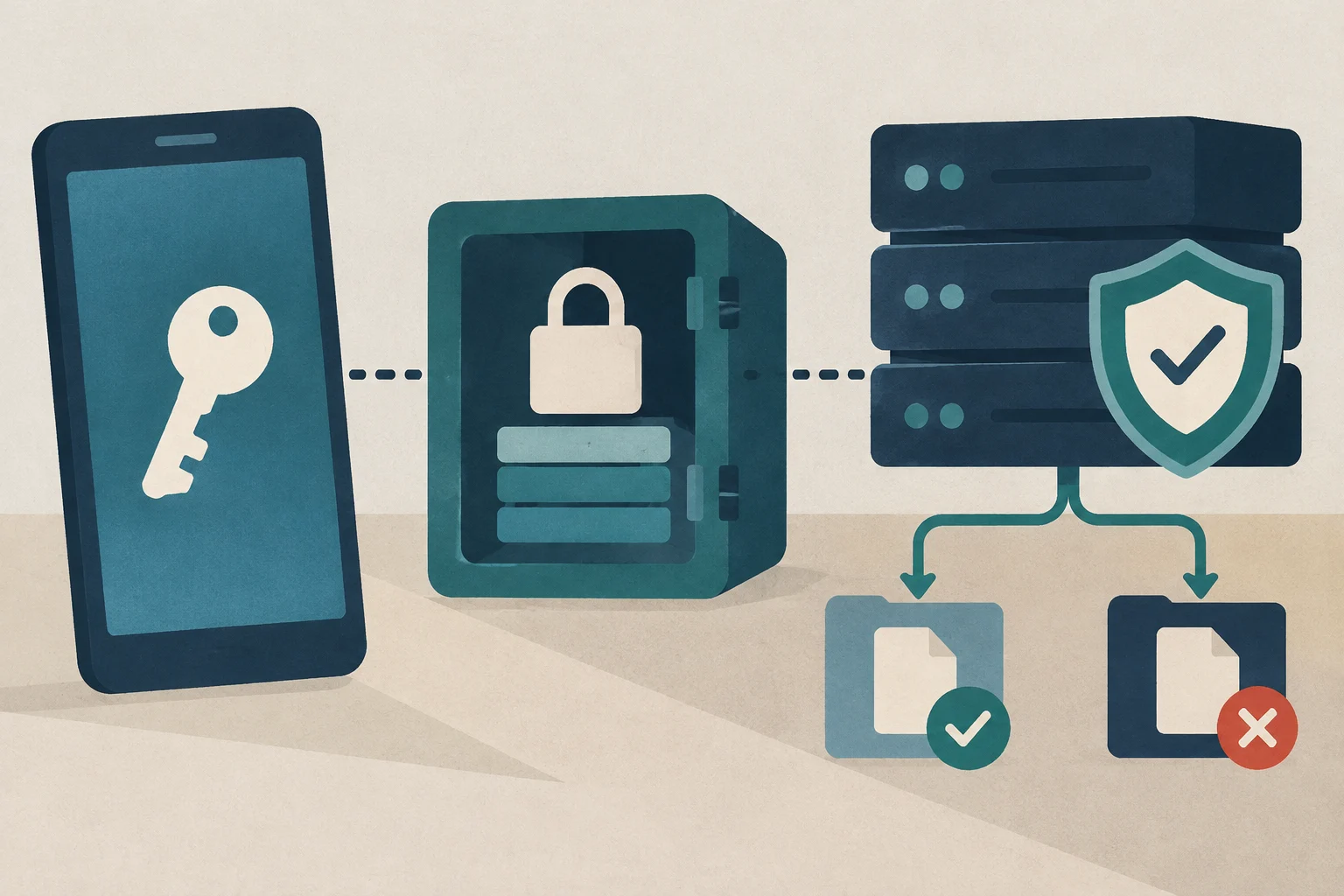
In mobile applications, the secure storage of a client secret is problematic. For this reason, the implementation of PKCE (Proof Key for Code Exchange) is mandatory to prevent the interception of the authorization code. PKCE replaces the secret with a cryptographic verifier generated in each session.
JWT token lifecycle
The management of JWT tokens requires exhaustive validation in each request. The server must verify the signature, algorithm, expiration date, and issuer. A frequent critical error is accepting the none algorithm in the token header, which allows an attacker to forge unsigned tokens. The validation library must maintain an explicit whitelist of allowed algorithms, such as RS256 or ES256, and reject any other value. Additionally, the refresh token must be invalidated immediately after use to prevent reuse attacks.
Editorial illustration · Edition Business
Secure storage and server permissions
Insecure storage of credentials is a recurring vulnerability in the OWASP Mobile Top 10. In Android, the Android Keystore System must be used for cryptographic keys and EncryptedSharedPreferences for sensitive data. In iOS, the equivalent is the Keychain. Tokens must never be stored in unencrypted SharedPreferences, plain text files, or debug logs.
Backend permission validation
A mobile app can be inspected and modified. Therefore, private keys, administration tokens, and payment secrets should not reside within the application. The server must decide whether the user can read or modify each resource. Hiding a button in the interface is not enough; the API must check that the requested resource belongs to the authenticated user. Object-level authorization failures (IDOR) allow a user to access another user's data simply by changing an identifier in the request.
Differences between MVP and mature product
The level of security control must adapt to the product's maturity and the sensitivity of the data. The following table summarizes the key differences:
Area
MVP Check
Mature Product Check
Access
Reliable login, recovery, session expiration
Second factor, suspicious activity detection
Data
No secrets in the app, minimal local data
Secure storage, retention policies
API
Server validates owner and role in each request
Rate limits, continuous monitoring, alerts
Payments
Secrets on server or provider
Refund, dispute, and fraud management
Logs
No passwords, tokens, or private notes
Log redaction, access permissions, retention
Launch
Test real iOS and Android builds
Automatic checks, review of external SDKs
Monitoring and final tests
Security does not end with the launch. It is necessary to implement a holistic monitoring strategy that reliably alerts and integrates with SecOps processes. Log every authentication attempt, both successful and failed, with timestamp, IP address, and device. Configure automatic alerts for anomalous patterns, such as multiple login failures from the same IP.
Before deployment, it is crucial to test on real builds of iOS and Android. Tests on emulators may not reflect vulnerabilities related to reverse engineering or network manipulation. Additionally, external SDKs must be treated as product dependencies: review what data they collect, whether they are necessary, and how they affect privacy declarations in application stores.
A plain-language guide to help management and operational teams understand digital concepts, how they connect, and what questions to ask when evaluating a solution.
The key lies not in the tool, but in the strategy: identifying processes with the highest hidden costs, calculating ROI with real data, and ordering workflows before automating them. A practical guide for Spanish SMEs.
A practical guide for retail SMEs looking to overcome spreadsheet limitations. Learn how to diagnose your stock, define key needs, and select the right cloud software to reduce shrinkage and improve decision-making.