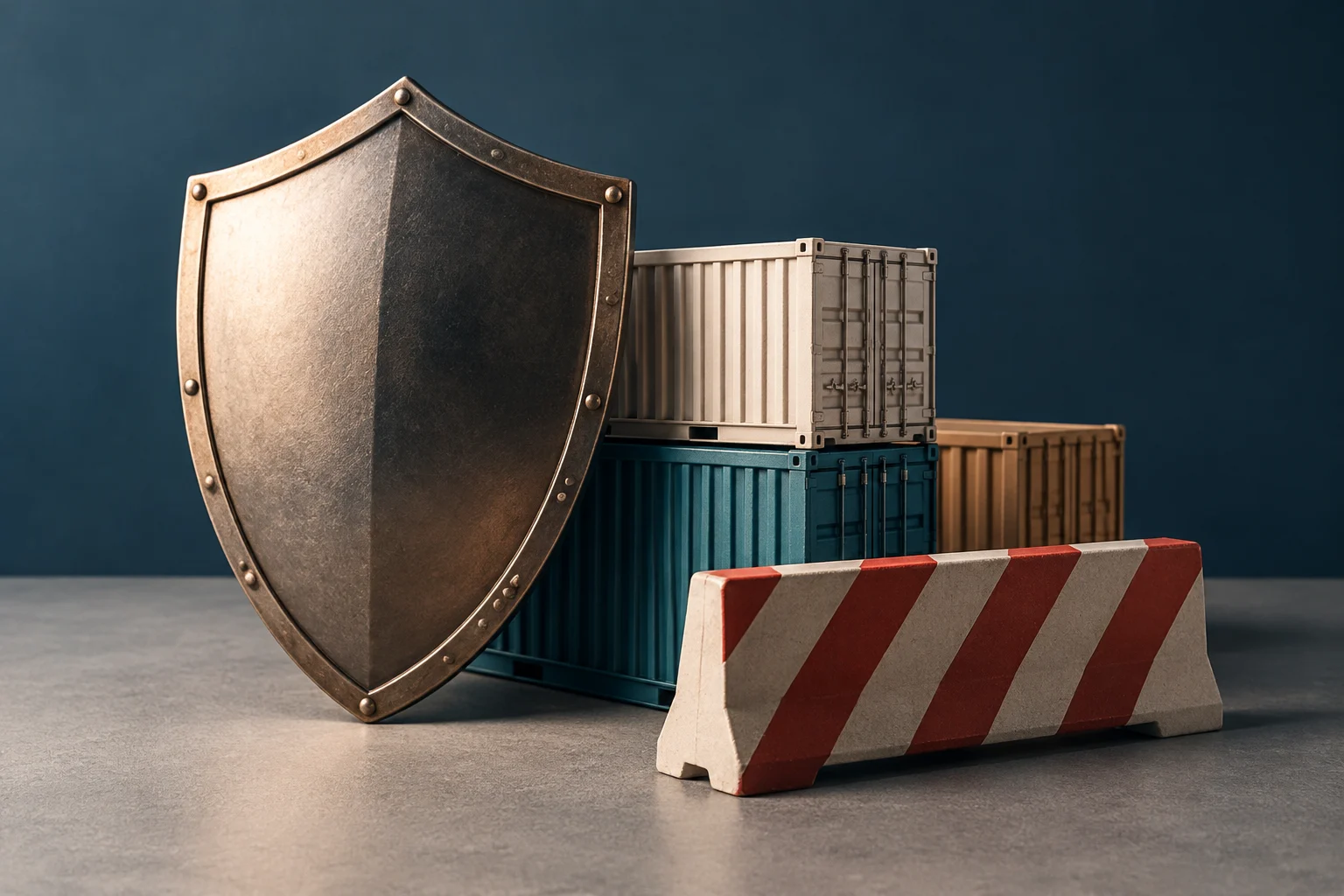
A rapid response to the instrumentalization of trade
France and Germany have presented a joint proposal to equip the European Union with a new rapid-response trade defense tool. The initiative, outlined in a document and a letter addressed to the President of the European Commission, Ursula von der Leyen, seeks to allow Brussels to react with greater speed to trade practices they consider unfair, such as dumping, massive subsidies, or the restriction of currency convertibility.
According to the text, trade is increasingly being used as a tool of political and economic pressure. The leaders of the bloc's two main economies argue that the EU's current instruments are insufficient to respond to a scenario of systemic and persistent distortions that, they maintain, put the European industrial base at risk and cause widespread job losses.
Two key instruments: diversification and exclusion
The Franco-German proposal contemplates the creation of two new instruments that the European Commission should propose as soon as possible:
- Reduction of strategic dependence: A mechanism to limit the exposure of European companies to foreign suppliers considered critical. This point is especially relevant in sectors such as rare earths, where the European industry depends heavily on external sources, primarily from China.
- Emergency exclusion mechanism: A tool that would allow restricting or even excluding a third country from the European single market if it adopts measures that undermine fair market conditions through political or economic means.
The most disruptive aspect of this second proposal is the activation procedure. The document proposes that any countermeasure proposed by the Commission should be adopted automatically unless a reverse qualified majority of member states opposes it. This represents a lower threshold than that required for some current trade measures and would allow activation within a period of days, according to German government officials.
The Chinese context and the shift in German stance
Although the official document describes the new instrument as "country-agnostic" and does not explicitly mention China, the context of the proposal points directly to the relationship with Beijing. The text refers to overcapacity and structural trade imbalances with "key partners," problems that the European Commission has repeatedly linked to Chinese state aid.
This initiative marks a notable shift in the stance of Germany. Until recently, Berlin maintained a pragmatic approach toward China, viewing it primarily as a large market. However, Germany's trade deficit with the Asian giant reached a historic record in 2025, and Chinese competition is directly affecting strategic sectors such as the automotive industry, where German companies face Chinese rivals backed by subsidies and with growing production capacity.
"France and Germany are very interested in ending naivety in trade," a French presidential advisor told journalists, emphasizing the urgency of acting on imbalances he considers unsustainable.
Implications and next steps
The European Commission has received the initiative with approval. The community spokesperson, Olof Gil, noted that the proposal fits with the competitiveness strategy Brussels is developing and its policy toward China. The proposal will be debated at the European Council scheduled for October 15 and 16, 2026, in Brussels.
It is important to note that these proposals do not yet form part of community legislation. To become law, they must be analyzed by member states and receive the approval of EU governments and the European Parliament. Additionally, the Franco-German document acknowledges that a more defensive policy may provoke retaliation, so it proposes creating an inventory of possible response measures and quantifying their impact to avoid contradictory national responses.
The initiative arrives at a delicate time, with Trade Commissioner Maroš Šefčovič preparing a trip to Beijing to keep negotiation channels open. The challenge for the EU will be to balance the need to protect its industry with avoiding an escalation that transforms trade disputes into an open conflict.