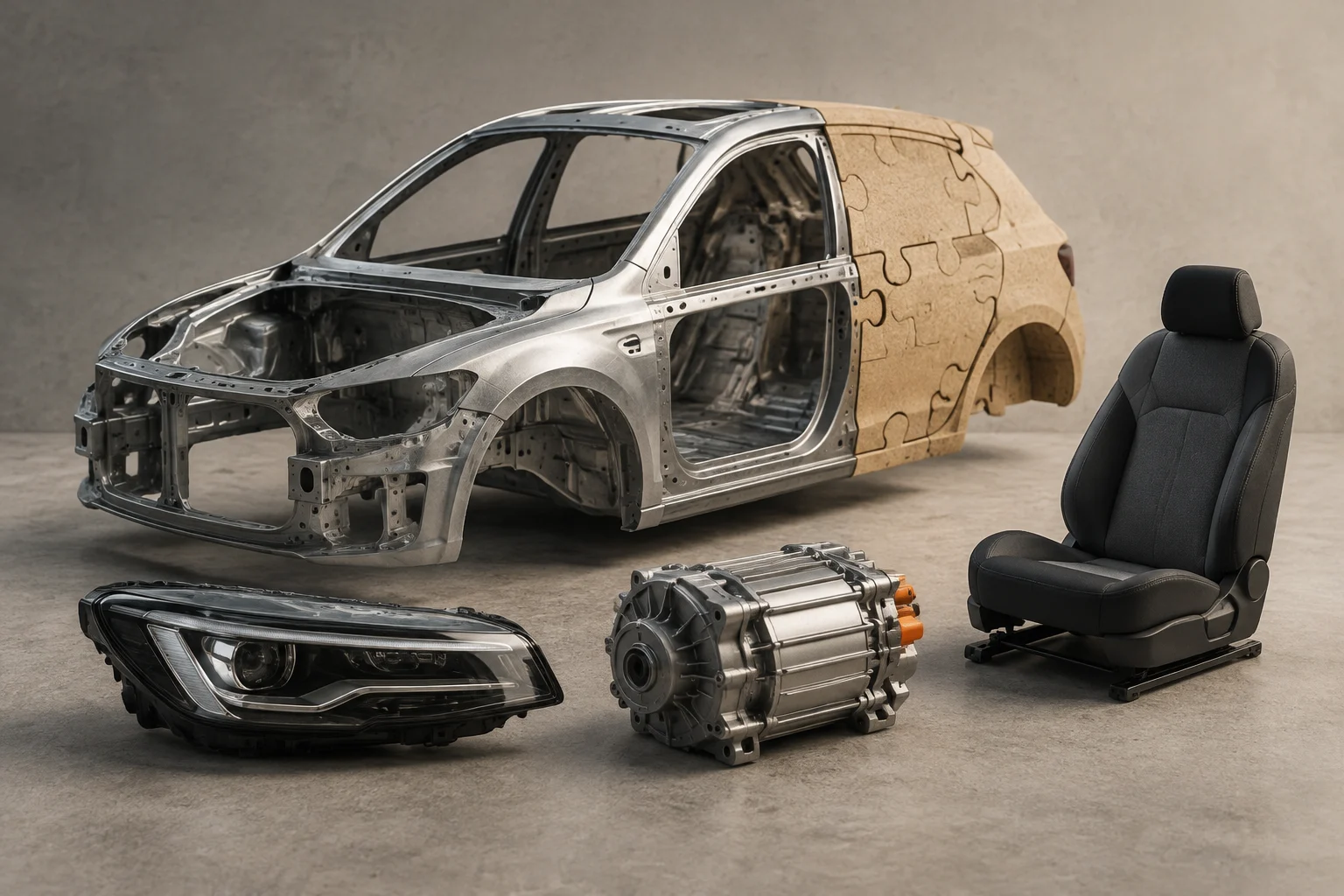
Valeo demands 75% European content in cars to halt competitiveness loss
Valeo CEO Christophe Perillat calls for vehicles sold in Europe to incorporate at least 75% local components to prevent massive job losses. This request aligns with the EU's 'Industrial Accelerator Act' draft, which considers raising the origin threshold for accessing public aid, generating concern in Spain over the risk that its factories may not meet the new criteria.
Christophe Perillat, CEO of Valeo, has issued a stark warning about the state of the European automotive industry. In statements to Automobilewoche and Challenges, the executive noted that Europe has lost 25% of its competitiveness against China since 2020. This decline is attributed primarily to rising energy prices, wage pressure, and the wave of inflation that has hit the continent.
Perillat argues that without regulatory intervention, the European industry could suffer a massive loss of jobs. According to his estimates, each percentage point of lost European content could cost 15,000 jobs. The executive insists that the situation is not about fearing competition, but about the need to level the playing field. "I am not advocating for Europe to become a fortress," he clarified, but warned that the cost gap is structural and cannot be corrected by innovation alone.
The 75% threshold and international reciprocity
Valeo's central proposal is to require that cars sold in Europe incorporate at least 75% 'Made in Europe' content. Perillat justifies this figure based on reciprocity policies applied in other regions, such as the United States (with the Inflation Reduction Act) or India, where a minimum level of local value creation is required to access the market.
The goal is to ensure that foreign companies entering the European market add value within the continent, preventing production from being offshored to countries with lower costs. Perillat emphasizes that this measure would protect the industrial base and maintain the local supply chain, which is crucial for the EU's economic resilience.
The 'Industrial Accelerator Act' and legislative debate
This request is part of the debate on the future Industrial Accelerator Act of the European Union. A draft circulating among parliamentary working groups considers raising the local content threshold from 70% to 75% for vehicles to access public aid and state purchases. A key novelty is the exclusion of the battery from this calculation, given that Europe still relies heavily on Asia for the battery value chain.
For batteries, specific rules of origin are proposed: at least 20% of strategic raw materials should be extracted, processed, or recycled within the EU in the early years, rising to 40% by 2036. Similarly, the use of low-emission European steel is phased in: a minimum of 25% from 2029, 35% in 2032, and 50% in 2036.
The Spanish dilemma: local manufacturing is no longer enough
Spain, Europe's second-largest car manufacturer, watches this regulation with concern. The country exports more than 90% of the vehicles it produces, making it particularly vulnerable to changes in origin criteria. The most notable case is the CUPRA Raval, assembled in Martorell (Barcelona), and the Volkswagen ID. Polo, which share a platform and factory. According to industry information, some versions of these models could fall below the new 75% threshold, thus losing access to purchase incentives and public procurement.
The Spanish position defends an open strategic autonomy. Madrid proposes that at least 40% of components come strictly from the 27 EU countries, while the remaining 30% could be opened to the European Economic Area and reliable partner third countries (such as the UK, Canada, or Japan) under reciprocity criteria. This distinction is crucial to recognize the contribution of Spanish plants and their supply chains, which often include non-community origin components.
Outlook and next steps
The regulation is still under negotiation, and percentages may vary before final approval. Industrial groups warn that the transition timeline for steel and batteries is too fast, and point to a deficit of up to 150 GWh of battery capacity in the short term. Meanwhile, Valeo and other suppliers are pressing the EU to adopt a firmer stance against Chinese competition, arguing that inaction could lead to the disappearance of less powerful European companies under the dual pressure of electrification and costs.
The outcome of this legislative debate will determine not only the viability of the European automotive industry but also the cost structure and competitiveness of electric vehicles in the European market over the next decade.
The Cuban government transforms state-owned warehouses into **Neighborhood Markets** managed by the private sector, retaining only 1,913 establishments for rationing. Although the measure aims to reduce prices by 15%, costs remain unaffordable for most of the population facing a supply crisis and extreme poverty.
The BOE has published RDL 28/2026 and 29/2026, which introduce urgent measures such as the suspension of evictions for vulnerable groups, automatic lease extensions, and a 10 billion euro fund for home purchases. RDL 28/2026 will enter into force on November 15, 2026, subject to ratification by the Permanent Delegation, while RDL 29/2026 regulates the automatic extension of contracts.
The parent company of 28 by Sam Wood has immediately ended all commercial agreements with its founder after he was charged with assault and strangulation. The brand will continue under the leadership of Mark Watkin while several partners and influencers cut their ties.