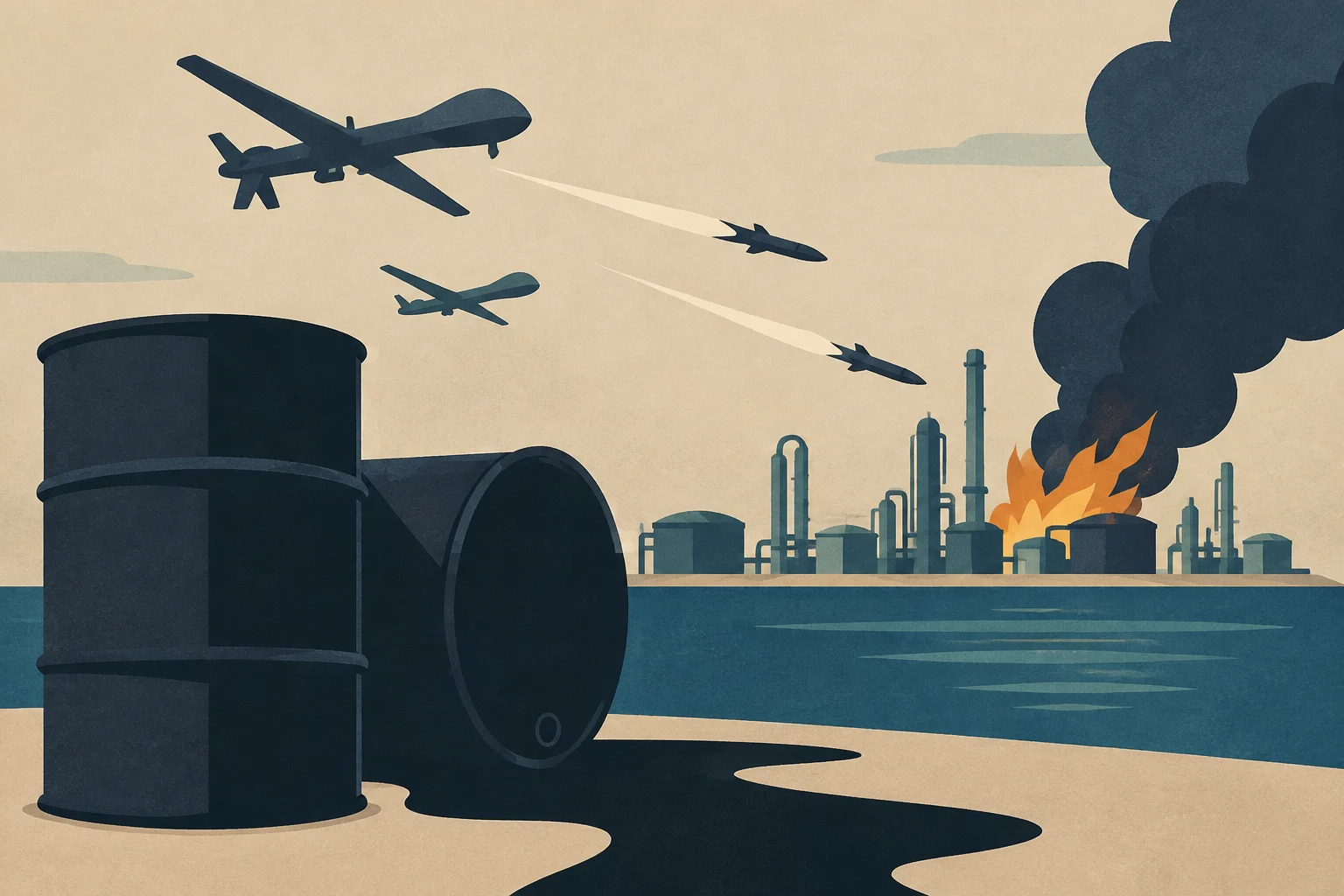
Brent tops $114 following Houthi attacks on Saudi Arabia
Brent crude reaches a five-month high after new missile and drone attacks on the Yanbu refinery and Saudi airports. WTI stands at $100.7 as the escalation in Yemen and tensions in the Strait of Hormuz pressure energy markets.
The price of Brent crude has surpassed $114 per barrel, reaching its highest level in over five months. This rebound, which exceeded 1% in the European pre-open, is due to the intensification of attacks by the Yemeni Houthi insurgents against strategic targets in Saudi Arabia. Simultaneously, the West Texas Intermediate (WTI), the benchmark in the United States, rose 1.3% to $100.7 per barrel.
Military escalation in southern Saudi Arabia
Houthi military spokesperson Yahya Sari claimed four "high-level" operations carried out in the last 48 hours using ballistic missiles and drones. According to his version, the targets include:
The headquarters of the Saudi Ministry of Defense in Riyadh.
The international airports of Dammam and Abha, where air traffic was reportedly interrupted.
A refinery in Yanbu, on the Red Sea coast, where a direct impact caused a fire.
The Saudi-led coalition confirmed the interception and destruction of two drones in the south of the country and one missile aimed at the capital. Its spokesperson, Turki al Maliki, attributed these launches to the Yemeni insurgency. The Houthis have warned that they will expand their operations if Saudi Arabia intensifies its intervention in the conflict, in response to the offensive launched in early October by the internationally recognized Government of Yemen to recover territories.
Yanbu: the key to avoiding the Strait of Hormuz
The market's sensitivity to these attacks is not due solely to Yanbu's refining capacity, but to its logistical function. This city is the destination of the East-West pipeline, which allows Saudi Arabia to export oil via the Red Sea without needing to cross the Strait of Hormuz.
Given that navigation through the Persian Gulf remains conditioned by the conflict between the United States, Israel, and Iran, any interruption in this alternative corridor reduces the options for maintaining global shipments. This vulnerability explains the buying pressure on crude, which prolongs the strong rise of the previous session, when Brent appreciated by nearly 4%.
Impact on supply and reserves
Data from the consultancy Kpler indicates that oil exports from the Middle East (excluding Iran) averaged 24.6 million barrels per day during the week ending October 18. However, this volume includes alternative routes and does not imply a complete normalization of the Strait of Hormuz. Producers have resorted to transshipments between tankers and offshore terminals to sustain shipments.
The International Energy Agency (IEA) warns in its October report that supply recovery remains fragile. As of the end of September, observed global oil inventories were 509 million barrels lower than at the end of February, reducing the margin to absorb new interruptions. Furthermore, shipments of refined products are recovering more slowly than crude oil and remain below half of their pre-war levels, a relevant difference for diesel and industrial supply.
Political dimension in the United States
The rise in fuel prices has entered the campaign for the U.S. midterm elections on November 3. President Donald Trump accused Iran of trying to raise the price of oil to harm Republicans. In a message on his social platform, Trump claimed that Tehran spreads information about supposed attacks and mines to make fuels more expensive and assured that more crude now flows through Hormuz than before the conflict, a statement that Kpler data requires qualifying due to the volatility of flows.
In Burgos, the secretary-general of the PSOE in Castile and León attributed economic growth to the Government’s scope to raise the minimum wage and pensions. He also called for measures on housing and higher wages.
The HKMA spoke with HSBC after the bank announced a Singapore hub expected to hire more than 100 specialists. The discussion reflects competition to attract investment and technology talent, while the bank maintains AI teams and initiatives in Hong Kong.
The defense has appealed to the High Court of Justice of Extremadura against the nine-year disqualification from public employment or office imposed for administrative prevarication. It argues that fundamental rights were violated and that the judgment does not establish Sánchez’s specific involvement.