
Guide · 18.11.2026
How to submit and track a business registration in France
Prepare documents for France’s Guichet unique, check the signature and fees, and respond if the reviewing authority asks for a correction.
Read storyUseful journalism to understand, manage and grow a business.
SearchDifference between contingency, continuity, and recovery plans. Step-by-step methodology to define RTO/RPO, assign roles, and test operational resilience.
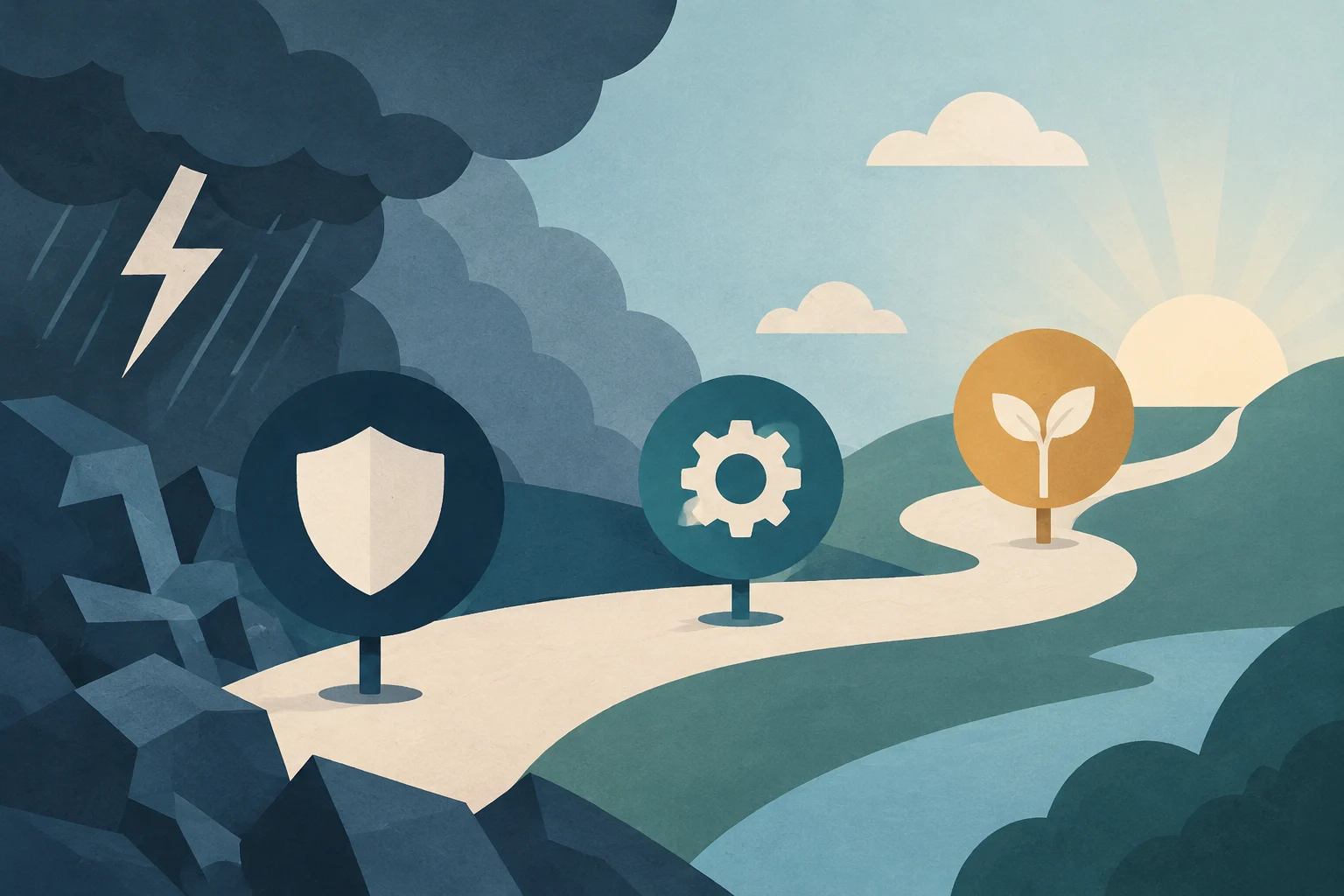
In the service sector, where the main asset is the workflow and response capacity, operational interruption represents an existential risk. Unlike manufacturing, where inventory can act as a buffer, a consulting, IT, or maintenance company cannot "store" its service. Therefore, the structure of a contingency plan should not be limited to technological recovery, but must guarantee the sustainability of the business process itself.
A frequent error in risk management is using these terms as synonyms. According to IBM, a contingency plan is a specific strategy for each scenario that provides detailed instructions on how to respond and recover from a predefined event. Unlike the Business Continuity Plan (BCP), which is a broad framework for the entire company, or the Disaster Recovery Plan (DRP), focused on IT infrastructure, the contingency plan operates at a variable level of granularity: from the loss of a key supplier to the failure of a specific system.
GRC Tools emphasizes that confusion between these three instruments generates response gaps and diffuse responsibilities. The mature architecture follows a logical sequence:
The development of an effective plan requires a rigorous methodology that starts from operational reality. Prosegur and Cibernos agree that the starting point is the identification of resources and risk assessment, followed by the definition of measurable objectives.
The Business Impact Analysis (BIA) is the basis of the plan. In service companies, this analysis must identify which processes are critical for billing and customer satisfaction. Not all processes have the same importance; the distinction between "dispensable" resources and those that "can never fail" determines the investment in resilience.
Once critical processes are identified, two fundamental technical and operational parameters must be established:
Cibernos classifies continuity solutions into three levels according to these parameters:
| Criticality Level | RTO / RPO | Response Time | Typical Application in Services |
|---|---|---|---|
| Cold | High | Days | Non-critical administrative processes, historical archive. |
| Warm | Medium | Hours | Project management, second-level technical support. |
| Hot | Near zero | Immediate | Real-time billing, critical customer service, IT infrastructure. |

A contingency plan is not a theoretical document, but a set of actionable instructions. Prosegur points out that the plan must be global, considering the action of all personnel, not just technical teams. This implies the creation of alternative procedures to normal operating conditions.
It is imperative to define who declares the crisis and who executes the actions. GRC Tools recommends a predefined crisis committee with substitutes, integrating general management, business, IT, legal, and communication. The absence of clear roles causes unnecessary debates during the first critical hours, increasing the economic impact of the stoppage.
The plan must include message matrices for different stakeholder groups (employees, customers, suppliers, regulators). In the service sector, communication with the customer is vital to maintain trust; therefore, press release templates and guides for spokespersons should be prepared to minimize rumors and reputational damage.
The reality of the company changes, as do technologies and threats. IBM warns that hybrid architectures, artificial intelligence, and the IoT complicate traditional failover procedures. Therefore, the plan must be a document in constant renewal.
Cibernos highlights the need to perform simulated contingency tests to identify possible failures before a real incident occurs. GRC Tools adds that organizations that rehearse their crisis processes at least once a year, with realistic drills, present much reduced reaction times and superior coordination.
The plan must follow the iterative life cycle PDCA (Plan-Do-Check-Act). This implies not only the initial implementation, but the periodic review of procedures, the update of emergency contacts, and the adaptation to new risks identified in daily operations.
The contingency plan focuses on reducing the impact of a specific incident within usual operations, providing detailed instructions for that scenario. The continuity plan (BCP) is a broader strategic framework that seeks to safeguard the viability of the entire company against any interruption, covering multiple scenarios and levels of the organization.
In services, the interruption of the workflow is the main risk. Unlike industry, there is no physical inventory that allows continuing to operate while systems are repaired. The loss of service capacity translates directly into loss of income and reputation, making recovery objectives (RTO) stricter.
It must be a living document. Prosegur indicates that it must be constantly renewed due to internal and external changes. At a minimum, an annual formal review and simulated tests are recommended, but any significant change in technological infrastructure, organizational structure, or customer portfolio should trigger an immediate update of the plan.
Prepare documents for France’s Guichet unique, check the signature and fees, and respond if the reviewing authority asks for a correction.
Read story
A first guide to starting a business in Germany. Check which steps may apply, make a cash forecast and find advice in Mössingen and Unterallgäu.
Read story
A practical guide for site directors and prevention technicians on the drafting, approval, and updating of the Health and Safety Plan (HSP) in Spain. It analyzes the difference from the Safety Study, the legal requirements of Royal Decree 1627/1997, and protocols for serious risks.
Read story