How to assess the cybersecurity maturity of a tech SME
A useful diagnosis starts by knowing which systems and data are critical, who can access them, and how the company would respond to an incident. This framework helps detect gaps and prioritize actions without hindering innovation.
Maturity is measured by the ability to prevent, respond, and recover
A tech SME may rely on cloud applications, code repositories, internet-exposed services, and external providers. This combination offers agility but also creates various entry points for an incident. Therefore, assessing cybersecurity maturity is not about counting installed tools: it involves verifying whether the company understands its risks, applies coherent controls, and can maintain or recover its operations.
The diagnosis must be tailored to the organization's size, resources, and activities. Not all companies require the same controls, but it is advisable that they can answer basic questions: what information is essential, which services process it, who has access, and what would happen if any of them became unavailable.
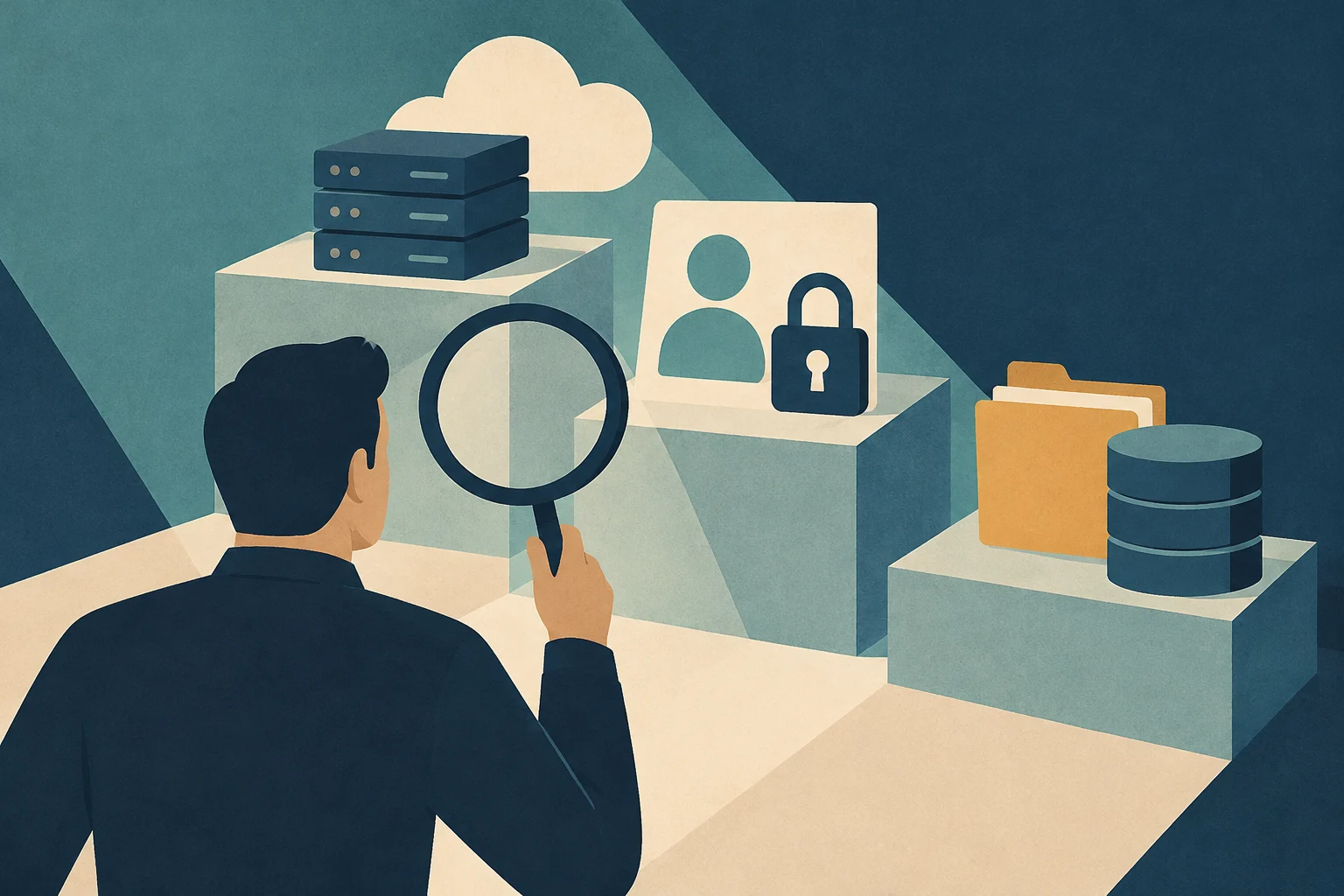
Editorial illustration · Edition Business
A practical framework to review the situation
Instead of assigning a score without a formal methodology, it is more useful to review several areas and record, for each one, what is implemented, what evidence demonstrates it, and what remains pending. INCIBE policies and checklists can serve as a starting point and be adapted to the company.
1. Inventory, exposure, and critical assets
Identify the equipment, services, applications, domains, and corporate accounts used by the company, including resources hosted in the cloud and those managed by third parties. Then, indicate which ones are accessible from the Internet and who maintains each one.
The inventory helps detect unnecessary services, obsolete systems, and dependencies that might go unnoticed. It also aids in prioritization: a vulnerability in an exposed service that supports an essential operation deserves more attention than an isolated and dispensable asset. Periodically review updates and remove or limit components that are no longer needed.
2. Identities, permissions, and accounts
Check how accounts are created, modified, and closed when someone joins, changes roles, or leaves the company. Also review administrative accounts and provider access, avoiding permissions that are broader or longer-lasting than necessary.
Multi-factor authentication (MFA) adds a barrier against the use of stolen credentials. It is advisable to apply it especially to administrative accounts, email, cloud services, and remote access. The principle of least privilege reduces the scope of a compromised account: each person and service should have only the permissions necessary for their function.
3. Information protection and application usage
Identify where sensitive data is stored and which applications are authorized to process it. An SME may have information distributed across devices, corporate storage, cloud platforms, and collaboration tools; establishing clear rules reduces the risk of it being stored or shared in uncontrolled locations.
The policy should address, among other aspects, information classification, device usage, remote work, cloud storage, and secure deletion. If the company uses artificial intelligence tools, define what information can be input into them and what must be kept out, in accordance with the risks and conditions of the services used.
4. Development, updates, and providers
In a tech company, proprietary software and its dependencies form part of the surface that must be protected. Review how vulnerabilities are detected and corrected, how components are maintained, and who can modify or deploy code. Available sources point to the risk of unupdated systems and applications, but they do not establish a single technical standard for all SMEs; controls must be adapted to the architecture and product.
Security also depends on cloud, support, software, and maintenance providers. Identify which services are critical, what access third parties retain, and how an incident affecting them would be communicated. Security requirements and access conditions must be proportional to the service and the information it handles.
5. Training and work habits
Phishing and social engineering aim to get a person to hand over credentials, open a file, or authorize an action. Training helps recognize suspicious signs and know how to report a possible incident, but it must not replace technical controls.
Ensure that staff know the guidelines for managing passwords, protecting information, using approved applications, and reporting unusual messages or behaviors. INCIBE policies include materials for executives, technical staff, and employees, as well as editable checklists that can facilitate adaptation.
6. Backups, response, and continuity
A preventive strategy does not completely eliminate risk. The company needs to know how to act if it loses access to data or services, if an account is compromised, or if a provider suffers an incident. Define responsible parties, communication channels, and initial steps, and verify that backups are protected and can be restored.
Business continuity is not demonstrated solely by having a backup: one must know which processes to recover first and verify that information and systems are operational again. Drills and reviews allow finding dependencies or incomplete instructions before they become urgent.
From gaps to a prioritized plan
Once the areas have been reviewed, turn the findings into a work plan. For each gap, note the affected asset, the risk it represents, the proposed measure, a responsible person, and the progress status. Prioritize first the problems that may facilitate unauthorized access or interrupt essential systems and data; then, plan improvements that require broader changes.
A simple register can be organized as follows:
Area
Diagnostic question
Evidence to check
Assets and exposure
Do we know which services are accessible from the Internet?
Updated inventory and assigned responsible parties
Access
Do critical accounts use MFA and limited permissions?
Access configuration and account review
Software
Are vulnerabilities identified and corrected?
Update procedure and follow-up
Providers
Are their access and responsibilities controlled?
List of services, permissions, and agreed requirements
Recovery
Can essential data and services be restored?
Verified backups and recovery tests
This register is not a certification or a formal audit. It serves to organize decisions, assign responsibilities, and repeat the evaluation when systems, providers, or company needs change.
Measuring progress without turning security into a brake
Cybersecurity works best when integrated into daily decisions: when enabling a new service, incorporating a provider, granting permissions, or deploying an application. Documenting exceptions and reviewing controls allows maintaining agility without losing sight of exposure.
The goal is not to eliminate all risk or acquire all available tools. It is to build a shared vision of critical assets, correct the most relevant gaps, and improve the ability to respond and recover. For a tech SME, this gradual process turns security into part of the operation and not an added barrier to innovation.
A plain-language guide to help management and operational teams understand digital concepts, how they connect, and what questions to ask when evaluating a solution.
The key lies not in the tool, but in the strategy: identifying processes with the highest hidden costs, calculating ROI with real data, and ordering workflows before automating them. A practical guide for Spanish SMEs.
A practical guide for retail SMEs looking to overcome spreadsheet limitations. Learn how to diagnose your stock, define key needs, and select the right cloud software to reduce shrinkage and improve decision-making.