Practical Guide to Structuring a Continuous Training Plan in SMEs
How to design, prioritize, and evaluate a training plan in a Spanish SME: skills diagnosis, measurable objectives, budget management with FUNDAE, and impact metrics on productivity and retention.
Continuous training has ceased to be an accessory benefit to become a key strategic tool for the competitiveness of small and medium-sized enterprises (SMEs). In an environment where skills obsolescence accelerates and talent retention is critical, structuring a training plan not only responds to operational needs but also aligns directly with productivity, innovation, and organizational culture.
This guide details how to design an effective training plan, adapted to the reality of SMEs in Spain, integrating the initial diagnosis, content prioritization, budget management, and results evaluation.
Foundations: From Expense to Strategic Investment
For training to generate value, it must be understood as a future investment and not as an operational cost. According to data from the National Statistics Institute (INE), in 2023, 38.8% of men and 32.1% of women between 25 and 64 years old had a level of education corresponding to the first stage of secondary education or lower. This gap highlights the importance of companies taking an active role in updating the skills of their workforce to cover training needs that the education system does not always address in the workplace.
A well-structured training plan allows:
Developing internal talent, reducing dependence on costly external hires.
Maintaining competitiveness in the face of technological and market changes.
Complying with legal obligations and taking advantage of tax incentives such as the FUNDAE bonus.
Phase 1: Diagnosis and Strategic Alignment
The first step is not to choose courses, but to understand the current situation. The training plan must be the continuation of the company's strategy and be included in the human resources plan.
Analysis of Needs and Competencies
It is necessary to identify the areas where the workforce needs to strengthen their skills. This analysis must consider:
Current vs. required competencies: What skills are essential to meet the company's strategic objectives?
Performance evaluation: Review the results of periodic evaluations to identify skill gaps.
External context: Analyze the evolution of the sector and competitor practices to detect improvement opportunities.
Segmentation of Profiles
Not all employees need the same training. It is crucial to segment the workforce to personalize content:
New employees: Integration and knowledge of internal procedures.
Middle management: Leadership, team management, and conflict resolution.
Technical staff: Updating digital tools and agile methodologies.
Executives: Strategic vision and adaptation to market changes.
Phase 2: Design of Objectives and Content
Once the what and the who have been identified, the how and the why must be defined.
SMART Objectives
Training objectives must be Specific, Measurable, Achievable, Relevant, and Time-bound (SMART). This allows focusing resources on areas of greater impact and facilitates subsequent evaluation.
Examples of objectives:
Technical skills: Train 80% of the sales team in the new CRM before Q3.
Leadership: Prepare 5 middle managers to assume roles of greater responsibility in 12 months.
Adaptation to change: Update cybersecurity knowledge for all administrative staff in 6 months.
Selection of Formats and Methodologies
The choice of format must adapt to the objective and the learner's profile. SMEs can combine different modalities:
E-learning: Ideal for theoretical content, time flexibility, and automatic time recording.
In-person: Effective for practical skills, teamwork, and real-time doubt resolution.
Blended Learning: Combines the best of both worlds, allowing online theory and in-person practice.
Microlearning: Brief knowledge pills for the constant updating of digital skills.
Learning by doing: Simulations, role-playing, and practical cases to apply knowledge directly to the job.
Editorial illustration · Edition Business
Phase 3: Budget Management and Legal Framework in Spain
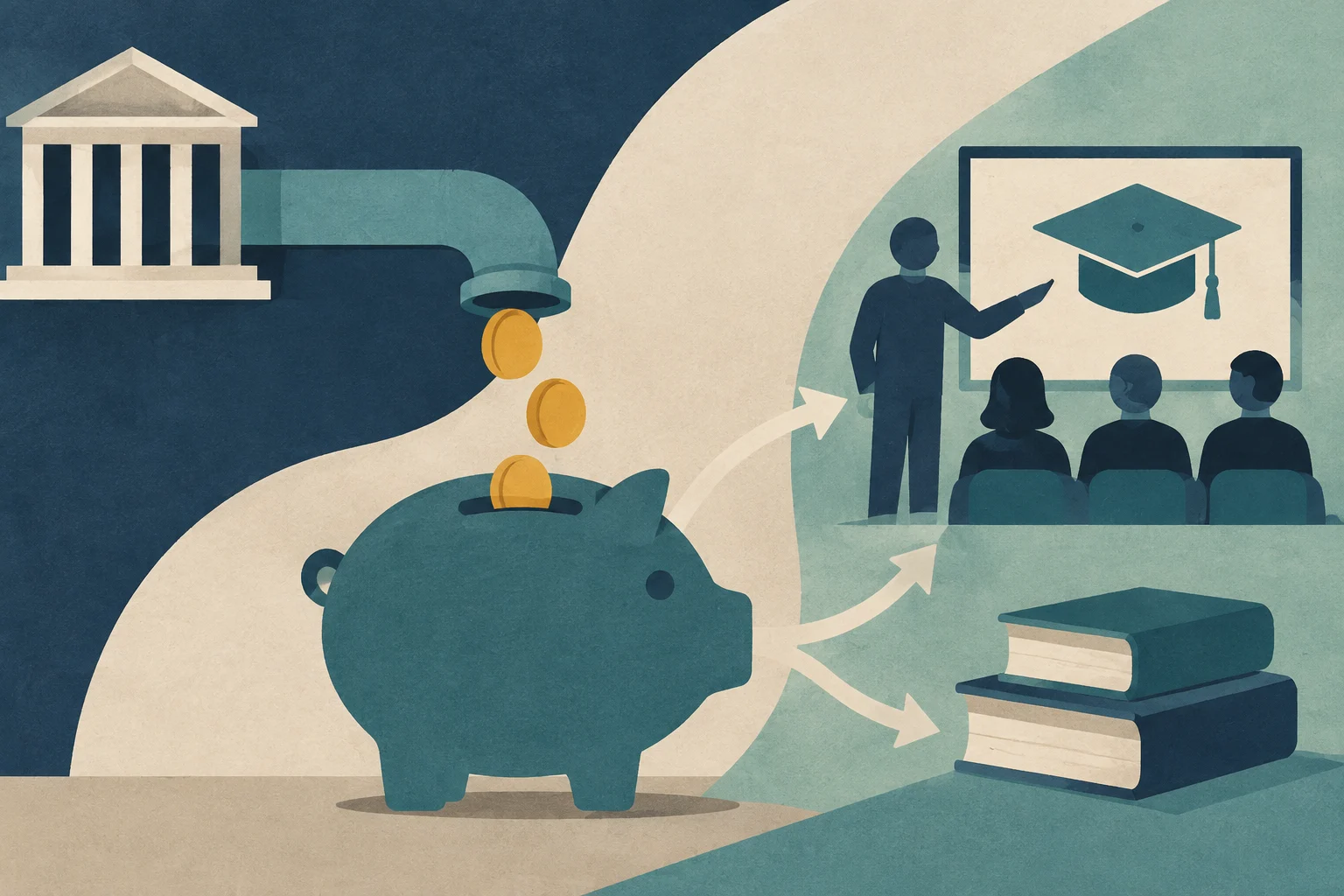
One of the great advantages for companies in Spain is the possibility of subsidizing part of the investment in training through the State Foundation for Training in Employment (FUNDAE), formerly the Tripartite Foundation.
How the FUNDAE Bonus Works
Source of funds: It is retained monthly from the Social Security contribution for vocational training.
Use: It allows covering part of the cost of training actions, both internal and external.
Requirements: It is necessary to complete official documents specifying the number of hours inside and outside working hours. Each training action must have a specific code for the management of the subsidy.
Registration: For e-learning training, it is recommended to use software that records the time dedicated by each worker, facilitating justification before FUNDAE.
Phase 4: Execution and Participation
Implementation is the phase where the plan is put into action. Communication and commitment are key to ensuring participation.
Strategies to Foster Participation
Involve leaders: Management support encourages team participation.
Flexibility: Adapt training schedules to facilitate access and compatibility with personal life.
Reinforce the purpose: Clearly communicate how training will benefit individual professional development and company success.
Consensus with representatives: If there are employee representatives, it is important to agree on the plan with them to guarantee their acceptance and support.
Selection of Trainers
Internal trainers: Ideal for internal procedures, company culture, and technical skills already mastered by experienced employees.
External trainers: Necessary for cutting-edge skills, innovative digital tools, or topics completely new to the organization.
Phase 5: Evaluation and Impact Measurement
Measuring results is key to understanding whether the investment in training is generating the expected impact. Evaluation must be continuous and multidimensional.
Key Performance Indicators (KPI)
Performance and productivity: Does the team apply the acquired knowledge? This can be measured by the reduction of errors, increase in sales, or improvement in service quality.
Talent retention: Training increases job satisfaction and is one of the most valued benefits. A clear career plan helps reduce turnover and improves the employer brand.
Return on Investment (ROI): Check if training has contributed to improving processes, reducing costs, or increasing quality.
Team satisfaction: Conduct surveys to know the team's perception of the training and its relevance.
Conclusion
Designing a continuous training plan in an SME requires a structured approach that starts from the business strategy, goes through a rigorous diagnosis of competencies, and culminates in a flexible and measurable execution. Taking advantage of tools such as the FUNDAE bonus and LMS platforms allows optimizing the budget and ensuring regulatory compliance. Ultimately, training not only develops competencies but also reinforces workforce commitment, reduces turnover, and positions the company as a place of professional growth, ensuring its long-term competitiveness.
A guide to interpreting latency, errors, CPU, memory, saturation, throughput, and availability, and relating those signals to capacity, scaling, and service commitments.
A step-by-step procedure for SMEs to identify applicable legislation, distinguish harmonized standards, and manage conformity assessment, technical documentation, and CE marking before marketing in the European Union.
Clear definitions of the AfCFTA, Regional Economic Communities, and rules of origin to help SMEs interpret the regulatory framework and plan their entry into the African market.