Brent crude nears $117 per barrel
The price of Brent crude stood at $116.90 per barrel on October 23, 2026, a level not reached since April 30. During the session, the European benchmark crude rose by more than 3.3%, while the West Texas Intermediate (WTI), the US benchmark, marked $103 with an intraday increase of 3.5%.
This movement places the oil market in a zone of high volatility, driven by the escalation of geopolitical tensions in the Middle East and uncertainty about the future of the conflict between the United States and Iran.
Houthi attacks on Saudi infrastructure
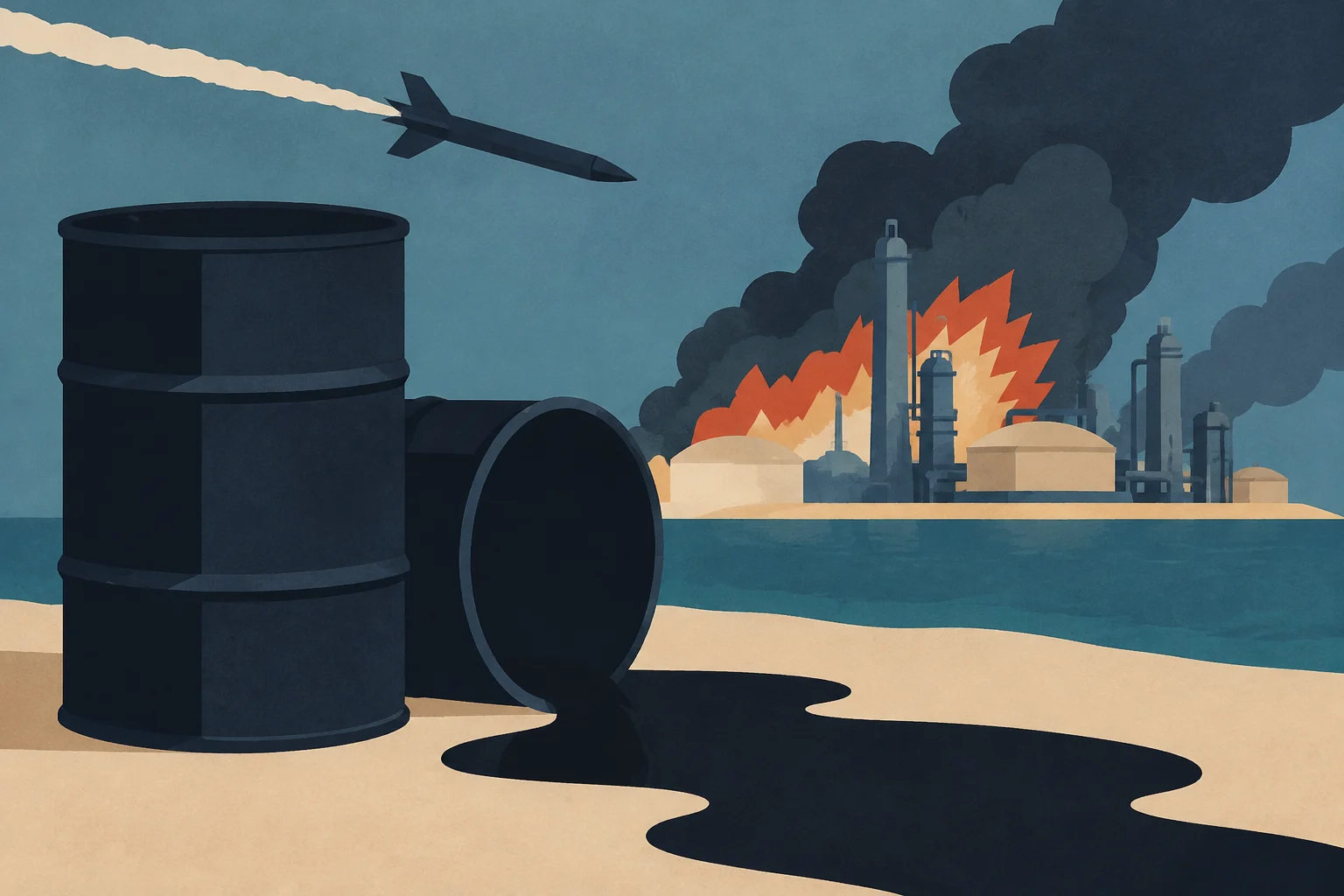
The triggering factor for this latest surge has been the confirmation by the Yemeni Houthi rebels of a series of attacks on strategic targets in Saudi Arabia. According to the Houthi forces spokesperson, Yahya Saree, four "high-level" military operations were carried out in the last 48 hours, employing ballistic missiles and drones.
Among the targets hit are:
- The headquarters of the Saudi Ministry of Defense in Riyadh.
- Dammam International Airport, which caused the interruption of air traffic.
- Abha International Airport.
- A refinery in Yanbu, one of the country's main oil facilities, located on the shores of the Red Sea. Saree indicated that the impact was direct and caused a fire at the target site.
These attacks are part of the Houthis' response to the international coalition's support for the military operations of the internationally recognized Government of Yemen, which announced a large-scale offensive in early October to recover territories captured by the rebels.
Uncertainty over new strikes on Iran
In addition to the Houthi offensive, markets are reacting to fears of a new direct escalation between the United States and Iran. Various reports point to US President Donald Trump weighing new attacks on the Asian country, while reinforcing his military presence in the region with the arrival of a new aircraft carrier.
The US Army has assured that the blockade imposed on Iranian ports a hundred days ago has prevented the country from exporting oil worth "at least $25 billion" (approximately 22.12 billion euros), limiting the capacity of the Revolutionary Guard to "finance terrorism".
However, the Strait of Hormuz, an essential route for oil transport, continues with moderate ship traffic. Trump dismissed any type of negotiation with Iran at this moment on Thursday, warning that "something" will happen "relatively soon" in relation to the conflict. He also accused Iran of raising the price of oil as an electoral tool against his Republican party ahead of the legislative elections on November 3.
Impact on markets and outlook
Uncertainty about the future of the Iran war looms over markets on the eve of the midterm elections in the United States, scheduled for November 3, a date the president has marked as key for making decisions about the conflict. In fact, he has promised not to attack the Asian country at least until after the elections.
"This surge is due less to current fundamentals than to growing supply concerns. Markets are increasingly anxious about a new escalation in the Persian Gulf, a scenario that could threaten oil flows, which have remained notably stable so far," stated analysts at ING Think, Warren Patterson and Ewa Manthey.
Analysts indicate that the situation "does not offer an optimistic outlook". Consequently, their expectation that Brent would average $80 per barrel during the fourth quarter of 2026 seems unattainable. Even if tensions do not intensify, the mere possibility will likely maintain a considerable geopolitical risk premium in prices.
Stock market reaction
Despite the rise in crude, stock markets have not responded with significant drops. The Euro Stoxx 50 registered a gain of 0.70%, while the New York Stock Exchange opened with gains in its three main indices: the Dow Jones rose 1.17%, the S&P 500 1.15%, and the Nasdaq 0.40%.