What changes under federal law
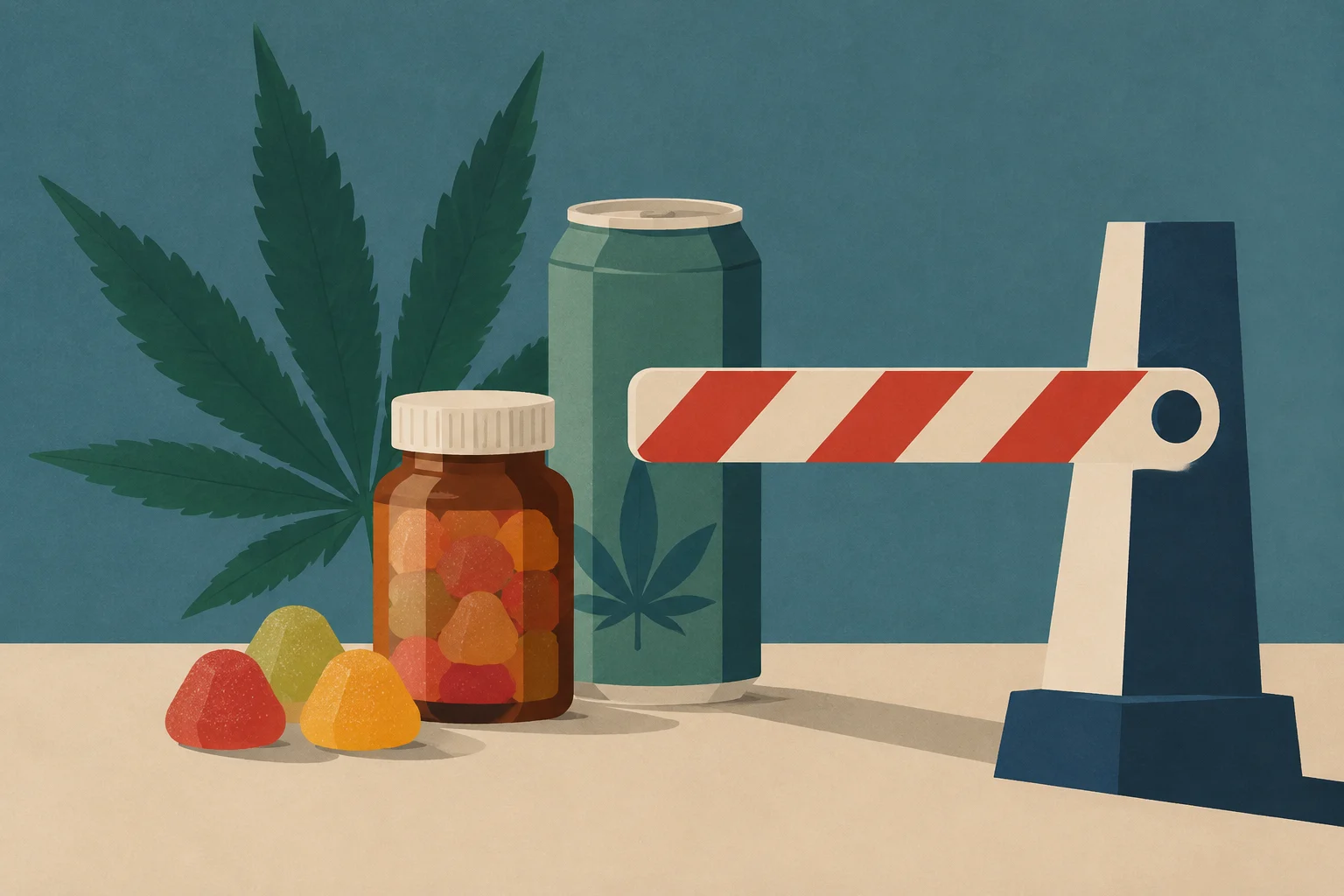
A federal spending law passed by the United States Congress and signed by President Donald Trump changes the rules for hemp-derived products. When the provision takes effect on December 11, 2026, hemp products may not contain more than 0.4 milligrams of total THC per package. The limit is lower than the amount commonly found in many edible products and would, in practice, push many gummies, beverages, and other intoxicating products off the market.
The legislation also provides for earlier restrictions on certain synthetic cannabinoids, including delta-8 THC. Sources describe a phased implementation: that first part was scheduled for November 12, 2026, followed by the general THC limit in December. The law establishes a period before enforcement begins, but it does not, by itself, provide a comprehensive regulatory framework for these products.
The legal gap that opened the market
The measure seeks to close a gap associated with the 2018 Farm Bill. That law defined hemp using a limit of less than 0.3% delta-9 THC by weight. This definition allowed some products to meet the legal criterion while still containing amounts of THC capable of producing intoxicating effects. The spread of hemp-derived products in convenience stores, gas stations, and other retailers prompted different regulatory responses across states.
Hemp and marijuana belong to the same plant species, but they have been distinguished legally, among other criteria, by their THC content and uses. In this context, intoxicating products made from hemp have been available in places where recreational marijuana is not authorized or is subject to different state controls. The new federal provision changes that landscape for products exceeding the per-package limit.
Economic impact and pressure to regulate
The economic stakes are considerable, although estimates vary by source and by the scope of the market being measured. Whitney Economics estimates that the prohibition could reduce retail revenue by $28.3 billion, displace 225,000 jobs, and cut states’ potential sales-tax revenue by $2.1 billion. Bloomberg Línea cites an estimate of at least $28 billion and more than 300,000 jobs at risk. These are impact estimates, not losses that have already occurred.
Companies and industry organizations are pressing Congress to replace the prohibition with rules that allow sales to adults and establish age checks, laboratory testing, dosage limits, and labeling and packaging requirements. The disagreement is whether the 0.4-milligram limit offers a regulated path for THC products or, because it is so low, amounts to removing most of them from the market.
The effects could also extend to full-spectrum CBD products, which retain trace amounts of THC. Jonathan Miller, legal counsel to the U.S. Hemp Roundtable, warned that the threshold could affect even some non-intoxicating CBD products, such as topical lotions. The actual scope will depend on how the rule is applied to each product and on its characteristics; available sources do not detail all the technical compliance criteria.
Implications for Latin American suppliers
The U.S. market matters to foreign companies that sell hemp ingredients, extracts, and finished products. Pablo Fazio, an analyst and consultant on the cannabis industry and regulatory policy in Latin America, told Bloomberg Línea that the measure could create uncertainty for producers in countries such as Colombia, Argentina, Uruguay, Paraguay, Chile, and Brazil.
According to Fazio, a potential contraction in U.S. demand could put pressure on prices and affect investment decisions. However, the sources do not provide enough data to quantify the impact on Latin American exports: coverage notes that clear figures on these trade flows are lacking. The regional impact is therefore an expectation held by analysts and companies, not an economic outcome that has already been measured.
What comes next in the debate
The December provision is part of a broader political negotiation. The industry is seeking for Congress to adopt separate rules for intoxicating products and CBD derivatives, while supporters of closing the legal gap argue that the previous market lacked sufficient safeguards, particularly to protect minors. The scheduled effective date leaves companies facing a transition period, but sources do not confirm that an alternative regulatory framework will be adopted before then.
For affected companies, whether the outcome is an effective prohibition or a regulated sales system will depend on legislative changes and on how the rule is implemented in practice. Until those decisions are known, figures on jobs, sales, and effects on foreign trade should be understood as estimates or projected risks, not definitive consequences.