Growth does not match households’ experience
The U.S. economy presents an apparent political contradiction: GDP grew close to 4% in the third quarter of 2025, but President Donald Trump’s approval rating fell to its lowest level since his return to the White House. In an NBC poll cited by El País, 63% disapproved of his performance, and nearly two-thirds thought the country was heading in the wrong direction.
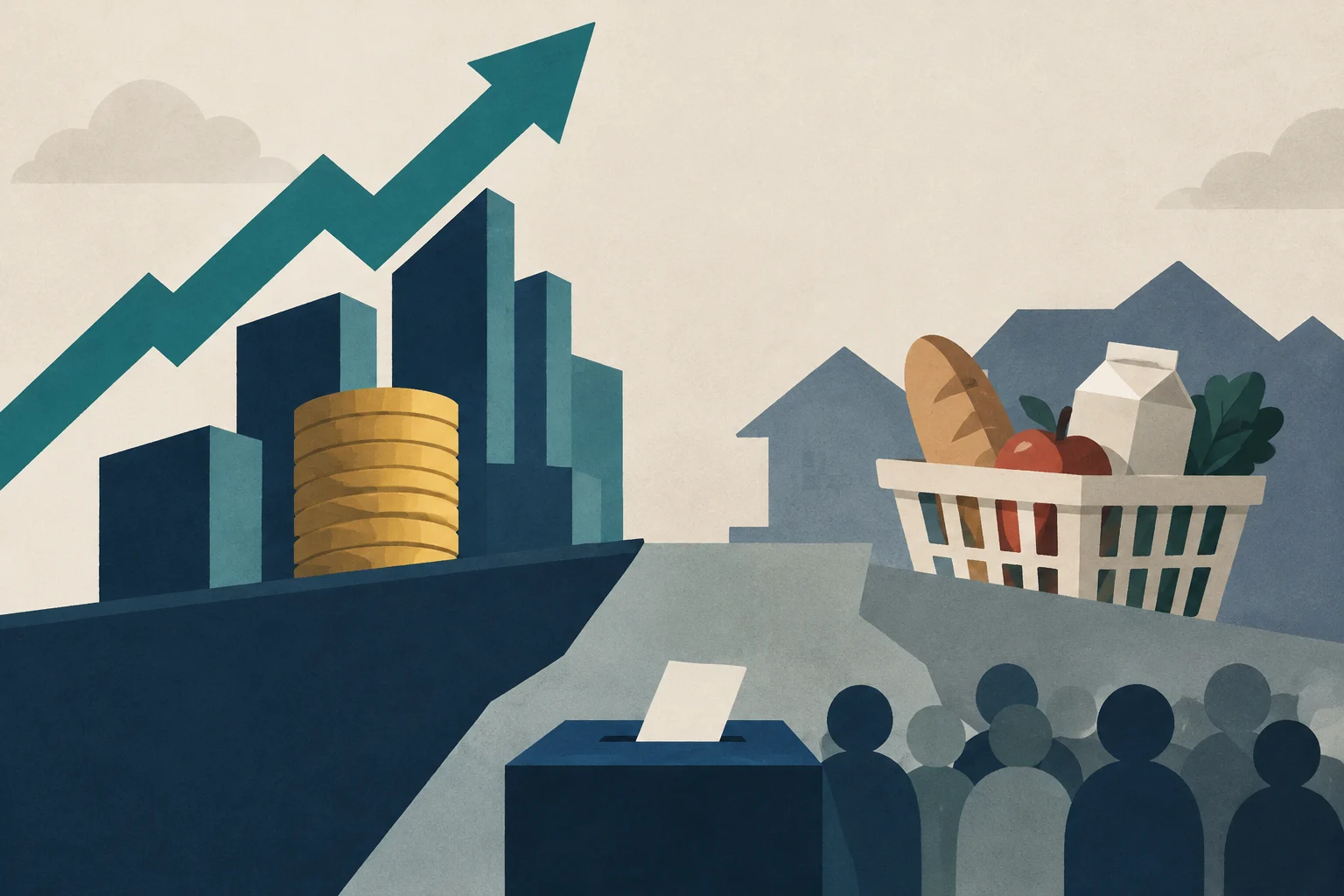
The gap lies between aggregate growth and what families feel in their budgets. The economy can expand without households perceiving a comparable improvement if essential prices remain high, wages lose purchasing power, or gains are concentrated among those who already have more resources.
The cost of living pushes other issues aside
The economy once again ranked as voters’ top concern, particularly inflation and affordability. In the NBC poll, only 32% approved of Trump’s handling of the economy, compared with 68% who disapproved. In addition, 40% said their financial situation was worse than a year earlier, while 19% said it had improved.
The pressure is especially evident in housing and energy. According to an analysis by Ruchir Sharma published by Gestión, mortgage rates had exceeded 7%, and rising energy costs were linked both to the war with Iran and to increased electricity demand from artificial intelligence data centers. The same article noted that gasoline prices had risen by more than 40% over the previous year. These are different factors, but both can affect everyday expenses and reinforce the perception that the economic boom is not benefiting everyone equally.
The war also shapes how voters view the economy. El País reported that nearly two-thirds of respondents considered gasoline prices a problem for their families. In that poll, a majority opposed further military action in Iran. The conflict therefore affects not only energy costs: it also clashes with Trump’s campaign promise to keep the United States out of international conflicts.
Artificial intelligence drives investment but raises concerns
Investment in artificial intelligence (AI) contributes to growth, but its benefits and costs are unevenly distributed. Sharma argues that the boom mainly benefits affluent consumers and technology companies, while many households do not own the shares capturing much of those gains. He also notes concerns about AI’s impact on employment and the perception that data centers are driving up electricity bills.
That combination helps explain why an indicator such as GDP is not enough to predict voters’ mood. An economy can produce more and attract large investments, but if people do not see progress in their real wages, housing costs, or job security, growth is unlikely to translate automatically into political support. The opposition to AI described by Sharma is a social perception, not proof that the technology alone has caused economic discontent.
What the polls show—and what they cannot establish
The figures cited come from different polls and measure different things: presidential approval, assessments of the economy, and perceptions of personal circumstances. They should not be treated as a single measure or as a direct prediction of the election outcome. The NBC poll mentioned by El País was conducted from March 30 to April 13, 2026, among 32,433 adults; its results describe the opinions of those surveyed during that period.
The legislative election is scheduled for November 2026. Falling popularity may increase pressure on Republicans, but the sources do not support concluding that the party will lose control of Congress. The clearest connection is political: when the official message highlights growth while voters prioritize prices, energy, and housing, the gap between macroeconomic data and everyday life becomes a credibility problem for the government.