Scope Ratings Warns of Peak Credit Pressure from the Diesel Crisis in 2027
Credit rating agency Scope Ratings warns that the financial impact of rising diesel prices will peak in 2027. Refining bottlenecks, exacerbated by geopolitical conflicts, will leave sectors such as transport and airlines exposed as their hedges expire, increasing the risk of defaults among SMEs and distributors.
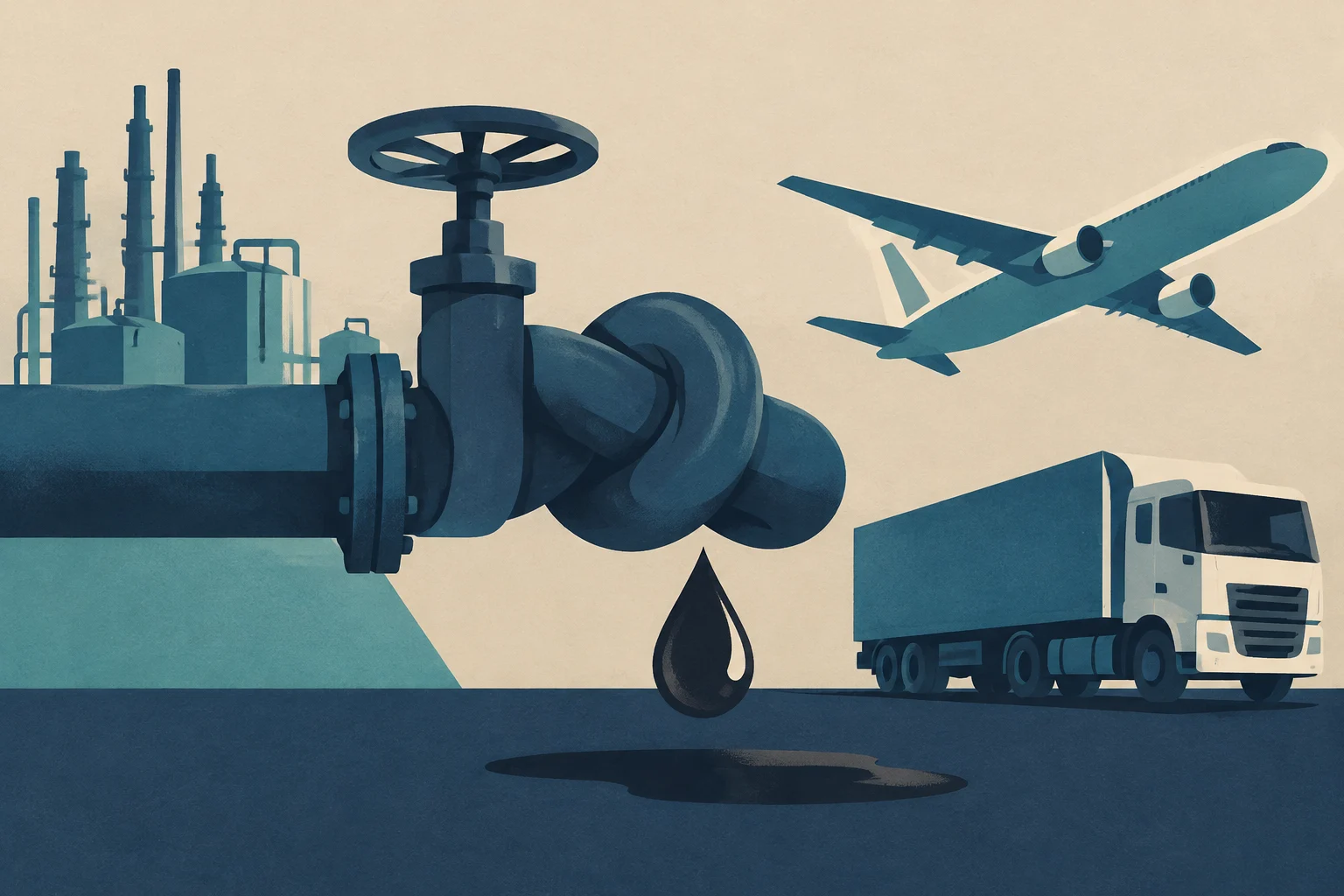
Credit rating agency Scope Ratings has warned about the credit risk facing fuel-consuming companies in Europe. According to a report by Rohit Nair, the firm’s director of corporate ratings, corporate balance sheets will come under the greatest financial pressure in 2027. The forecast is based on the identification of a “bottleneck” in the refining sector, caused not by a shortage of crude oil, but by difficulties processing and distributing it as diesel and kerosene.
The international context is a decisive factor. The war between the United States and Iran and Ukrainian attacks on refining facilities in Russia have sharply reduced global supply. In August, combined net diesel exports from the Persian Gulf and Russia stood 1.6 million barrels per day below the levels recorded in February. Since the two regions accounted for nearly 45% of global seaborne diesel trade before the conflict, recovery will be slow. Scope Ratings estimates that price spreads will remain well above pre-2026 levels well into the following year, even if the Strait of Hormuz reopens.
Vulnerable sectors and expiring hedges
The impact will not be uniform. The sectors most exposed are transport, airlines, agriculture and construction. These industries are vulnerable because their financial hedges are expiring. Many companies enter into such contracts to protect themselves against sharp price increases, but that protection is temporary. Once the contracts expire, companies will have to pay market prices, which are currently at record highs.
The situation is critical for road transport, which carries 95.8% of goods in Spain, according to the Spanish Transport and Logistics Observatory (OTLE). Juan Manuel Martínez, president of the Spanish Transport Association (AET), warns that passing costs on to customers “is neither so easy nor so immediate.” This leaves operators, particularly self-employed drivers and small businesses, with no room to absorb the additional costs. Martínez expects to see “many business closures in the coming months and in 2027.”
Impact on liquidity and the risk of defaults
Pressure on companies is not limited to rising operating costs; it also threatens their liquidity. More expensive fuel increases working-capital needs, as companies must pay more for the same volume of fuel. For independent distributors and undercapitalized retailers, this can lead to defaults. Scope Ratings notes that these businesses could be the first to experience solvency problems in 2027.
There is also an indirect effect on financing conditions. A sustained rise in diesel prices could fuel inflation and lead to increases in interest rates. Combined with greater concern about corporate default risk, this will prompt banks to tighten credit conditions, completing the vicious circle for weaker companies.
In the airline sector, fuel accounts for between 25% and 30% of operating costs. Although some airlines hedge oil prices because they have greater financial liquidity, kerosene is becoming much more expensive than crude. This leaves a significant part of the increase unhedged. Companies without active hedges and with little cash will be particularly vulnerable when they have to renew their contracts at higher prices.
The other side of the crisis: refineries and oil companies
While fuel-consuming companies face credit pressure, refineries and large integrated oil companies such as Repsol, BP and Moeve are seeing stronger cash flows. In August, the spread between the price of diesel and a barrel of Brent averaged $88 per barrel, three times the average of $29 recorded between 2023 and 2025. This indicator reflects the extraordinary increase in the price of refined products relative to crude oil.
However, Scope Ratings cautions that these higher margins will not automatically lead to improved credit ratings for these companies in the short term. Profits depend on operating costs and the activity of their facilities. For the rest of the economy, the signal is clear: the diesel crisis has shifted from a price problem to a supply shock that threatens the continuity of numerous businesses in 2027.
In Burgos, the secretary-general of the PSOE in Castile and León attributed economic growth to the Government’s scope to raise the minimum wage and pensions. He also called for measures on housing and higher wages.
The HKMA spoke with HSBC after the bank announced a Singapore hub expected to hire more than 100 specialists. The discussion reflects competition to attract investment and technology talent, while the bank maintains AI teams and initiatives in Hong Kong.
The defense has appealed to the High Court of Justice of Extremadura against the nine-year disqualification from public employment or office imposed for administrative prevarication. It argues that fundamental rights were violated and that the judgment does not establish Sánchez’s specific involvement.