Airbus completes the unification of its Cádiz plants with a 90 million euro investment
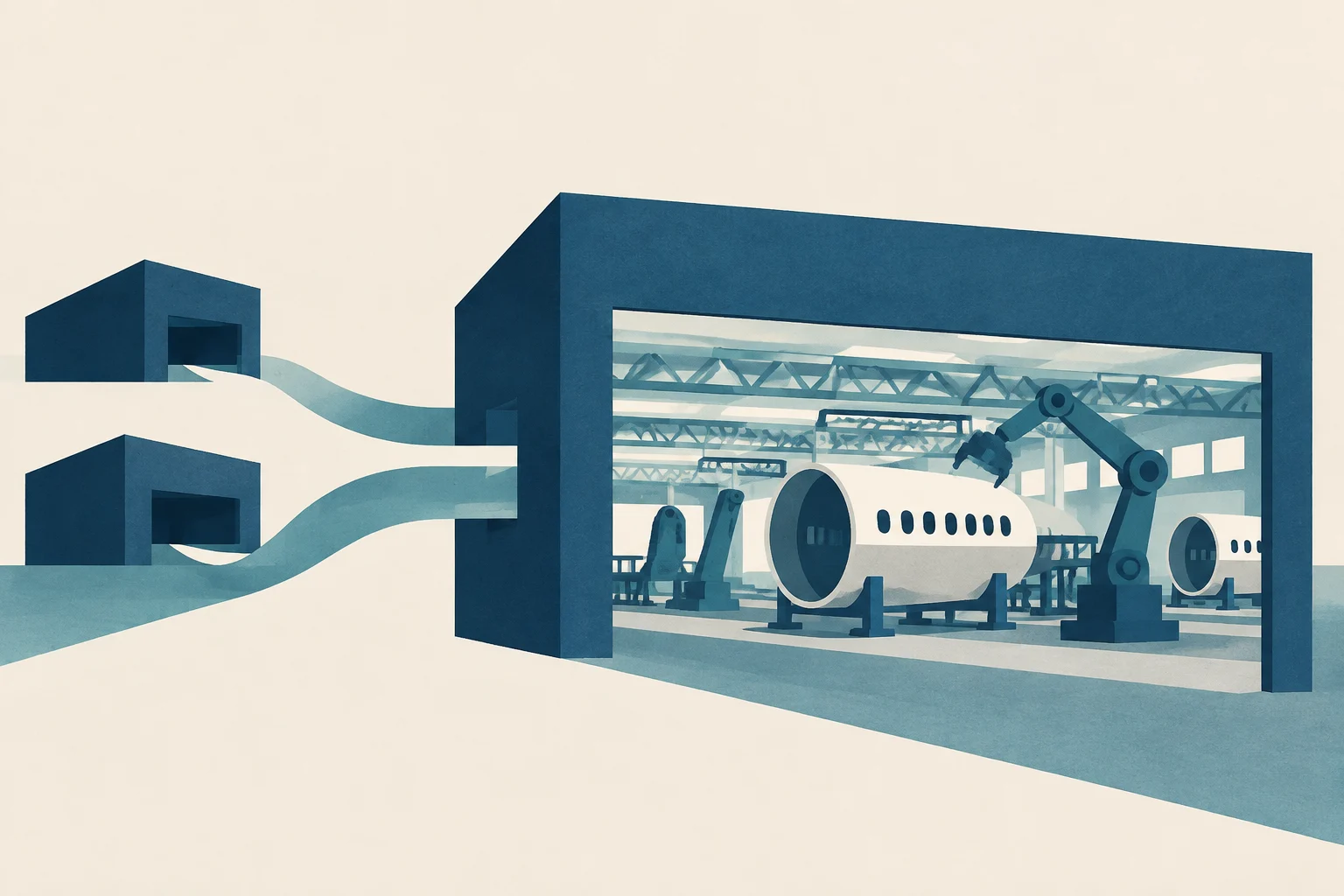
Airbus has finalized the consolidation of its two factories in the Bay of Cádiz into a single center in El Puerto de Santa María. The process, initiated in 2021, involved an investment of 90 million euros, the expansion of 4,000 m², and the robotization of production lines. The new 80,000 m² complex houses 750 direct workers and produces components for the A320, A330, A350, and defense models. The company plans to increase production rates to 75 A320 units per month by the end of 2027.
Airbus has officially presented the unification of its two plants in the Bay of Cádiz (Puerto Real and El Puerto de Santa María) into a single industrial center located in El Puerto de Santa María. The process, initiated in 2021, has involved an investment exceeding 90 million euros, the expansion of 4,000 m² of industrial surface area, and the robotization of production lines. The new complex, covering 80,000 m², concentrates 750 direct workers and produces components for the A320, A330, A350 models and defense programs.
The company plans to increase the production rate to 75 A320 units per month by the end of 2027. The phased transfer has allowed industrial activity to be maintained and guaranteed the industrial use of the land in Puerto Real, which was sold to a Chinese group for wind energy.
A phased consolidation process
The consolidation project was executed in a phased manner to maintain industrial activity during the process. Airbus established different phases to transfer the lines corresponding to the A320, A350, and A330 programs, as well as an in-service support activity related to the 'superjumbo' A380.
The A320 line was the first to complete the transfer. Subsequently, the A350 line was addressed, whose components are among the largest manufactured in the plant. This operation was carried out in two phases: the first ended in early 2025, and the second, after the summer of that year.
The transfer of the A330 required additional planning due to the need to modify the plot layout and build a new building to house the activity. The last transfers of the new plant, the fifth one—dedicated to A330 parts—have been the most prolonged, motivated by the need to process the necessary construction permits.
Editorial illustration · Edition Business
A multiproduct and robotized plant
The merger of plants has turned Airbus Cádiz into a "multiproduct excellence model", as emphasized by Lars Wagner, Chief Executive Officer of Airbus Commercial Aircraft. The commercial and defense divisions coexist in the same factory and "mutually benefit from their technologies".
In addition to the production of Commercial Aircraft parts for the A320, A330, and A350, the Defence and Space division does the same for military aircraft A400M, A295, MRTT, and Eurofighter, as well as the Eurodrone.
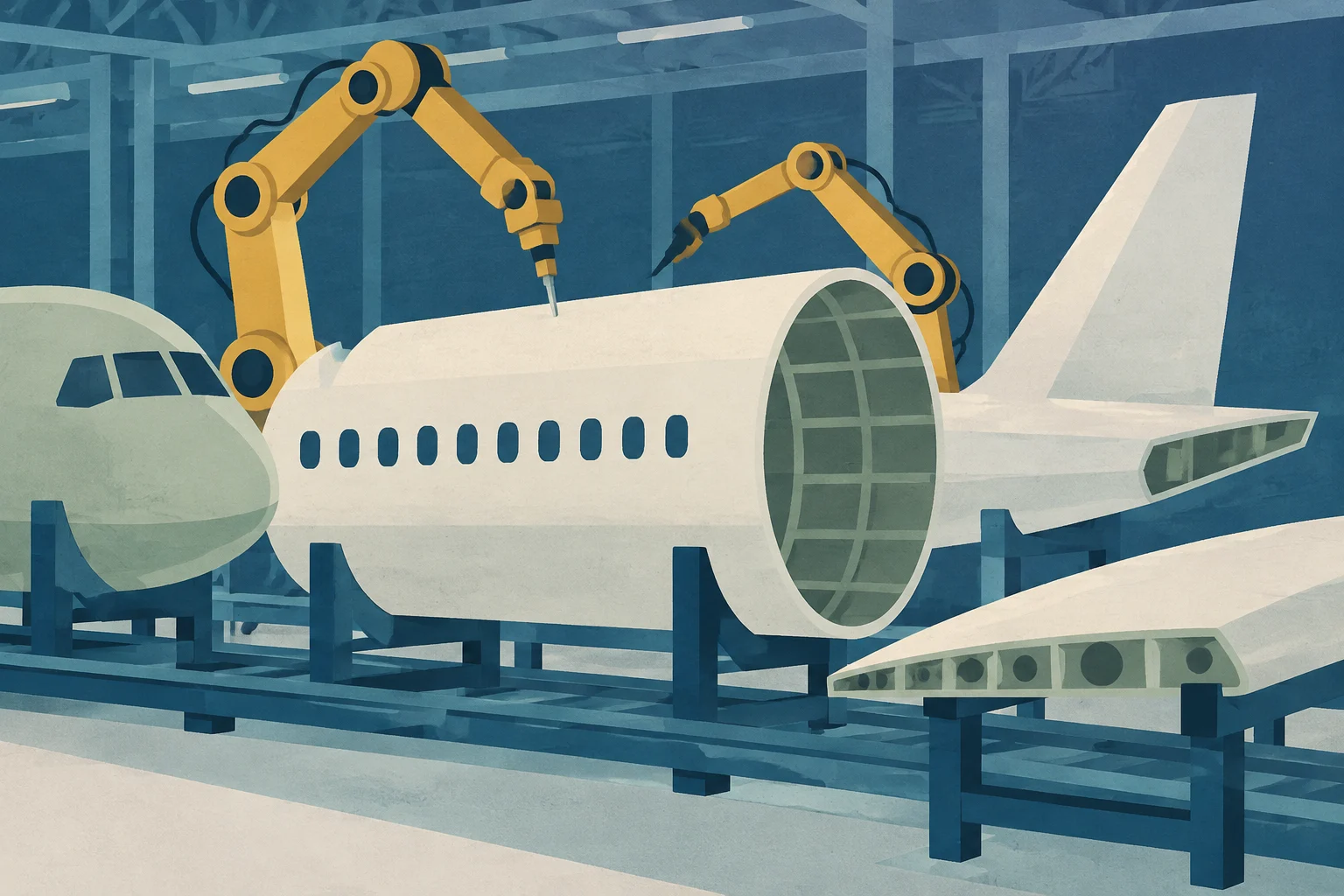
To achieve this, the company has "increased robotization and automation to make the plant more competitive," as pointed out by Ricardo Rojas, President of Commercial Aircraft at Airbus Spain. The new plant in El Puerto, which concentrates the merger, allows the Cádiz aeronautical industry to gain weight and, above all, represents a new technological milestone for Airbus.
Impact on employment and the local economy
The transfer of the last workers from Puerto Real was completed last July with the construction of a new hangar, number five. Since then, the 750 workers who made up both plants have coexisted in the El Puerto de Santa María facilities to produce parts for three aircraft lines—the A320, A330, and A350—from its commercial division, in addition to the defense line, which already existed in the El Puerto hangars.
Of the 750 direct workers the unified factory now has, almost half come from the Puerto Real plant. Both their jobs and the machinery have found a place in four of the five hangars the center now has.
The impact of Airbus's work in Cádiz is 4,000 people as an indirect workforce through subcontractors. The company has also worked to maintain the industrial use of the facilities it owned in Puerto Real. These facilities are currently home to another company that will develop its activity there. It is the Chinese group Zhenshi, which manufactures fiberglass for its application in aeronautical blades and the naval industry, among other destinations.
Future production goals
After the unification and the expansion of its manufacturing capabilities, the company plans to raise the production rate of the Cádiz plant to supply components for 75 A320 aircraft per month by the end of 2027, 12 A350 per month in 2028, and five A330 per month in 2029, as specified by Iván Martínez, Director of the Cádiz plant, in a press conference prior to the institutional event.
This higher production ratio is viable after Airbus has increased the plant's industrial surface area by 4,000 square meters, in addition to the acquisition of additional land of 2,800 square meters for logistics use. Now, the center, which has also expanded office areas and built a multifunctional building of 450 square meters, counts with 80,000 square meters in total.
A recent labor conflict
The high-profile announcement comes just days after the closure of a labor conflict that lasted up to three months, with two strikes and several interruptions in between, since July 1. The second round of indefinite strikes began on August 25 and ended suspended from September 9, after a little more than two weeks of mobilizations.
In Cádiz, 94.3% of the workers who participated in the consultation supported that suspension. The conflict is so recent that the definitive cancellation was officially communicated this same week, on October 5, after the entire Spanish workforce approved the agreement in a referendum with 76.76% of favorable votes.
Workers demanded to recover purchasing power lost since the pandemic and to guarantee the maintenance of teleworking up to 40% of the working day in compatible positions. The agreement, reached with the mediation of the Ministry of Industry, provides for salary increases equivalent to real CPI plus two percentage points annually between 2026 and 2028 and another 1.95 points in 2029: an additional recovery of 7.95% distributed over four years. It also includes an extraordinary bonus of 2,000 euros gross for the delay in applying the CPI, preserves remote work agreements, and expands flexibility to choose holidays.
In Burgos, the secretary-general of the PSOE in Castile and León attributed economic growth to the Government’s scope to raise the minimum wage and pensions. He also called for measures on housing and higher wages.
The HKMA spoke with HSBC after the bank announced a Singapore hub expected to hire more than 100 specialists. The discussion reflects competition to attract investment and technology talent, while the bank maintains AI teams and initiatives in Hong Kong.
The defense has appealed to the High Court of Justice of Extremadura against the nine-year disqualification from public employment or office imposed for administrative prevarication. It argues that fundamental rights were violated and that the judgment does not establish Sánchez’s specific involvement.