Guide to A3 Mercados: Understanding Agricultural Futures and Options in Argentina
A3 Mercados integrates the history of MATba, ROFEX, and MAE to offer a unified derivatives platform. This guide explains the mechanics of futures and options, their use in price hedging, and the operational risks that every producer must evaluate before trading.
The Argentine capital market is undergoing a stage of historical consolidation. The recent integration of MATba, ROFEX, and MAE under the name A3 Mercados marks the conclusion of a process that began with operational interconnection in 2017 and culminated in the merger of the entities in 2025. For the agricultural sector, this change is not just an administrative adjustment: it represents the unification of the infrastructure where futures and options on agricultural and financial commodities are traded.
Understanding how this new platform works is essential for producers seeking to manage the price risk of their crops. Below, the institutional evolution, the mechanics of derivative instruments, and practical considerations for their use are detailed.
Institutional convergence: from interconnection to A3 Mercados
The history of futures markets in Argentina dates back to the early 20th century. According to documentation from the Rosario Stock Exchange (BCR), MATba was founded in 1907 and ROFEX in 1909. For decades, they operated as separate entities, although with strong complementarity: MATba positioned itself as the leader in agricultural commodity futures, while ROFEX specialized in financial products.
The first step toward unification was taken on January 4, 2017, when both markets signed an interconnection agreement. This agreement allowed agents and clients to access a single platform to trade, clear, and settle all listed products. The Santa Fe Stock Exchange (BCSF) highlights that this integration aimed to align with international standards and with the Capital Markets Law No. 26.831, which promotes a federally integrated market.
In 2025, this process evolved into a total merger. A3 Mercados emerges as the successor entity to MATba Rofex S.A., also integrating MAE (Mercado Abierto Electrónico), established in 1989 as a fixed-income platform. The headquarters of the new entity is located in Rosario and has a team of more than 590 people. According to Andrés Ponte, Vice President of A3 Mercados, the mission is "to bring the capital market to people so they can improve their savings and investment profile," covering cash products, derivatives, and OTC (Over The Counter) operations.
Derivatives mechanics: futures and options
For the producer, derivatives are risk management tools, not necessarily speculation instruments. It is fundamental to distinguish between the two main types of contracts available on A3 Mercados:
The futures contract
A future is a standardized agreement to buy or sell an asset (such as soybeans, corn, or wheat) at a determined price on a future date.
Standardization: The contract size, product quality, and expiration date are fixed and defined by the exchange.
Margins: To trade, the investor must establish an initial margin. As the market price varies, daily adjustments (mark-to-market) are made, which may require additional deposits or release funds.
Settlement: Contrary to popular belief, not all futures end with the physical delivery of the grain. Most contracts are settled financially through the compensation of the difference between the closing price and the market price at expiration. Physical delivery is an option, but not the general norm for all participants.
The options contract
An option grants the right, but not the obligation, to buy (call) or sell (put) an asset at a predetermined exercise price before an expiration date.
Premium: The buyer of the option pays a premium to the seller. This premium is the maximum cost that the buyer can lose if they decide not to exercise the right.
Flexibility: Unlike a future, the buyer of an option can benefit from favorable price movements without being obligated to close the position if the market moves against them, limiting their loss to the premium paid.
Editorial illustration · Edition Business
Price hedging vs. Speculation
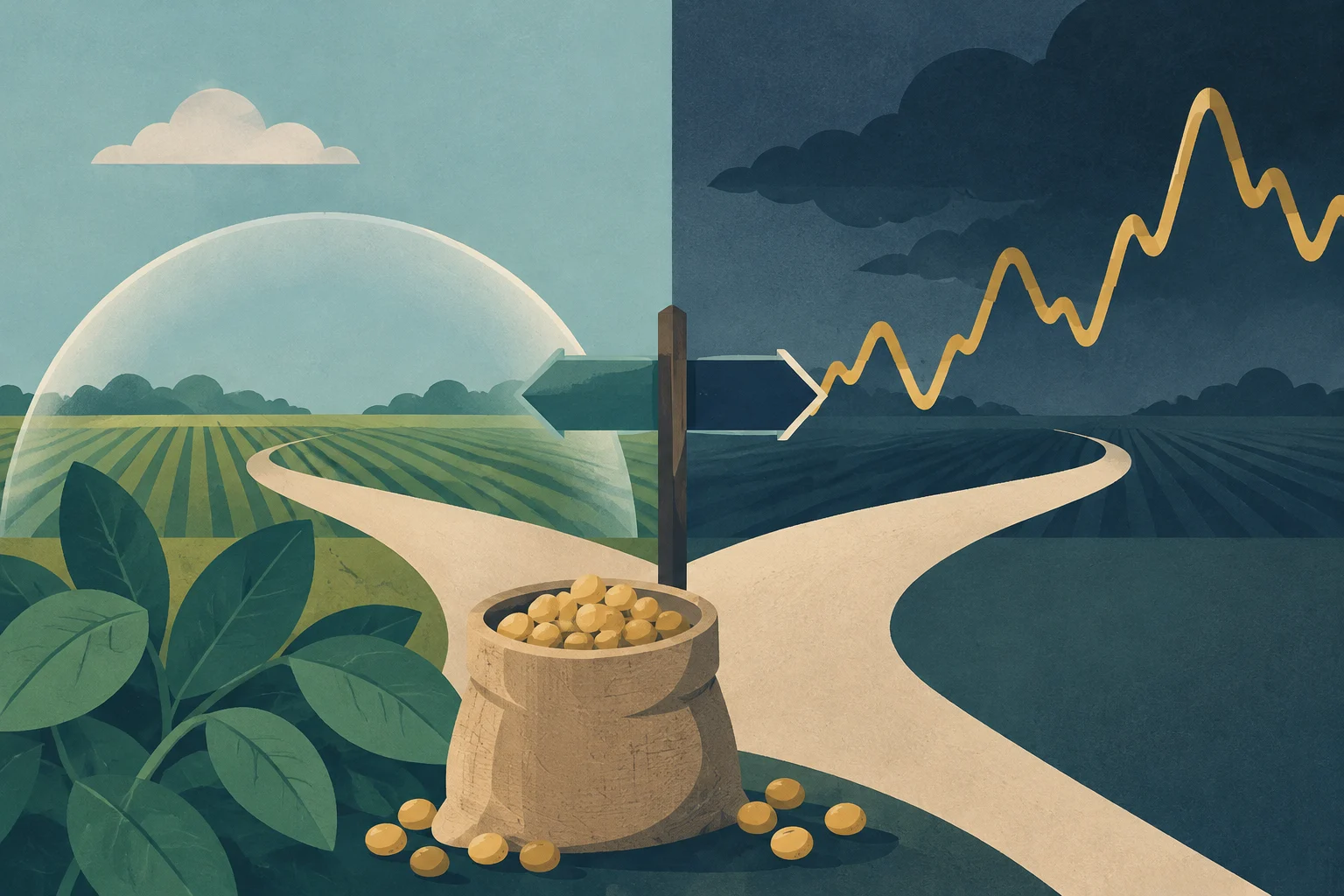
The main use of these instruments for the agricultural sector is price hedging. The objective is to fix a selling price for the future harvest, protecting the profitability margin against sharp drops in the market.
Speculation, on the contrary, seeks to obtain gains from the direction of the price by assuming the risk. While hedging reduces income volatility, speculation increases it. It is crucial that the producer defines their objective before trading.
Operational risks and practical considerations
Trading on A3 Mercados involves assuming specific risks that must be thoroughly understood:
Basis risk: It is the difference between the futures contract price and the local spot price of the producer. If this gap widens, the hedge may not be effective for the actual selling price at the farm.
Liquidity: Not all expirations have the same market depth. Trading in expirations with low open interest may imply higher transaction costs or difficulty in closing positions.
Need for funds: The daily adjustments of futures may require additional capital injections (variation margin) if the market moves against the position. Poor liquidity management can lead to the forced liquidation of the position.
Complexity of options: The value of an option depends on multiple factors (time, volatility, asset price). Inadequate management can result in losses greater than the initial premium if acting as an option seller without adequate coverage.
Frequently asked questions
Is A3 Mercados the same as MATba or ROFEX?
A3 Mercados is the entity resulting from the merger of MATba, ROFEX, and MAE. Although historical brands may continue to be recognized, the trading, clearing, and settlement infrastructure is now unique and centralized under A3 Mercados.
Can I trade agricultural futures without having the grain at that moment?
Yes. Futures contracts are financial and do not require physical possession of the asset at the time of negotiation. However, if physical delivery at expiration is chosen, the quality and logistics requirements established in the contract must be met.
What happens if I cannot cover the variation margin?
If the account balance is not enough to cover negative daily adjustments, the stock exchange agent will notify the client. If the balance is not regularized within the established period, the position may be forcibly liquidated by the market, generating a realized loss.
Where can I check quotes?
A3 Mercados offers a real-time price viewer on its digital platform, where agricultural and financial futures can be followed, including volume, last price, adjustment, and open interest.
Learn how to consult and distinguish the daily references from the CBRT: calculation method, schedules, differences between currencies and banknotes, and the non-binding scope of these figures for companies and individuals.
A useful estimate goes beyond salary: it includes employer contributions and other labor costs, distinguishes patient-care hours from non-patient-care hours, and compares the budget with actual recorded time.
A practical guide to identifying exposures in USD, CAD, and MXN, organizing cash flows, and deciding when hedging foreign exchange risk may make sense.