Essential AI Glossary for Executives: From LLMs to Agentic AI
A practical map to unify technical and business language. Understand key terms like LLM, Agentic AI, and bias to evaluate providers, manage risks, and clearly communicate the capabilities and limits of artificial intelligence in your company.
Artificial intelligence has ceased to be an abstract concept and has become an operational variable in the daily management of companies. However, the adoption of these technologies faces a linguistic barrier: technical jargon is often confused, used interchangeably, or employed for unclear commercial purposes. For the management teams of SMEs, the objective is not to master software engineering, but to understand the real scope of the tools, critically evaluate providers, and communicate expectations in a realistic manner.
This glossary organizes the fundamental concepts into four logical blocks: basic concepts, technical terms, risks and governance, and strategic applications. Each definition is accompanied by its direct implication for business decision-making.
Fundamental concepts: the foundation of the architecture
Artificial Intelligence (AI)
AI is the discipline that develops systems capable of performing tasks that traditionally require human intelligence, such as understanding language, recognizing patterns, or making decisions. In the business environment, AI is not a single technology, but a set of techniques applied to specific problems.
Machine Learning
Machine Learning (ML) is a subfield of AI where systems learn from data without being explicitly programmed for each rule. Instead of defining rigid logics ("if the customer has not bought for 60 days, they are inactive"), the system analyzes historical data and discovers the patterns on its own.
Business example: An ML model that predicts the risk of subscription cancellation by analyzing user behavior, without anyone having indicated which specific signals to look for. This allows for proactive management of customer retention.
Deep Learning
Deep Learning is an advanced ML technique that uses neural networks with multiple layers to learn complex representations of data. It is the technology behind the most notable advances in image recognition, machine translation, and content generation.
Operational implication: When a provider mentions Deep Learning, it generally implies that the project will require more data, greater computing capacity, and more training time than traditional ML. In return, it can solve problems of greater complexity, such as the analysis of unstructured documents or computer vision.
Editorial illustration · Edition Business
Technical terms that define current capabilities
LLM (Large Language Models)
LLMs or Large Language Models are Deep Learning models trained with enormous volumes of text to understand and generate natural language. Tools like ChatGPT, Claude, or Gemini are examples of this category.
What an executive should know is that not all LLMs are the same. They differ in quality, cost, privacy, and, crucially, in their performance with the Spanish language. The choice of model directly impacts the accuracy of the responses and the infrastructure costs.
Generative AI
Generative AI is distinguished from predictive AI (which analyzes existing data) by its ability to create new content: text, images, code, audio, or video.
Practical application: Generating drafts of marketing campaigns, creating images for the web, or automating the writing of initial reports. Its value lies in the acceleration of content production, although it always requires human review to guarantee quality and truthfulness.
Agentic AI
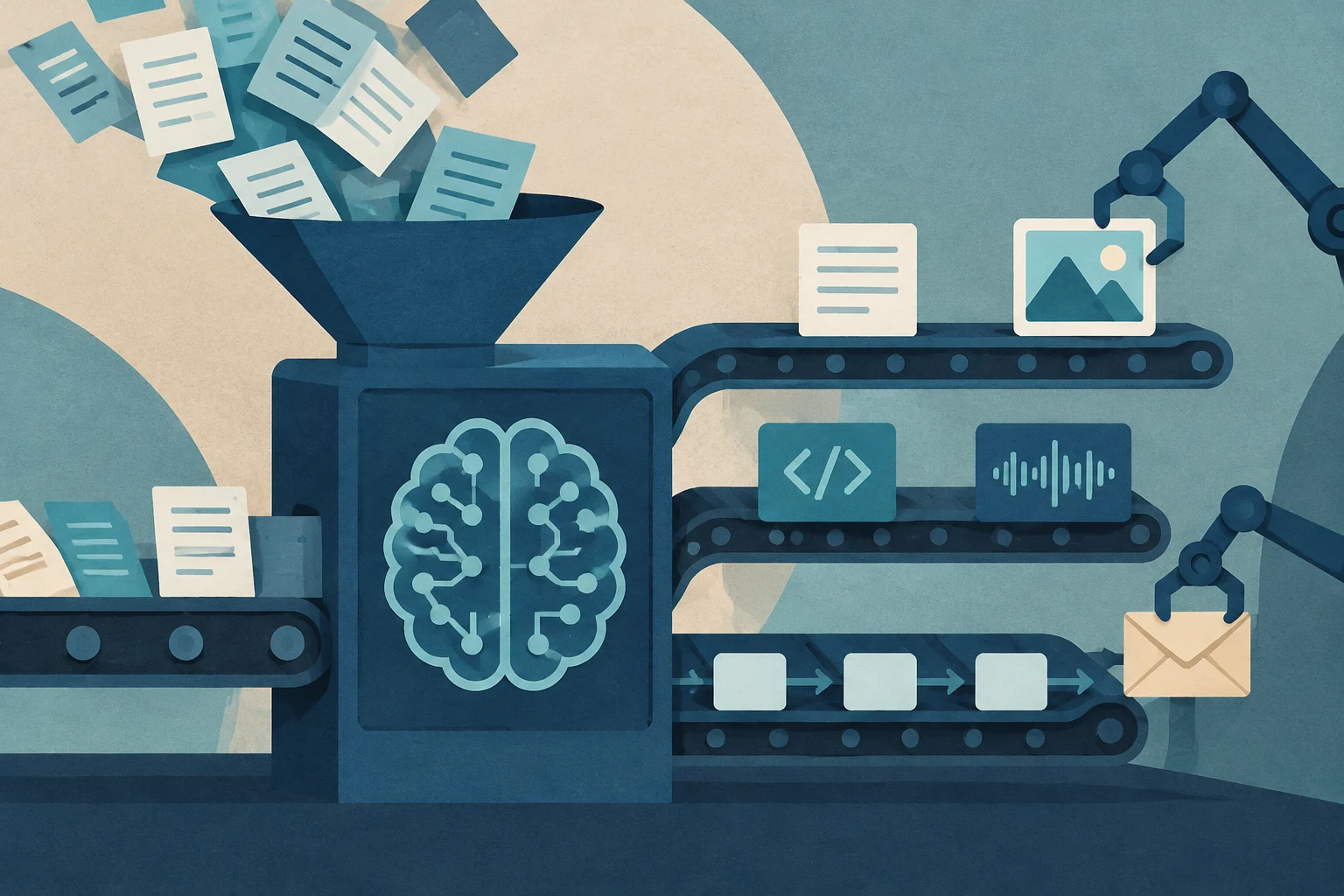
Agentic AI represents the step beyond the chatbot. These systems do not only answer questions, but execute complex tasks autonomously. They plan steps, make intermediate decisions, use external tools (such as searching the web or sending emails), and adapt if something fails.
Example: An AI agent receives the instruction "prepare a competitive report on sector X." Autonomously, it searches for updated information, analyzes the data, writes the report, and sends it by email. This changes the paradigm of automation: from automating steps to automating complete workflows.
API (Application Programming Interface)
An API is a set of rules that allows communication between two software applications. In the context of AI, APIs are the mechanism that allows integrating AI models into the company's existing tools (CRM, ERP, document management systems) without the need to rewrite all the software.
Risks, limits, and governance
Hallucination
Hallucination is one of the most critical risks of generative AI. It occurs when the system generates incorrect, invented, or non-existent information, but presents it with the same confidence as a truthful data point.
Risk management: In sensitive contexts (health, legal, financial), hallucination can have serious consequences. The strategy must always include a layer of human verification or information retrieval systems (RAG) that anchor the responses in verified internal documents.
Bias
Bias occurs when a system produces unfair or unbalanced results because it has been trained with incomplete, unbalanced, or unrepresentative data regarding the reality of the company.
Ethical and legal implication: If an AI for personnel selection learns from historical data that contained discrimination, it will replicate and amplify that discrimination. Data governance must audit not only the technical quality, but the ethical representativeness of the datasets.
AI Washing
AI Washing refers to commercial practices where companies use the term "AI" for products that have little or no real generative technology, with the objective of gaining influence and justifying premium prices.
How to detect it: Demand concrete demonstrations of the capabilities, ask about the technical architecture, and verify if the system really learns from data or if it is just a set of predefined rules (traditional automation) disguised as AI.
AI Governance
AI Governance encompasses the development of policies, rules, and processes to regulate the use of artificial intelligence. It includes the supervision of algorithms, the audit of systems, and the compliance with legal and ethical regulations.
For SMEs, governance should not be a separate department, but a set of process controls: who can use the tool, what data can be entered, how the outputs are reviewed, and who is responsible for the errors.
Questions to evaluate providers and projects
Before signing a contract or implementing a tool, executives can use this set of questions to filter out commercial noise:
What type of AI is it exactly? Is it an LLM, a vision model, a recommendation system, or simple rule automation?
How does it manage data? Is it trained with my data? Are my data used to improve the provider's global model? Where are they stored?
How does it mitigate hallucinations? Are there verification mechanisms against internal sources? What is the confidence level that the system reports?
What is the total cost of ownership? In addition to the license, are there API, computing, or integration costs that scale with usage?
What happens if the AI fails? Is there an escalation process to humans? Who is legally responsible for the decisions made by the system?
The understanding of these terms allows management teams to move from curiosity to strategy. By unifying the language, collaboration between the technical team and the business team is facilitated, unrealistic expectations are reduced, and more informed and secure investment decisions are made.
A practical guide to inventorying AI tools, assigning responsibilities, protecting data, and retaining evidence, with attention to the obligations of the European AI Regulation and its application dates.
AI adoption in SMEs has outpaced their ability to measure it. This guide provides a framework to establish baselines, define specific KPIs, and calculate Total Cost of Ownership (TCO), allowing you to distinguish between actual savings and perceived agility.
A good choice starts with the process, not the brand: measure manual work, compare solutions by what they do, and test a small automation before expanding it.