Agricultural Marketing Guide for Small Producers: Channels, Cooperatives, and Value-Added
Choosing where to sell before planting can reduce risks and improve the viability of a small farm. This guide compares direct sales and wholesale channels, explains how cooperatives can help, and what to evaluate when adding value to products.
For a small farm, finding buyers can be more difficult than producing. Wholesale and processing channels usually require constant and sufficient volumes, conditions that a single producer cannot always meet. Therefore, market research must precede the decision on what to grow: planting first and looking for an outlet later exposes the producer to selling in a hurry, at unfavorable prices, or failing to find a buyer.
The marketing plan must consider both production costs and selling costs: preparation and packaging, transportation, customer service time, and, if applicable, processing. It also needs to define the area in which sales will take place, identify potential buyers, and estimate what demand is actually unmet.
Choosing a channel based on the product and the buyer
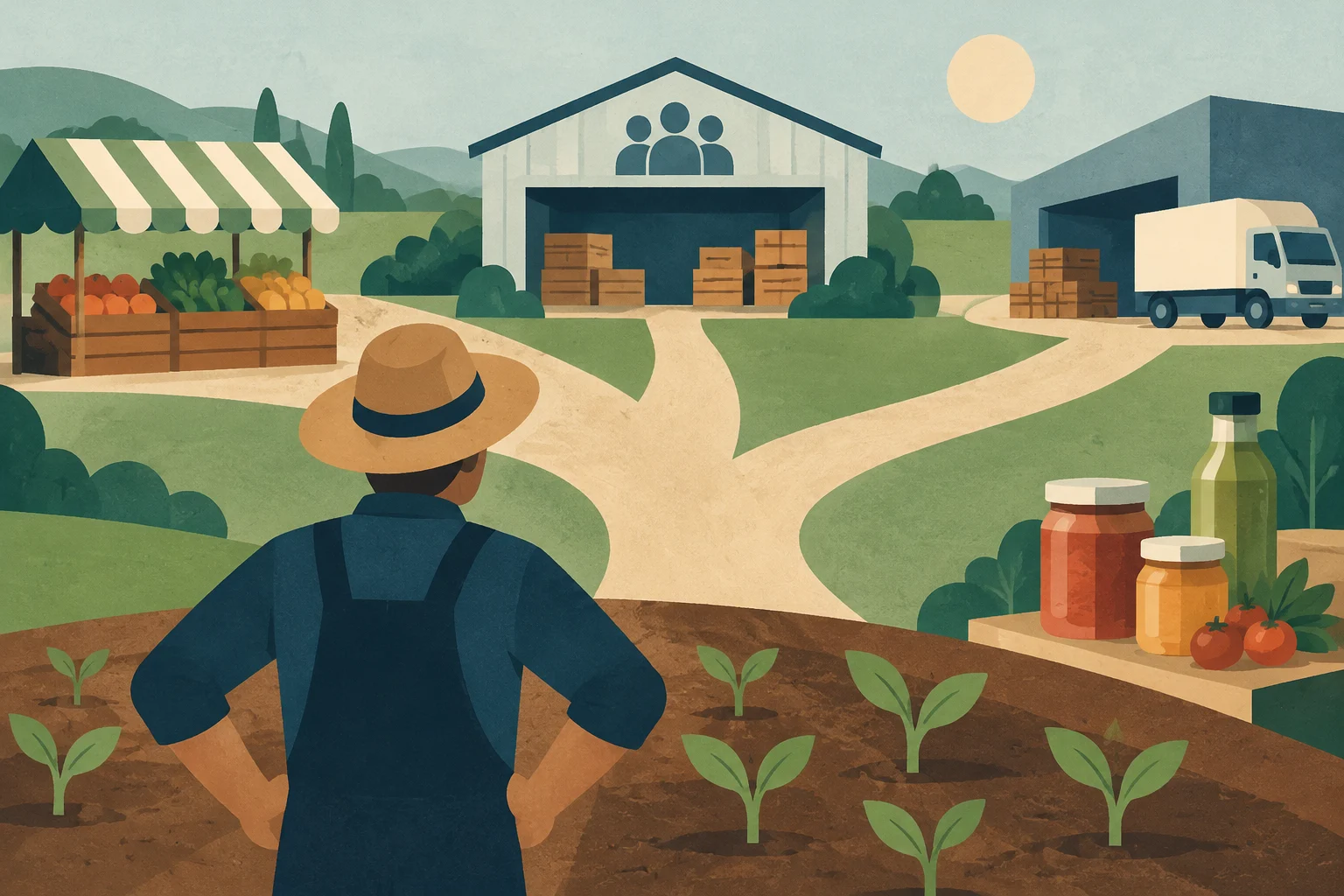
Direct sales allow maintaining contact with customers and can take various forms: farmers' markets, Community Supported Agriculture (CSA) programs, sales to local restaurants and institutions, and mail or internet orders. Each option requires different tasks. In a market, for example, the producer must also organize the presentation and customer service; in sales to restaurants, the regularity of supply and delivery coordination are important.
Selling directly to retail stores is also possible, although local purchasing programs are not available everywhere. When there is no intermediary handling these functions, the farmer may end up assuming packaging, distribution, and marketing tasks in addition to cultivation.
Wholesalers, packers, and processors can offer an outlet for larger volumes, but their requirements may exclude small producers or those located far from production zones. If a processor expresses interest, it is advisable to agree on purchase conditions before planting: Penn State Extension material recommends securing a contract in advance. The availability of buyers and specific requirements vary depending on the product and region.
Editorial illustration · Edition Business
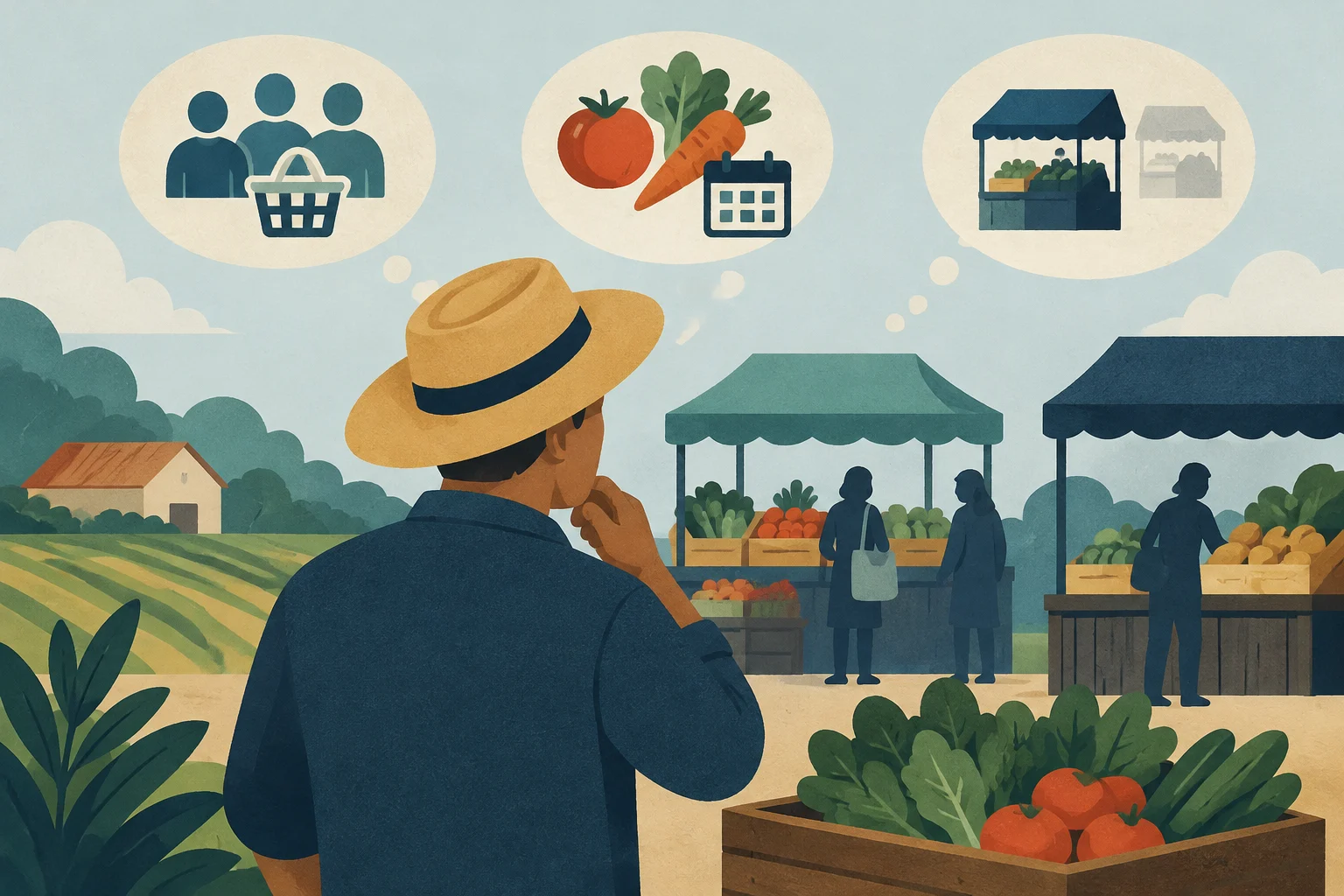
Measuring local demand and competition
Before committing resources, it is advisable to answer specific questions:
Where will it be sold? Defining the market area helps identify customers, transport costs, and relevant competitors.
Who would buy and what do they need? Researching what products they buy, where, and during which seasons allows adjusting the offer to existing habits.
What alternatives do those customers have? Comparing the location, quality, availability, and services of other sellers helps recognize opportunities and limits.
How much could be sold and at what price? The estimate must consider the available quantity, demand, and competition. If supply increases without differentiation or meeting an unmet need, prices may drop.
Local agricultural extension services can provide information on markets and training for direct sales. Observing how a product is marketed in other areas can also be useful, although practices from elsewhere do not guarantee that demand will be the same in one's own market.
Cooperatives: sharing scale and functions
A cooperative or other producer alliance can help pool volumes, coordinate marketing, or share facilities and resources. This can open options that would be difficult to sustain individually. However, adding producers does not by itself guarantee low costs or buyers: the group needs sufficient volume, effective management, and a proposal compatible with the market.
The case of the Iowa Turkey Growers Cooperative illustrates a collective response to the loss of infrastructure. After the closure of an Oscar Mayer processing plant and feed factory, producers formed the cooperative and purchased the facilities in 1996. According to NCAT material, the entity continued producing and marketing whole turkeys and processed products year-round. It is a documented example, not a guarantee that replicating the model is viable for other products or regions.
Scale also imposes limits. Some processing activities require large volumes for unit costs to be competitive. An alliance may have difficulty sustaining a plant if it does not reach that scale. Before investing, the group must evaluate supply capacity, operating costs, and the existence of buyers for the final product.
Adding value: capturing it or creating something different
Capturing value means the producer retains a larger share of the value generated in stages such as processing, packaging, or marketing. Creating value consists of offering something differentiated from conventional alternatives, for example through an origin identity, a brand, a certification, or quality attributes. Both strategies can be combined, but they require different capabilities and resources.
Value-added does not always have to involve transforming food. Cleaning, cooling, sorting, packaging, or drying can also modify the offer. Other options include artisanal products or activities and services linked to the farm. The choice must respond to a plausible demand: a differentiated presentation or an origin story only has commercial value if customers appreciate it and are willing to pay for it.
A differentiated product may require new production and promotion skills, as well as work to inform the consumer. If food is processed, food safety, labeling, and other regulations that depend on the jurisdiction and product type come into play. Self-processing can also increase exposure to product liability. Before starting this activity, sources recommend consulting the relevant agricultural authorities and evaluating insurance coverage and legal obligations with qualified professionals.
Turning the idea into a business decision
A prudent route consists of proceeding in stages: first, confirm who could buy and what quantity they seek; then, compare channels and calculate their costs; and finally, decide whether it is advisable to sell the product as harvested, transform it, or associate with other producers. If the outlet depends on a specific buyer or processor, it is important to clarify volumes, quality, schedule, and purchase conditions in advance.
Viability does not depend only on the selling price. Work time, marketing costs, the ability to meet supply, and obligations associated with processing also count. Value-added can open markets and extend the selling season, but it requires planning and is not an automatic solution to income problems.
Anticipate increases in construction activity with a practical checklist for reviewing forecasts, bottlenecks, materials, personnel, equipment, suppliers, quality, and safety before expanding capacity.
Learn how to verify a VAT identification number in the European Commission’s VIES system to correctly apply the VAT exemption to intra-Community transactions and avoid tax risks.
Learn to use free official tools to investigate prior art, verify inventions and analyze patent documents. This guide explains how to formulate effective searches in Espacenet, PATENTSCOPE and national registers such as INVENES and DEPATISnet.