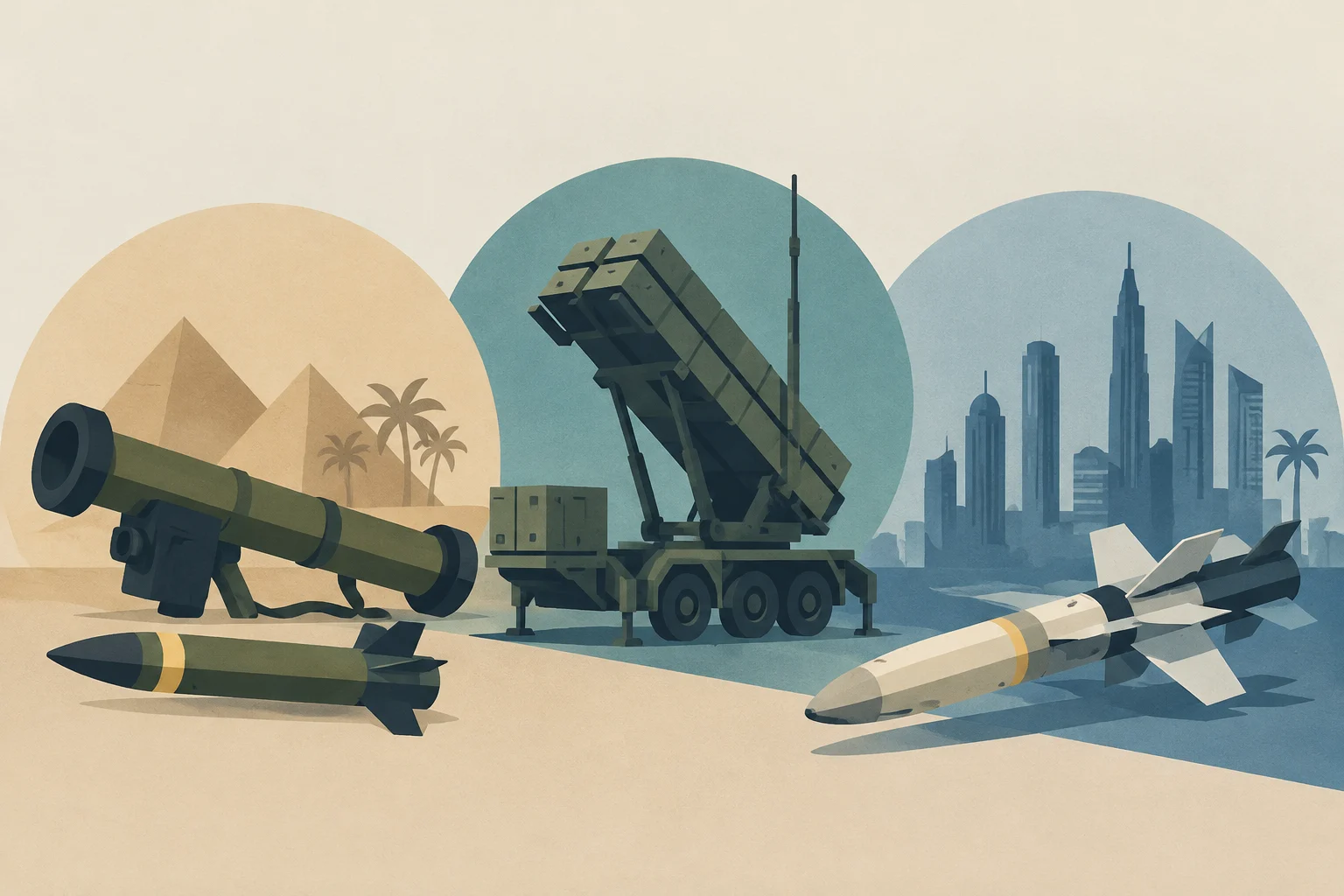
The U.S. Department of State has notified Congress of the approval of three potential military material sales to Egypt, Kuwait, and the United Arab Emirates (UAE). The operation, with an estimated total value of $2.27 billion, covers anti-tank defense systems, maintenance of Patriot missile batteries, and precision guidance kits. The U.S. administration maintains that these transactions will not alter the regional military balance and aim to support Washington's foreign policy and national security objectives.
Details of the approved transactions
The three sales, announced on Friday, are distributed as follows:
- Egypt: Acquisition of up to 2,020 FGM-148F Javelin anti-tank missiles (including 20 test missiles) and 200 lightweight launch units. The estimated cost is $832 million. The package includes simulation equipment, spare parts, technical assistance, and documentation.
- Kuwait: Purchase of missile repair and return services, along with spare parts and technical assistance for its Patriot air defense systems. The estimated value of this operation is $400 million.
- United Arab Emirates (UAE): Acquisition of up to 10,000 APKWS-II guidance sections. These kits convert unguided rockets into precision munitions for air-to-air and air-to-surface configurations. The estimated cost is $1.041 billion, the highest item in the batch. It includes warheads, rocket motors, fuzes, and logistical assistance.
Strategic context and acquired capabilities
Each approved system responds to specific operational needs of the buying countries. The Javelin, a fire-and-forget portable system, would provide Egypt with additional anti-tank capability. The State Department noted that this same system has been used effectively by Ukraine against Russian armored vehicles, although the sale to Egypt will not require the permanent presence of U.S. personnel in the country.
In the case of the UAE, the APKWS-II kits allow conventional rockets to be transformed into precision weapons. The air-to-air variant is used as a low-cost option to shoot down enemy drones, a relevant capability following the drone and missile attacks the country suffered during the conflict between the U.S., Israel, and Iran. The air-to-surface variant, for its part, is designed for surgical strikes.
Kuwait, which has been one of the countries most affected by Iranian attacks in the region, seeks to strengthen its Patriot fleet. This system operates at a different level than anti-tank missiles, protecting territory and critical infrastructure against incoming air and missile threats. The current approval adds to other recent proposals, such as a potential $800 million sale approved in January for the sustainment and technical support of the Patriots.
Impact on the regional balance
The State Department stated in a statement that the proposed sale of this equipment and support "will not alter the basic military balance in the region." The administration argues that these countries are forces of political stability and economic growth in the Middle East.
Regarding personnel deployment, the Javelin sale to Egypt will not require U.S. contractors or personnel in the country. For the UAE, no additional U.S. personnel will be permanently assigned. However, five U.S. contractor representatives will be sent to Kuwait for two years to provide support in the handling and documentation of Patriot battery maintenance.
These sales are part of the Foreign Military Sales (FMS) program, which allows other countries to acquire U.S. weapon systems with their own sovereign funds. Egypt, in addition, receives approximately $1.3 billion annually in Foreign Military Financing (FMF), U.S. taxpayer funds for the purchase of weapons, an agreement derived from its four-decade peace treaty with Israel.