Portugal's 2024 Forest Accounts: Decline in Value Added and Wood Stock
The Portuguese INE published the 2024 Forest Accounts on November 23, 2026. Gross value added in forestry fell by 3.7% in volume and 7.7% in value, while wood stock remains 10% below 2015 levels.
The National Statistics Institute (INE) of Portugal published the 2024 Forest Accounts edition on November 23, 2026. This statistical publication provides a detailed overview of forestry activity in the country, focusing on the economic and physical magnitudes of the sector. It is fundamental to distinguish between the publication date (2026) and the reference year of the data (2024) to correctly interpret trends and comparisons.
The document allows for the analysis of the performance of forestry and logging, as well as the state of the wood stock in the national territory. The information is presented in accessible formats, including PDF, Excel, and CSV, which facilitates the analysis of historical series and the sector's economic accounts.
Decline in Gross Value Added in the Sector
One of the main conclusions of the publication is the contraction experienced by the Gross Value Added (GVA) of forestry and logging in 2024. According to INE data, this magnitude decreased by 3.7% in volume and 7.7% in value compared to the previous year, 2023.
This reduction is not an isolated phenomenon but part of a downward trend that has persisted over the last three years. The report notes that 2024 was the third consecutive year of decline in volume, following reductions of 1.0% recorded in 2022 and 1.4% in 2023. This continuity suggests sustained pressure on the productive activity of the forestry sector in Portugal.
Sector's Weight in the National Economy
The contraction of forestry GVA has had a direct impact on its contribution to the national product. The weight of forestry and logging in the national GVA dropped from 0.5% in 2023 to 0.4% in 2024. Although this is a small proportion within the Portuguese economy, the decrease reflects the loss of relative relevance of the sector in the general macroeconomic context.
For companies and analysts following the sector, this figure is a key indicator of the economic health of the forestry industry. The fall in value added, especially in nominal terms (7.7%), may be influenced by price factors, production costs, or changes in demand structure, although the document is limited to presenting statistical magnitudes without delving into the specific causes of this variation.
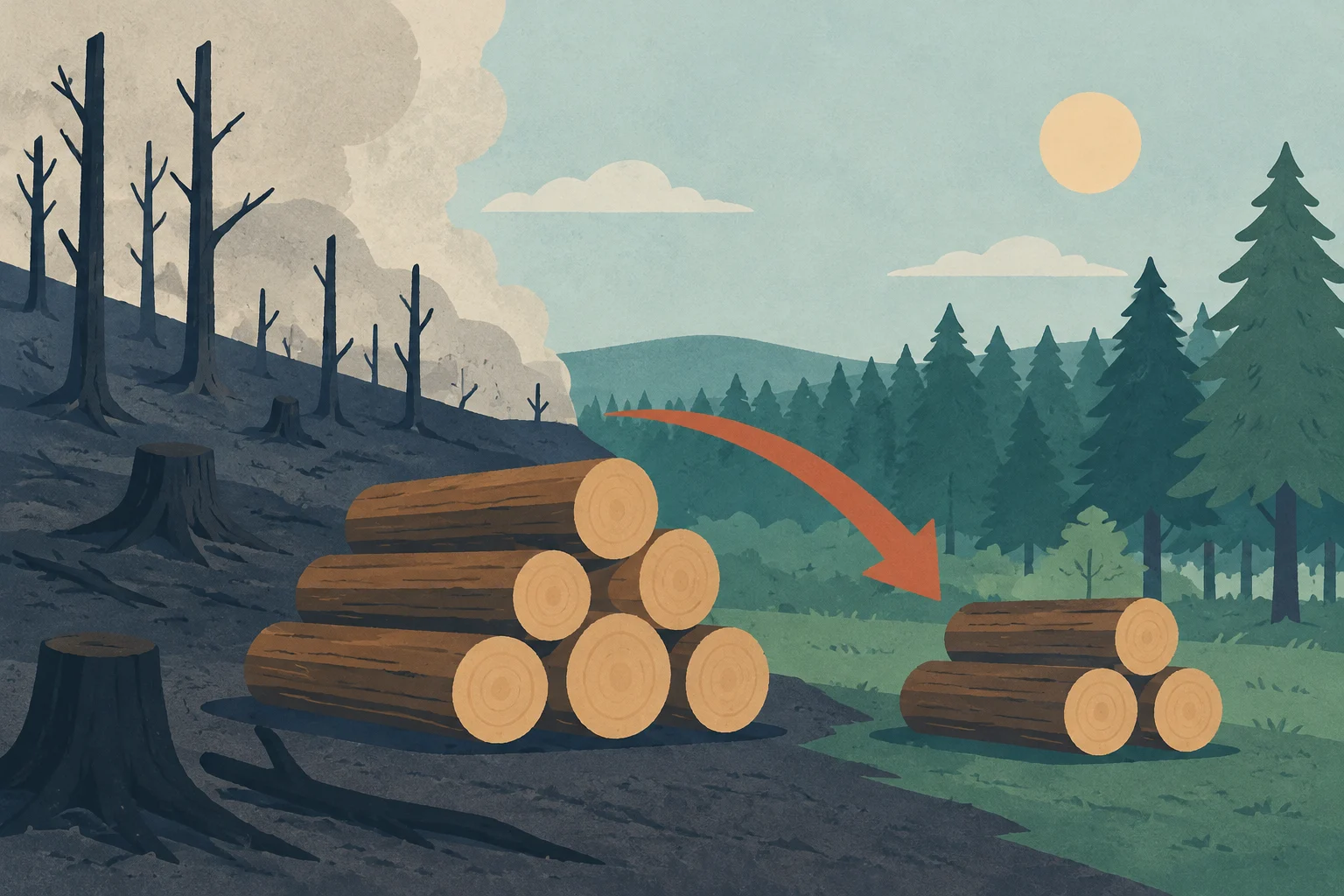
Editorial illustration · Edition Business
State of Wood Stock and the Impact of Fires
In addition to economic accounts, the Forest Accounts provide physical data on forest resources. The wood stock in the national forest is estimated at 170.03 million cubic meters (m³) for 2024. This volume is 10.0% below the level recorded in 2015.
The INE attributes this significant difference to the impact of the 2017 fires, which drastically reduced the forest mass. The recovery of the stock since then has been insufficient to reach pre-catastrophe levels, posing challenges for the long-term sustainability of wood supply.
Extraction and Growth Indicators
Another relevant data point included in the publication summary is the relationship between extractions and the natural growth of wood. In 2024, wood extractions represented 86.8% of the net wood growth. This indicator is crucial for assessing the exploitation pressure on forest resources. A rate close to or exceeding 100% may indicate overexploitation, while a lower rate suggests more conservative management that allows for biomass accumulation.
Methodology and Scope of the Data
The INE publication includes annexes and methodology detailing the sources and calculation methods used. It is important to consider the following when interpreting the data:
Units: Physical magnitudes are expressed in cubic meters (m³) and economic ones in nominal and real monetary units, although the summary highlights percentage variations.
Coverage: The data cover the national territory of Portugal.
Valid Comparisons: Comparisons should be made between consecutive reference years or with specific base years (such as 2015 for stock) while maintaining methodological consistency.
Revision: As is customary in official statistics, data may be subject to future revisions, so it is recommended to consult updated INE editions for the most accurate information.
Implications for the Forestry Industry
The combination of a fall in value added and a wood stock below levels from a decade ago suggests a sector facing both economic and resource challenges. The pressure on wood supply, evidenced by the high extraction rate relative to growth, could limit the industry's expansion capacity in coming years if more intensive or sustainable forest management strategies are not implemented.
For companies in the sector, these data serve as a reference for planning investment, inventory management, and pricing strategy. The decrease in the sector's weight in national GVA could also influence public support policies for the forestry industry, seeking to reverse the contraction trend and strengthen the sector's resilience against extreme climate events such as fires.
A practical four-phase guide to assessing the financial health, operational capacity, and reputation of business partners in Latin America, distinguishing between agency and distribution to minimize legal and financial risks.
The 2026 UK simulation highlighted the value of reinsurance and testing operational decisions, but it is not a forecast or a complete assessment of the sector's solvency.
Distinguishing available hours, productive work, and billable hours helps with project and workforce planning. Utilization is an operational signal: it should be interpreted in light of the billing model, role, quality, and team workload.