Mass consumption in Argentina: Eight months of decline in supermarkets and wholesalers according to INDEC
Sales in supermarkets and wholesale self-service stores fell in real terms in August 2026, extending the negative trend to eight months. Although nominal revenue rises due to inflation, the physical volume of products sold contracts, with adjustments in employment and changes in payment methods.
The National Institute of Statistics and Census (INDEC) reported that sales in supermarkets and wholesale self-service stores recorded year-on-year declines in August 2026, consolidating a trend of deterioration in mass consumption that has extended since the beginning of the year. In real terms, that is, discounting the effect of inflation, supermarket sales decreased by 3.7% compared to August 2025, while in the wholesale channel the drop was 3.6%. This result marks the eighth consecutive month of year-on-year setbacks in the supermarket segment and the seventh in wholesalers, confirming that the recovery in consumption has not managed to consolidate.
Physical volume in contraction versus nominal revenue
The distinction between nominal revenue and real volume is key to understanding the current market dynamics. While peso income increased due to price hikes, the quantity of products crossing the shelves decreased. In August, supermarkets billed $2,616,930 million, a 24.2% increase over the same month of the previous year. However, given that the implicit price index rose by 29% in that period, the real result was negative. Similarly, wholesalers billed $395,434 million (a 23.7% increase in nominal terms), but their physical volume receded.
This economic paradox implies that consumers are buying fewer units of products, although they spend more pesos per transaction. The average ticket in supermarkets was $35,569, with a year-on-year increase of 15.8%, while in wholesalers it was $47,067, a 29% increase over a year ago.
Monthly and cumulative performance
In the seasonally adjusted measurement, which eliminates calendar and seasonality effects, supermarket sales fell by 0.8% compared to July, accumulating three consecutive monthly declines. Wholesalers recorded a month-on-month drop of 1.2%. The cumulative total from January to August 2026 shows a decrease of 2.8% in supermarkets and 2.9% in wholesalers, evidencing a year of negative performance in all months for the supermarket channel.
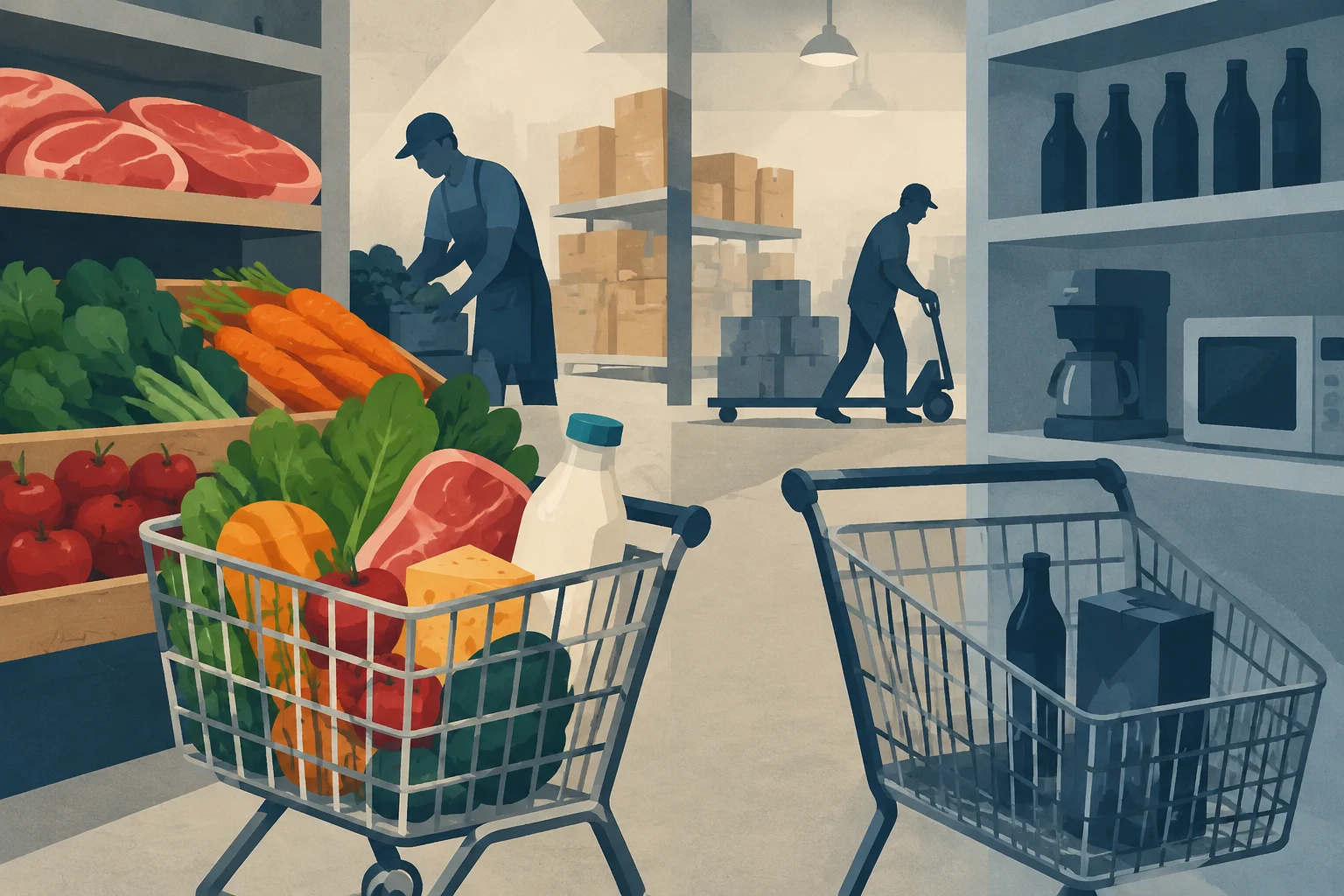
Editorial illustration · Edition Business
Impact on employment and performance by categories
The deterioration in sales was also reflected in the labor structure of the sector. Supermarkets recorded 95,355 workers, a year-on-year decrease of 4.5%, while wholesalers reduced their staffing to 12,863 employees, which implied a drop of 6.8%.
Analyzing categories by type, strong heterogeneity is observed. In supermarkets, the nominal increases in meats (38.5%) and vegetables and fruits (32.6%) exceeded the 29% increase in the implicit price index, so those categories grew in real terms. In contrast, categories such as beverages (11.5%) and electronics and household items (13.8%) showed more moderate nominal increases, which represents a significant drop in sales in real terms.
In the wholesale channel, the categories that countered inflation were fruits and vegetables (35.5%), dairy products (30.2%), grocery (29.8%) and meats (29.1%). Conversely, electronics and household items suffered a nominal drop of 1%, and beverages advanced only 6.5%.
Changes in payment methods and sales channels
INDEC data reveal a transformation in consumers' payment habits. In supermarkets, the credit card remains the main method, with a share of 43% in total sales. However, the "other payment methods" segment (which includes virtual wallets, QR codes, and mobile applications) experienced the greatest growth, with a year-on-year jump of 50.2% and a share of 16.1%.
In wholesale self-service stores, digitalization advances with greater force: "other payment methods" account for 32.7% of revenue, followed by credit cards (26.8%), cash (24.8%) and debit (15.7%).
Regarding sales channels, in-person presence remains the norm. Operations in the sales hall explain 96.9% of revenue in supermarkets, while online commerce barely reaches 3.1%, a figure that remains stable and fails to take off in this segment.
Regional differences and the case of shopping centers
Consumption behavior is not uniform across the national territory. In terms of year-on-year nominal variation, the provinces with the highest revenue increases were Neuquén (33.6%), La Pampa (30.9%) and Río Negro (30.7%), the only ones that exceeded the implicit price index. Conversely, Misiones recorded the lowest nominal variation (7.7%), followed by Chaco (14.3%) and Catamarca (16.5%), indicating a much more pronounced real drop in these jurisdictions.
Unlike everyday consumption channels, shopping centers showed a slight recovery in August. Their sales at constant prices grew 3.7% year-on-year and 3.3% compared to July. However, the annual balance remains negative, with a cumulative drop of 1.2% between January and August. Total revenue for shopping centers reached $698,563 million, a 24.3% increase over August 2025, driven by categories such as entertainment and leisure (62.8%) and furniture (41.6%).
The INE account records lower energy intensity and dependency in 2024. Its indicators combine physical and economic magnitudes, requiring attention to their definitions and limits.
The multilateral institution revised downward its estimate of Argentine GDP expansion, moving from 3.6% to 2.1% for 2026. Despite the adjustment, it highlights that the country would chain three years of growth, an unprecedented milestone in nearly two decades, thanks to the fiscal surplus and the reduction of country risk.
Following the call for general elections, the pharmaceutical industry association has submitted a document to the next Executive with measures to accelerate access to innovation, strengthen domestic production, and simplify bureaucracy, aiming to consolidate the country's leadership in R&D and strategic autonomy.