Social Media Crisis Protocol: How to Avoid Improvisation in SMEs
A practical guide for SMEs detailing how to establish roles, escalation levels, and response times to manage reputational incidents. Learn to differentiate crisis types and leverage the critical window of the first 24 hours.
A company's reputation in the digital environment is not a static asset, but a volatile ecosystem that can deteriorate within hours. For small and medium-sized enterprises (SMEs), the lack of a structured crisis protocol is not just an operational weakness, but a form of corporate negligence. When an incident breaks out, the information vacuum is quickly filled with speculation and external narratives. This guide offers an action framework based on prior preparation, risk taxonomy, and agility in response to protect customer trust and business stability.
Why preparation is the only real advantage
Managing reputational risks has ceased to be an extraordinary task and has become part of ordinary activity. Hyperconnectivity has eliminated time boundaries: a complaint in a forum can become a national fire before the management team finishes reading the first report. Data indicates that 90% of organizations already recognize the critical importance of planning reputational management to survive market volatility.
Not being prepared has measurable consequences. The erosion of trust can translate into a loss of market value of up to 7% in the first days and a drop in sales that can be irreversible. Furthermore, a poorly managed crisis can lead to legal or public relations problems of greater magnitude. Conversely, an adequate response can prevent permanent damage, maintain competitive advantage, and even strengthen branding by demonstrating commitment and transparency.
Editorial illustration · Edition Business
Taxonomy of chaos: identifying to avoid overreacting
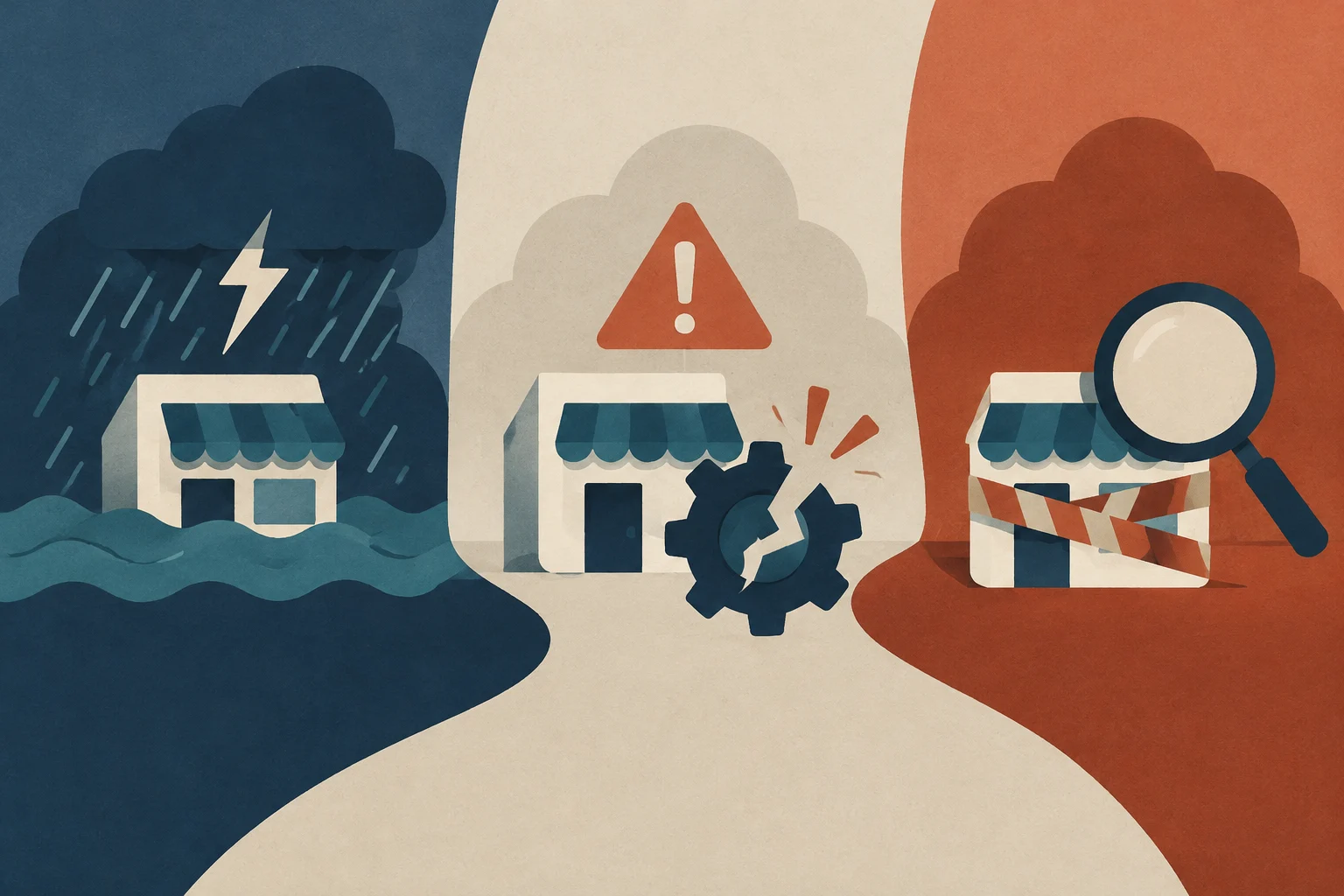
The most common error in crisis management is applying a full apology to a malicious rumor or, worse, denying an evident negligence. The Situational Crisis Communication Theory (SCCT) establishes that the response must be strictly proportional to the perceived responsibility. To design an effective protocol, it is fundamental to classify the incident into three clusters:
Victim cluster: Natural disasters, external cyberattacks, or malicious rumors. The brand has minimal responsibility. The strategy should focus on empathy and solidarity, avoiding apologies for external events.
Accidental cluster: Technical failures, involuntary operational errors, or insensitive posts. The threat is moderate. The response must include a clear apology, an explanation of the error, and immediate corrective measures.
Preventable cluster: Negligence, fraud, poor management, or employee misconduct. The attribution of responsibility is very high and the threat is critical. Here, radical transparency and accountability are mandatory.
The first 24 hours: the narrative control window
In a crisis, time is not a resource; it is a determining factor for success. The "first hour rule" is implacable: brands that respond coherently in the first 60 minutes have an 85% higher probability of protecting their long-term reputation.
The objective of this first hour is not to have the definitive solution, but to exercise effective damage control. This is achieved through a holding statement (wait-and-see statement) that demonstrates the company is in charge, cares about those affected, and is investigating the facts. Initial silence is read as indifference or hidden guilt, which is fatal for social media crisis management.
Warning signs and activation thresholds
To activate the protocol, the SME must define clear alert thresholds. Common signs include:
Unusual peaks in complaint volume (for example, 3 times above the average).
Appearance of high-risk terms on social networks: "lawsuit", "boycott", "fraud".
Mentions by influencers with high reach or national media outlets.
Practical example: When Wallapop launched a notification simulating a call from "Mom" for Mother's Day, the reaction was negative. By identifying it as a sensitivity error (accidental cluster), the company apologized in less than 24 hours and closed the crisis by reinforcing the emotional connection with the user.
The crisis committee: agility over hierarchy
A well-structured crisis management plan ensures that all teams work coherently, avoiding contradictory messages. The committee structure must prioritize agility over traditional hierarchy. Essential roles include:
Official spokesperson: The only person authorized to speak on behalf of the company. They must be a leader with empathy skills and knowledge of the subject. It is crucial to avoid multiple employees responding on their own to maintain message cohesion.
Monitoring team: Responsible for using social listening tools to track mentions, comments, and sentiment in real time.
Technical/operational team: In charge of resolving the root cause of the problem (software failure, logistics, etc.) and providing factual information to the communication team.
Legal: To evaluate legal risks and validate the drafting of statements.
Editorial illustration · Edition Business
Response and communication strategies
The response strategy must be coherent, transparent, and aligned with the brand's values. It is not just about offering a quick response, but ensuring that the message conveys empathy towards affected users.
Differentiation between daily management and structural crisis
It is vital to distinguish between managing daily negative comments and a structural crisis. An isolated aggressive comment is not a crisis; a wave of negative responses or calls for a boycott is. Daily management requires individual and empathetic responses, while a structural crisis demands unified and strategic communication.
Transparency and repair
Repair strategies vary according to the crisis cluster:
Denial: Only viable in the victim cluster if there is clear evidence that the company is not responsible. In any other case, denial usually worsens the situation.
Mortification: Giving up or publicly apologizing. It is the most effective strategy in accidental and preventable clusters, provided it is accompanied by visible corrective actions.
Transparency example: Faced with the Galaxy Note 7 explosions, Samsung acted quickly by withdrawing the devices and offering free replacements. That initial transparency was key to mitigating the long-term negative impact, demonstrating that corrective action is as important as the statement.
Recovery and post-crisis: it is not enough to put out the fire
The crisis does not end when the noise on social networks decreases. The recovery phase is crucial to restore trust and learn from mistakes. Post-crisis actions include:
Incident audit: Analyze what failed in detection, response, and communication.
Protocol update: Incorporate lessons learned into the crisis manual.
Communication of improvements: Inform stakeholders about the changes implemented to prevent the incident from recurring.
Prolonged monitoring: Maintain vigilance over brand sentiment for weeks to detect possible resurgences of the crisis.
Frequently asked questions
When is a social media crisis considered?
A crisis occurs when there is a significant negative change in the online conversation about the brand. It is not an isolated comment, but a wave of negative responses, massive complaints, or calls for a boycott that threaten the brand's security.
What is a holding statement?
It is a brief and clear wait-and-see statement published in the first hours of a crisis. Its objective is to inform the audience that the company is aware of the problem, is investigating, and will communicate more details shortly. It avoids silence and demonstrates control.
Should I delete negative comments during a crisis?
Generally, no. Deleting comments can be interpreted as censorship and worsen the brand's perception. It is better to respond with transparency and empathy, unless the comment clearly violates community guidelines (threats, harassment, illegal content).
How do I choose the crisis spokesperson?
The spokesperson must be a leadership figure with credibility, empathy skills, and knowledge of the subject. They must be the only authorized voice to speak on behalf of the company during the incident. Avoid designating people who are not comfortable on camera or who do not have the authority to make decisions.
Set up a business page, plan its first month, and follow visits through to inquiries and bookings. A practical checklist and a hypothetical example are included.
A practical guide to understanding the technical terms of digital advertising. Learn what DSP, SSP, RTB, CPM, and CTR are to evaluate supplier proposals and optimize your campaigns.
Review strategy, messaging, design, and contact details to check that your online and offline ads express the same brand, adapting to each channel without losing their identity.