Segmentation Is More Than Personalizing the Greeting
Email segmentation means grouping subscribers who share characteristics, interests, or behaviors and tailoring campaigns to each group. Personalization, by contrast, changes elements of an individual message—for example, including someone’s name. Using a person’s name does not make an email relevant if its content does not address their interests.
For a business, the difference matters: segmentation helps determine what to send, to whom, and when. A campaign may be relevant to customers who recently made a purchase and irrelevant to people who have never bought or have already purchased the promoted product. Relevance can support opens, clicks, and conversions, but those results depend on data quality, the offer, and execution; creating segments does not guarantee them.
Start with a Business Question
Before dividing your database, define which decision you want to improve: recommending complementary products, introducing something new, winning back customers, or reducing emails to less active contacts. Then choose the data that will help you create useful groups for that decision.
It is best to start with a few segments that you can serve with different content. A highly detailed breakdown adds no value if the business cannot keep the data up to date or prepare genuinely different messages. As a practical rule, each segment should have a clear reason for receiving its own communication.
Criteria for Building Segments
Profile and Context
Demographic and geographic data, such as location, can help tailor communications when it affects the offer or context. For B2B companies, organizational characteristics such as industry, size, or length of time as a customer may also be useful. Collect only attributes relevant to the campaign, and avoid assuming that everyone in the same group has identical needs.
Behavior and Interests
Interactions with emails, a website, or an app can indicate which topics and products interest each contact. For example, you can distinguish between people who click on a category and those who have shown no interest in it. Purchase history can help exclude products already purchased or suggest related add-ons, provided the recommendation makes sense for the customer.
Engagement Level
Classifying contacts according to their recent interactions helps you adjust content and frequency. Active subscribers may receive information about new products or interesting content; for those who have not interacted for a while, it may be more appropriate to try a reactivation campaign before continuing with regular sends.
The periods used to define “active” or “inactive” should reflect the business’s buying cycle and normal communication cadence. There is no universal timeframe that works for every list.
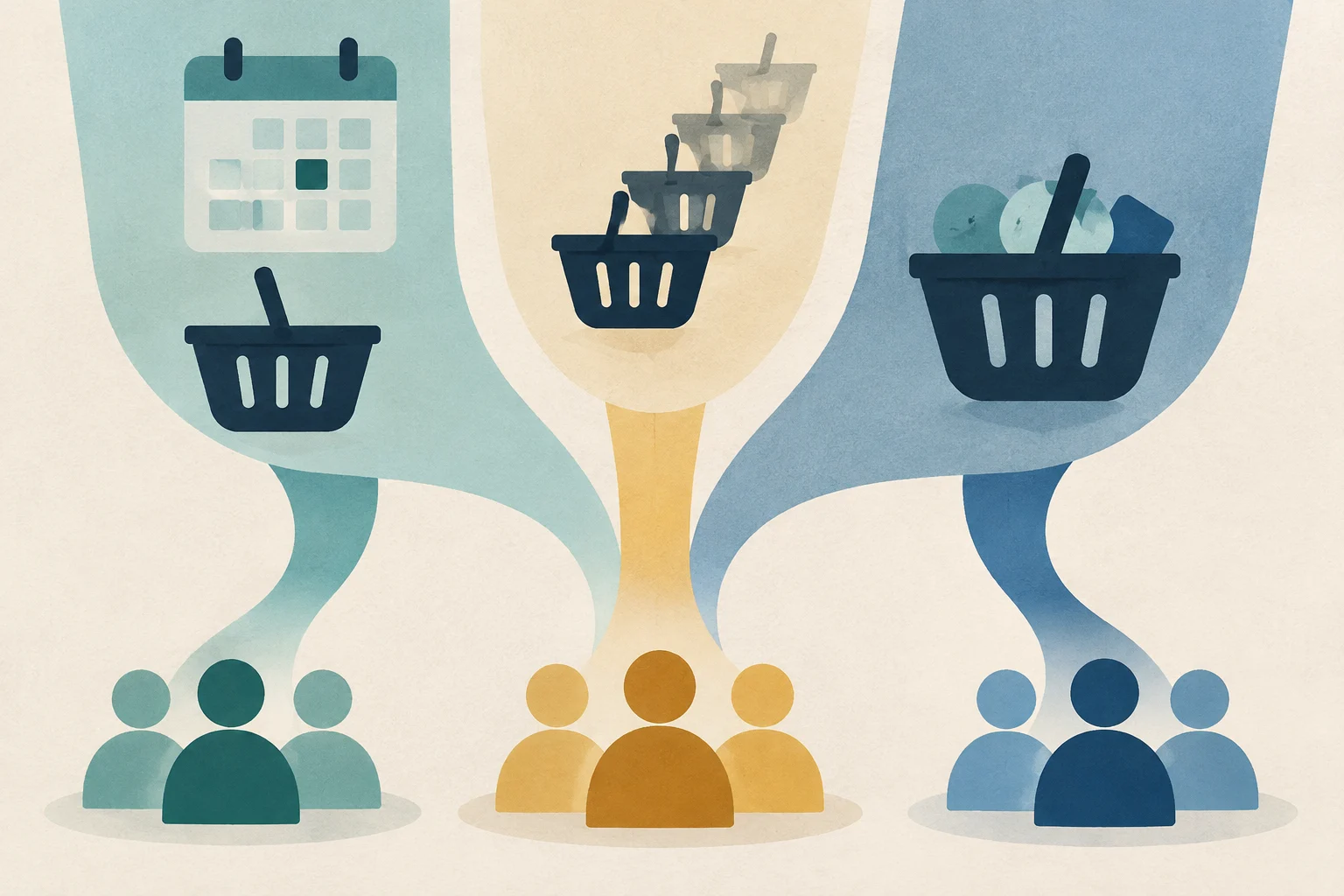
Editorial illustration · Edition Business
Use RFM to Understand the Purchase Relationship
In e-commerce and other businesses with recorded transactions, the RFM model groups customers according to three dimensions:
Recency: how much time has passed since the last purchase.
Frequency: how many purchases the customer made during the period being analyzed.
Monetary value: how much the customer spent, according to the measure and period defined by the business.
This approach can help distinguish recent buyers, repeat customers, and people whose purchasing activity has cooled. A business can then design different messages, such as post-purchase recommendations or an invitation to return. RFM organizes commercial signals; on its own, it does not explain why someone made a purchase or guarantee that they will respond to a particular offer.
Turn Product Data into Useful Messages
When a catalog changes frequently or has many variants, product data must be reliable so segmentation does not recommend incorrect, out-of-stock, or already-purchased items. A CRM can centralize customer and purchase information; a PIM can help organize catalog attributes such as category, features, and variants. By connecting this data to the email platform, a business can select products that fit each group.
For example, people who bought an item in a particular category can be shown compatible add-ons, while people who have not yet purchased can be introduced to that product line. Recommendations should be based on product attributes and relationships that are properly maintained, not merely on two items belonging to the same category.
Adjust Frequency and Keep Your List Healthy
Segmentation also helps prevent repetitive or poorly timed messages. Before scheduling a campaign, check whether the recipient has already received similar communications, bought the advertised product, or been included in another automation. Coordinating one-off campaigns with automated flows reduces the risk of someone receiving several emails without a clear reason.
For inactive contacts, a winback flow can provide a way to confirm their interest. If they do not engage again, a sunset policy can reduce or stop emails to those contacts, in line with the company’s criteria and the options available on its platform. Keeping a list healthy does not mean pursuing every contact indefinitely; it also means reviewing outdated data and respecting unsubscribes and communication preferences.
A Simple Process to Get Started
Define the goal. Decide which action or need the campaign will address.
Choose a useful criterion. Select profile, behavioral, engagement, or purchase data related to that goal.
Check data quality. Make sure the data is up to date and that inclusion and exclusion rules are clear.
Create appropriate content. Change the offer and the information, not just the recipient’s name.
Control the send. Check for overlap with other campaigns and adjust frequency based on observed behavior.
Measure and learn. Analyze opens, clicks, conversions, unsubscribes, and other relevant indicators. Compare segments and campaigns while also considering the period and type of message.
Segmentation works best as a learning cycle rather than a permanent classification. Interests and purchases change, so it is worth reviewing the rules regularly and checking that each group still has a specific purpose. The goal is not to send more variations by default, but to make each contact’s communications more relevant and less noisy.
Set up a business page, plan its first month, and follow visits through to inquiries and bookings. A practical checklist and a hypothetical example are included.
A practical guide to understanding the technical terms of digital advertising. Learn what DSP, SSP, RTB, CPM, and CTR are to evaluate supplier proposals and optimize your campaigns.
Review strategy, messaging, design, and contact details to check that your online and offline ads express the same brand, adapting to each channel without losing their identity.