Guide · Estados Unidos; orientación general, con referencias conceptuales australianas que no se presentan como requisitos aplicables en EE. UU.
How to Prepare Basic Financial Statements and Reconcile Profit, the Balance Sheet, and Cash
A practical guide to turning a small business’s records into an income statement, a balance sheet, and a historical statement of cash flows—and checking that the figures tie together.
Preparing basic financial statements means organizing and connecting a company’s accounting information to show what it earned or lost during a period, what it owns and owes on a specific date, and how its cash changed. For a small service business, these statements can help explain its activity and support conversations with an accountant, but they do not, by themselves, guarantee compliance with accounting, tax, or regulatory obligations.
This guide provides general information for businesses in the United States. Terms and concepts may vary depending on the business activity, entity, and applicable requirements. Explanations of these statements from Australian organizations are used here only as conceptual references; their tax or regulatory guidance does not apply to the United States.
1. Define the period, currency, and accounting method
Before adding up figures, determine which period the statements will cover and which currency you will use. An income statement and a statement of cash flows describe activity over a period; a balance sheet, by contrast, shows a position on a specific date. The three statements should refer to compatible periods and dates.
Also define the accounting basis. Under the accrual method, revenue is generally recognized when a service is provided or a sale is completed, even if the customer has not yet paid; expenses are recognized when incurred, even if they have not yet been paid. Under the cash method, receipts and payments are recorded when money comes in or goes out. Do not mix the two methods without a clear accounting reason: doing so can distort results or leave balances unreconciled. The SBA describes both bases and notes that the choice affects when transactions are recorded; specific requirements depend on the circumstances.
The statements in this guide are historical: they describe transactions that have already occurred. They are not a budget or a cash forecast.
2. Gather records and supporting documents
Start with the accounting system and verify its balances against supporting documents. Depending on the business, these may include:
Invoices issued, contracts, and records of services provided.
Receipts, vendor invoices, and expense records.
Payroll records, if the company has employees.
Bank statements and records for other payment methods.
Opening balances for cash, customer accounts, debts, and equity.
Information about assets, loans, inventory, and accounts payable, where applicable.
Compare cash and bank records with the statements; identify pending or duplicated transactions and transactions without supporting documents. Also check whether any amounts should be classified as accounts receivable, accounts payable, assets, debts, or capital contributions instead of being treated as revenue or expenses.
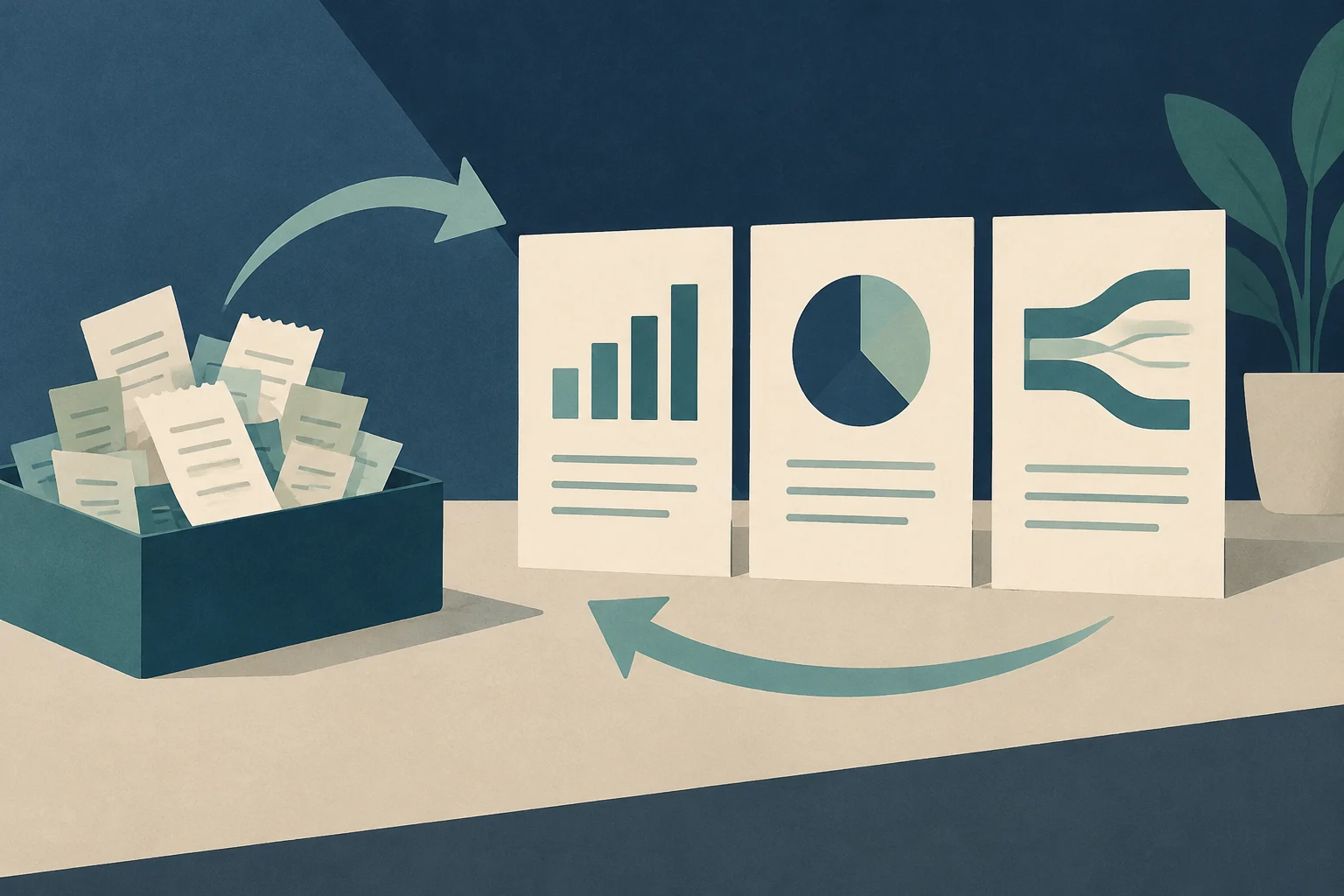
Editorial illustration · Edition Business
3. Prepare the income statement
The income statement—also called a statement of earnings or profit and loss statement—brings together a period’s revenue and expenses. Its basic calculation is:
Revenue − expenses = result for the period
Under the accrual method, record revenue when services are provided, not only when payment is received. Record expenses when they are incurred, according to the accounting basis used and the treatment appropriate to the transaction. Separate categories that help explain the business, but do not call all expenses “cost of sales”: classification depends on their nature and the business activity.
Profit is not the same as cash available. The company may have provided services that it has not yet been paid for, or have recognized expenses that it will pay later. Nor is a list of bank deposits and payments, by itself, an income statement.
4. Prepare the balance sheet as of a specific date
The balance sheet shows assets, liabilities, and equity on a specific date. It must satisfy this equation:
Assets = liabilities + equity
Assets may include cash, amounts owed by customers, and company property. Liabilities may include loans and unpaid invoices. Equity represents the owners’ accounting interest, subject to the entity’s structure and relevant records.
Check the opening balances and each transaction during the period. Accumulated results and owners’ contributions or withdrawals can affect equity; customer receipts and debt payments affect the relevant accounts. Depending on the company, adjustments may be needed for items such as depreciation, taxes, accruals, or inventory. These should not be omitted simply because they do not appear in this guide’s teaching example.
Book equity is not a guaranteed valuation or the company’s sale price. A balance sheet that balances does not, by itself, prove that all records are correct or that the statements are complete for regulatory, tax, credit, or investment purposes.
Editorial illustration · Edition Business
5. Classify transactions in the statement of cash flows
The statement of cash flows explains the change in cash over the same period. It groups receipts and payments into three general categories:
Operating: ordinary business activity, including customer receipts and operating payments.
Investing: purchase or sale of long-term assets, where applicable.
Financing: transactions with lenders and owners, such as loans, contributions, and principal repayments.
Cash flow is not the same as profit. In addition, a capital contribution is not a sale, and repayment of a loan’s principal is not an operating expense: these are financing transactions. A business may report a profit and still have little cash if it takes time to collect payment; it may also receive cash from a loan without that cash being service revenue.
6. Teaching example: a service business
The following case is hypothetical and simplified. It uses U.S. dollars (USD), a month called “M,” and the accrual method. It does not include inventory, fixed assets, other accounts receivable or payable, interest, taxes, or depreciation. This simplification illustrates how the statements connect; it is not an instruction to exclude items from actual accounting records.
At the start of the month, the company has USD 10,000 in cash and USD 4,000 in debt. Its opening equity is USD 6,000; therefore, assets of USD 10,000 = liabilities of USD 4,000 + equity of USD 6,000.
During the month, it provides and invoices services worth USD 10,000. It collects USD 8,000, leaving USD 2,000 outstanding. It also incurs and pays USD 6,000 in operating expenses; receives a USD 2,000 contribution from the owner; and repays USD 1,000 of the debt’s principal. There are no other transactions or adjustments in this example.
Income statement for month M
Item
USD
Revenue from services provided
10,000
Operating expenses
(6,000)
Example result before taxes
4,000
Revenue is USD 10,000 even though only USD 8,000 has been collected, because the example uses the accrual method. The difference, USD 2,000, remains outstanding for collection.
Statement of cash flows for month M
Category
Transaction
USD
Operating
Customer receipts less operating expenses paid
+2,000
Investing
No transactions
0
Financing
USD 2,000 contribution less USD 1,000 principal repayment
+1,000
Net change in cash
+3,000
Opening cash
10,000
Closing cash
13,000
Balance sheet at the end of month M
Item
USD
Cash
13,000
Accounts receivable
2,000
Assets
15,000
Outstanding debt
3,000
Liabilities
3,000
Opening equity
6,000
Result for the month
4,000
Owner’s contribution
2,000
Closing equity
12,000
Liabilities + equity
15,000
The equation balances: assets of USD 15,000 = liabilities of USD 3,000 + equity of USD 12,000. Cash also reconciles: opening cash of USD 10,000 + a net change of USD 3,000 = closing cash of USD 13,000. In this case, operating cash flow of USD 2,000 can also be calculated by subtracting the USD 2,000 increase in customer accounts from the USD 4,000 result; there are no other operating adjustments in the example.
The USD 2,000 contribution increases cash and equity, but not service revenue. The USD 1,000 repayment reduces cash and debt, but not operating expenses or the result. Recording either of these transactions twice would break the reconciliation.
7. Reconciliation and final review
Before considering the statements complete, check that:
The period’s records are supported and reconciled with bank statements and other cash records.
Revenue and expenses relate to the period and the selected accounting basis.
The closing cash balance in the statement of cash flows matches the cash balance on the balance sheet as of the same date.
The balance sheet satisfies assets = liabilities + equity.
Changes in equity are explained by the result, contributions, withdrawals, and other applicable transactions.
Loans, outstanding customer receipts, and outstanding payments are classified correctly.
Any potentially missing adjustments and matters requiring professional review are identified.
If balances do not match, trace the difference back to the records; do not add unknown figures just to make the balance sheet balance. Date errors, duplicates, incomplete records, or incorrect classification can cause discrepancies.
Gather invoices, receipts, bank statements, and other supporting documents.
Review period revenue and expenses according to the selected accounting basis.
Reconcile receipts and payments with the records and statements.
Review amounts due from customers and amounts payable to vendors.
Verify assets, debts, and opening and closing balances.
Check the balance sheet equation, cash, and change in equity.
Note outstanding items and questions for an accounting adviser.
Item or check
Previous value
Current value
Source and date
Notes
Responsible person
Cash
Accounts receivable
Other assets
Debts and other obligations
Equity
Period revenue and expenses
Period receipts and payments
Outstanding items or adjustments to review
This worksheet organizes a review; it does not certify that the statements are audited, complete, or suitable for any particular purpose. Requirements may depend on the business activity, entity type, and jurisdiction. To determine the accounting or tax treatment applicable to a specific case, consult a qualified professional.
Defining what is certified, how the billable amount is calculated, and when payment is due helps prevent duplicate charges, measurement disputes, and cash-flow pressures on construction projects.
A reliable estimate adds employer costs and other expenses to wages, divides the total by the hours actually spent on productive work, and adjusts the result to the productivity of each work item and its indirect costs.
Regulatory and technical fragmentation in Africa and the Middle East requires a country-specific approach. This guide explains how to identify currency exposures, navigate the coexistence of ISO 8583 and ISO 20022 standards, and evaluate intermediation costs and currency controls to optimize corporate liquidity.