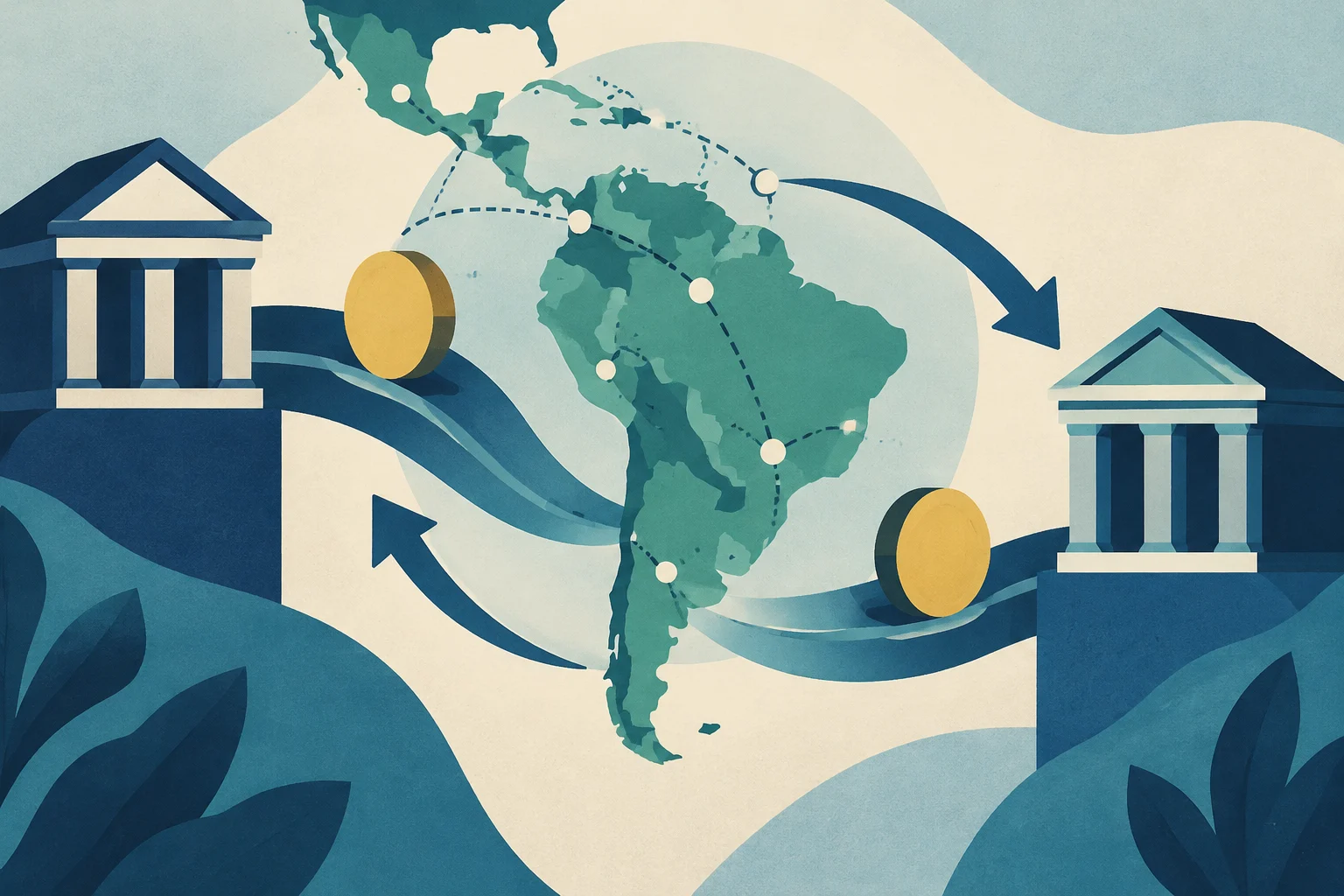
Guide to organizing cross-border collections and payments in Latin America
Operating in Latin America requires adapting cash flows to local realities: from the use of **PIX** and **SPEI** to managing exchange rate risk and bank reconciliation. This guide details how to structure an efficient collection and payment process, minimizing fees and avoiding margin erosion.
Commercial expansion into Latin America represents a strategic opportunity to diversify revenue, but it also introduces a significant layer of financial complexity. Unlike unified markets such as the SEPA zone in Europe, the Latin American region is fragmented into multiple jurisdictions with their own currencies, regulations, and payment systems. For companies, the challenge is not just selling, but collecting efficiently and paying suppliers without operational friction eroding profitability.
The anatomy of a cross-border payment
To optimize flows, it is fundamental to understand how money moves. Although networks like SWIFT are the global standard for traditional bank transfers, they do not move the money itself but transmit payment instructions. The actual flow depends on a network of correspondent banks.
In a typical scenario, a company in Spain or the U.S. paying a supplier in Brazil or Mexico follows this path:
Initiation and conversion: The origin bank converts the currency and uses reserve accounts abroad.
Routing: If there is no direct relationship, the payment passes through one or more intermediaries. Each actor charges a fee and performs compliance checks.
Settlement: The receiving bank credits the beneficiary's account.
This process, although reliable, is slow and costly. Each intermediary adds time and hidden costs. According to industry data, the volume of global cross-border payments exceeded 208 trillion dollars in 2025, which evidences the magnitude of the flows, but also the need for efficiency in each transaction.
Adaptation to local payment systems
One of the most common mistakes is trying to force a single payment method for the entire region. In Latin America, the adoption of local systems has transformed the speed and cost of transactions.
The case of Brazil and Mexico
Brazil (PIX): The instant payment system PIX has drastically reduced settlement times. While a traditional SWIFT transfer can take 2 to 5 business days, PIX operates in real time with minimal fees. For companies invoicing in Brazil, integrating PIX as a collection method significantly improves cash flow.
Mexico (SPEI): SPEI is the standard for local bank transfers. It offers a faster and cheaper alternative than international transfers for payments within the country. For companies with suppliers or clients in Mexico, using SPEI for the last mile of payment reduces dependence on foreign correspondent banks.
Exchange rate risk management
Exposure to currency fluctuation is the main enemy of profitability in international operations. In Latin American markets, where currencies can experience significant volatility, a variation in the exchange rate can reduce margins by 10% to 20% within weeks.
Mitigation strategies
Definition of billing currency: Whenever the commercial relationship allows, agreeing on prices in a stable currency (such as the euro or the dollar) transfers the exchange rate risk to the client. If the client insists on paying in their local currency, the company must assume the exposure or hedge it.
Forward contracts: Allow fixing the exchange rate for a future date, eliminating uncertainty about the value of pending collections or payments.
Multi-currency accounts: Maintaining balances in the local currency of the operating country allows payments to be made without immediate conversion, taking advantage of better exchange rates at the time of settlement.
Dynamic price adjustment: In markets with high inflation or volatility, it is necessary to periodically review prices to reflect the real cost of the currency.
Editorial illustration · Edition Business
Reconciliation and accounts receivable control
Passivity in collection management is a critical error. In international markets, payment terms are often longer and the risk of non-payment is higher. An active tracking system is indispensable.
Tracking protocols
Weekly review: Analyze the aging of accounts receivable to identify early delays.
Due date alerts: Implement automatic notifications before the payment date to avoid non-payments due to forgetfulness.
Preventive contact: Communicate with the client before the due date to confirm the payment status and resolve possible administrative issues.
Bank reconciliation: Ensure that each income corresponds to an issued invoice. Lack of reconciliation can hide amount errors or duplicate payments.
Regulatory and tax compliance
Each country in Latin America has its own regulations on invoicing, taxes, and capital controls. Ignoring these requirements can result in sanctions, bank retentions, or the inability to repatriate funds.
Key aspects to verify
Local invoicing: Some countries require electronic invoices with specific formats (for example, CFDI in Mexico).
Taxes: Know the application of VAT, IGIC, or equivalent local taxes. Withholding responsibility may vary depending on the type of service or good.
Capital controls: In some countries, the exit or entry of foreign currency is subject to limits or requires additional documentation.
AML/KYC Law: Comply with anti-money laundering regulations, which may require verification of the identity of the ultimate beneficiary.
It is recommended to work with specialized advisors in foreign trade in each jurisdiction to ensure compliance and avoid blocks in transfers.
Optimization of supplier payments
Just as it is crucial to collect on time, it is also important to pay international suppliers without compromising liquidity. The strategy must align with the collection cycle.
Negotiation of terms: Adjust supplier payment terms to coincide with expected income from clients.
Batch payments: Grouping multiple small payments into a single transaction can reduce bank fees.
Currency evaluation: Determine whether it is more convenient to pay in the supplier's local currency or in the company's currency, considering the exchange rate and conversion fees.
Conclusion
Organizing cross-border collections and payments in Latin America requires a proactive and adaptive approach. There is no single solution; the key is to know the local reality of each country, automate the tracking of accounts receivable, and actively manage exchange rate risk. By integrating local payment systems like PIX or SPEI and establishing clear compliance protocols, companies can transform operational complexity into a competitive advantage, ensuring a predictable cash flow and sustainable profitability.
The ECB confirms that the digital euro has not yet been issued. We analyze the technical and legal differences between central bank money, bank deposits, and private tokens, and what retailers should anticipate regarding the 2027 pilot and the potential issuance in 2029.
There is no universally superior option between operating an owned fleet or outsourcing transport. The decision depends on demand volume, seasonality, and the required level of control. This analysis provides a framework to compare direct costs, capacity, variability, and operational risks, highlighting the trend toward hybrid models that optimize resilience and total cost.
Practical guide to verify legal, financial, and operational requirements before submitting applications to EIC, STEP, Eurostars, and national programs like INTECA or Pyme Innova.