Digital Euro for Retailers: Differences from Instant Payments and Stablecoins
The ECB confirms that the digital euro has not yet been issued. We analyze the technical and legal differences between central bank money, bank deposits, and private tokens, and what retailers should anticipate regarding the 2027 pilot and the potential issuance in 2029.
The current state of the digital euro: preparation, not issuance
The digital euro remains a project in the preparation phase and is not yet a currency in circulation. According to the intervention by Piero Cipollone, a member of the Executive Board of the European Central Bank (ECB), delivered on November 10, 2026, before the European Parliament, the project is advancing towards a beta pilot that will begin in the second half of 2027. It is fundamental to distinguish that this pilot will not have legal tender status: it will serve to test technical functionality, operational processes, and user experience, but it will not constitute an obligation of acceptance for retailers nor a valid form of payment in the full legal sense.
The possible first issuance of the digital euro is conditional on the adoption of the legislative package known as the Single Currency Package. Although the European Parliament adopted its position in July 2026, the final text requires the conclusion of trilogue negotiations. The ECB estimates that if the regulatory adoption is completed by the end of 2026, the date of a possible issuance could be set for 2029. Any delay in legal approval could postpone this date, underscoring the dependence of the technical calendar on political and legislative will.
Structural differences: central bank money, deposits, and tokens
For payment service providers (PSPs) and retailers to understand technical integration, it is crucial to differentiate three concepts that are often confused in public discourse:
Central bank money (Digital euro and cash): This is the direct debt of the Eurosystem. In the case of the digital euro, it would be a digital form of cash, directly backed by the ECB and national central banks. Its value is intrinsic and does not depend on the solvency of a private entity.
Bank deposits (Instant payments): When a user makes an instant payment (SEPA Instant Credit Transfer), they are transferring a bank deposit. This money is a debt of the banking entity towards the client. The guarantee depends on the bank's solvency and deposit protection systems, not directly on the central bank.
Private tokens (Stablecoins): These are digital assets issued by private entities. Although a stablecoin may be denominated in euros and backed by reserves, it remains a private token. Its issuance, management, and risks are associated with the issuing entity, not the public monetary system.
This distinction is vital for payment system architecture. The digital euro would operate as an extension of digital cash, while instant payments and stablecoins operate on deposit or private asset infrastructures, respectively.
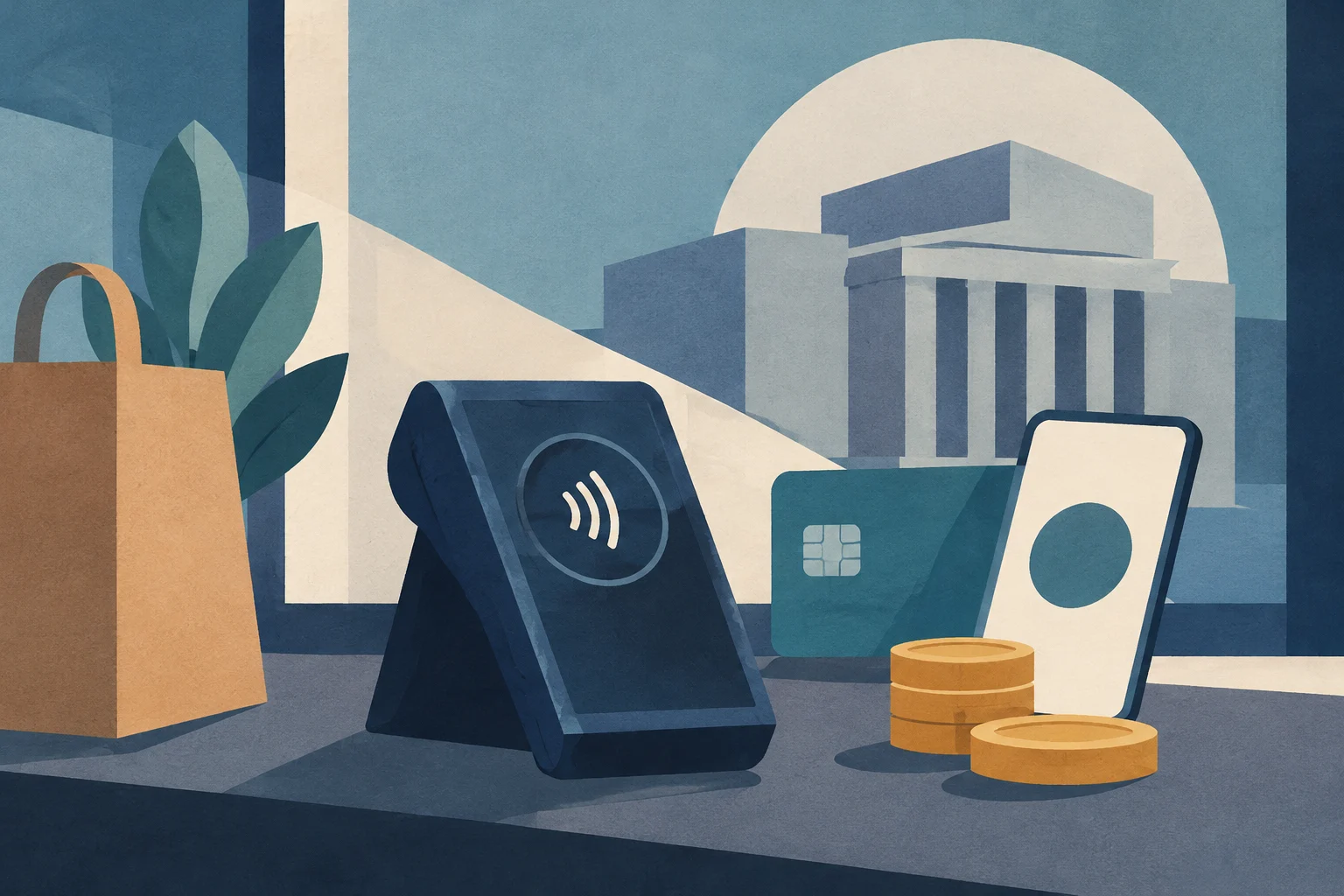
Editorial illustration · Edition Business
2027 Pilot: scope and participants
The ECB has selected 36 payment service providers (PSPs) to participate in the pilot, chosen from more than 50 applicants. These include banks and non-bank providers, with a diversity of business models and sizes. The pilot will also involve Eurosystem staff and selected retailers.
Initially, the focus will be on everyday services, such as canteens at the ECB and participating national central banks. Subsequently, a call will be opened for online and mobile retailers to test remote payments. The final selection of these retailers will be announced in early 2027.
The objective of the pilot is to validate that the digital euro functions not only at a technical level but also in daily life for consumers, retailers, and PSPs. It is not a legal obligation of acceptance, but a controlled proof of concept.
Gradual deployment: what it means for retailers
One of the most frequent questions among retailers is whether they will be obliged to accept the digital euro from the first day of its issuance. The answer, according to the ECB, is that a gradual deployment is planned.
The ECB has indicated that all relevant technical functions will be available from the first issuance. However, comments from market participants suggest that a phased deployment would support a smoother transition, giving providers time to adapt their systems. The ECB has expressed satisfaction with the co-legislators' intention to provide legal clarity on the feasibility of this phased deployment in stores.
This means that:
There will be no immediate obligation to accept the digital euro in all physical and digital retailers from day one of issuance.
Technical capacity will be present, but the legal obligation of acceptance may be subject to a phased calendar defined by the final legislation.
Retailers should not assume that the digital euro will immediately replace other payment methods, but rather that it will coexist with them during a transition period.
Innovation and future: conditional payments and AI
The ECB is also exploring how the digital euro can foster innovation in the market. Through the digital euro innovation platform, two lines of work are being developed:
Experimentation: Helping the private sector develop practical functions, such as electronic receipts and conditional payments. A conditional payment is one that is only executed if a predefined condition is met, which could have applications in subscriptions, pay-per-use, or guarantees.
Exploration: Studying how emerging technologies, such as artificial intelligence (AI), could improve future versions of the digital euro. This includes analyzing how AI could optimize fraud detection, service personalization, or operational efficiency.
It is important to highlight that these are study paths and not guaranteed functions for the initial launch. AI, for example, is mentioned as a possibility for future versions, not as a feature of the 2027 pilot or the first issuance in 2029.
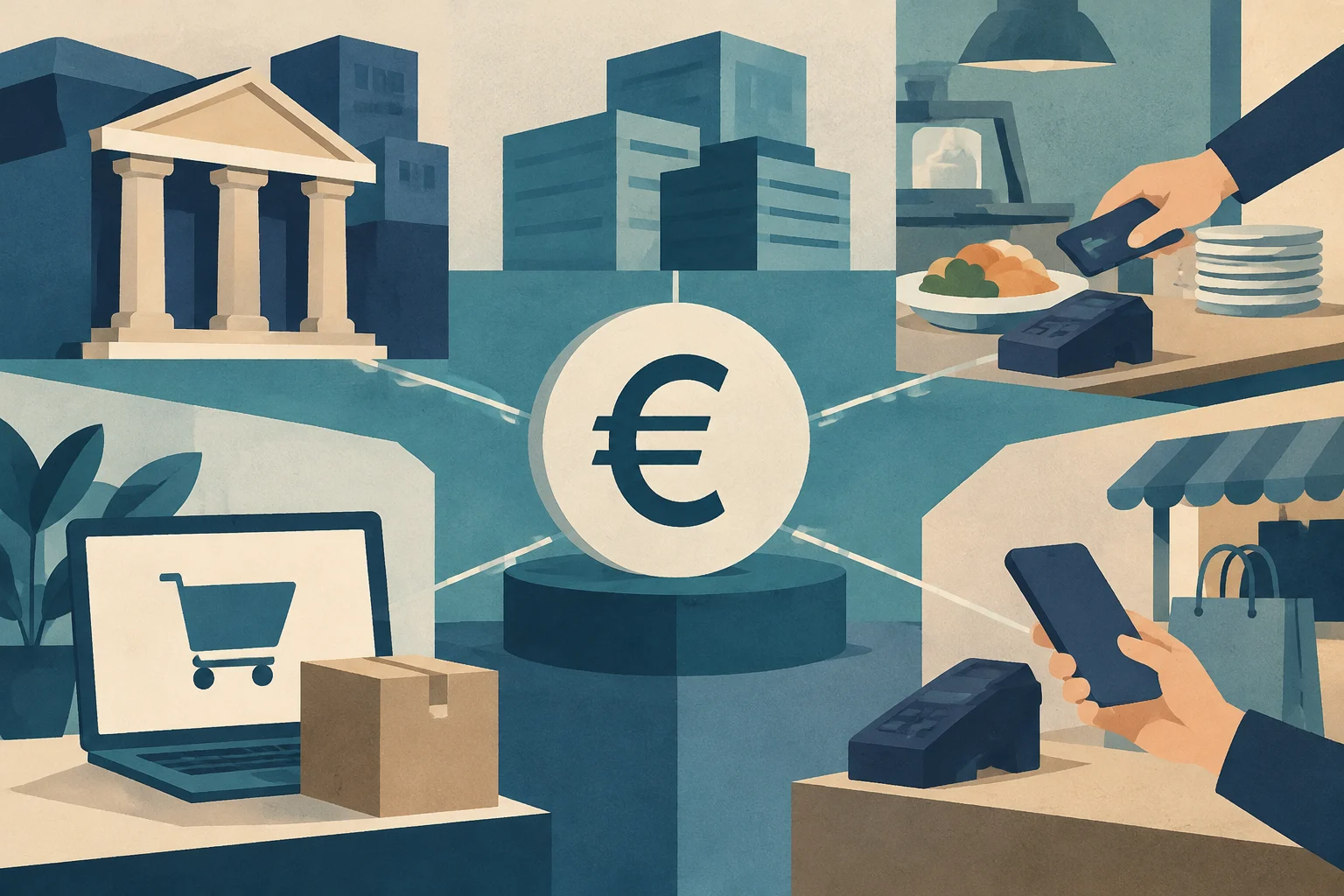
Editorial illustration · Edition Business
Coexistence with cash: a political priority
The ECB has reiterated that cash and the digital euro are "two sides of the same coin." Cash is not destined to disappear, and the ECB supports strong legislative provisions on the mandatory acceptance of cash, access to cash throughout the euro area, and the resilience of the cash infrastructure.
The introduction of the digital euro does not seek to replace cash, but to offer Europeans a digital form of cash that coexists with it. This is especially relevant in a context of growing digital payments, where convenience and autonomy in payments are priorities for users and retailers.
Implications for payment service providers (PSPs)
For PSPs, preparation for the digital euro involves more than just integrating a new form of payment. It requires:
System adaptation: Ensuring that technical infrastructures can handle the digital euro as a form of central bank money, distinct from deposits.
Liquidity management: Understanding how holding digital euros could affect the liquidity management of clients and the entity itself.
Regulatory compliance: Staying attentive to the evolution of the Single Currency Package and the rules of the digital euro scheme Rulebook, which will define the standards and procedures for providing basic payment services.
Innovation: Participating in the innovation platform initiatives to develop services that leverage the unique capabilities of the digital euro, such as conditional payments.
Frequently asked questions
Does the digital euro have legal tender status today?
No. The digital euro has not been issued. The 2027 pilot is a beta version without legal tender status. Issuance with legal tender status will depend on the adoption of legislation and is estimated for 2029.
Will retailers be obliged to accept the digital euro from the first day?
Not necessarily. The ECB plans a gradual deployment. The legal obligation of acceptance may be subject to a phased calendar defined by the final legislation. Retailers will have time to adapt.
What is the difference between the digital euro and a euro stablecoin?
The digital euro is central bank money, issued by the ECB and national central banks. A stablecoin is a private token issued by a private entity. Although both may be denominated in euros, their backing, issuance, and risks are fundamentally different.
Will the digital euro replace cash?
No. The ECB has stated that cash and the digital euro will coexist. Cash will remain a valid and widely accepted form of payment, and the ECB supports the protection of its mandatory acceptance.
What is a conditional payment in the context of the digital euro?
It is a payment that is only executed if a predefined condition is met. It is a function being explored in the digital euro innovation platform and could have applications in subscriptions, pay-per-use, or guarantees.
Conclusion
The digital euro represents a significant evolution in the European payment system, offering a digital form of cash backed by the central bank. For retailers and PSPs, the key lies in understanding the differences between central bank money, deposits, and private tokens, and in preparing for a gradual deployment that prioritizes technical adaptation and coexistence with other payment methods. The adoption of the legal framework is the next critical step to define the calendar and specific acceptance obligations.
There is no universally superior option between operating an owned fleet or outsourcing transport. The decision depends on demand volume, seasonality, and the required level of control. This analysis provides a framework to compare direct costs, capacity, variability, and operational risks, highlighting the trend toward hybrid models that optimize resilience and total cost.
Practical guide to verify legal, financial, and operational requirements before submitting applications to EIC, STEP, Eurostars, and national programs like INTECA or Pyme Innova.
A structured four-phase process for Spanish SMEs to locate, evaluate, and submit applications for grants, subsidized loans, or tax incentives available in 2026, using official tools and verifying key requirements.