How to use this glossary
Managing a clinic involves clinical, administrative and technological processes. Agreeing on what each term means helps management, clinical staff and suppliers describe the same processes and more easily identify what information needs to flow between systems.
This glossary brings together concepts found in the available sources. It is not a comprehensive catalogue of efficiency metrics or healthcare billing codes: the material consulted does not provide enough definitions to cover those areas rigorously.
Medical imaging and archive systems
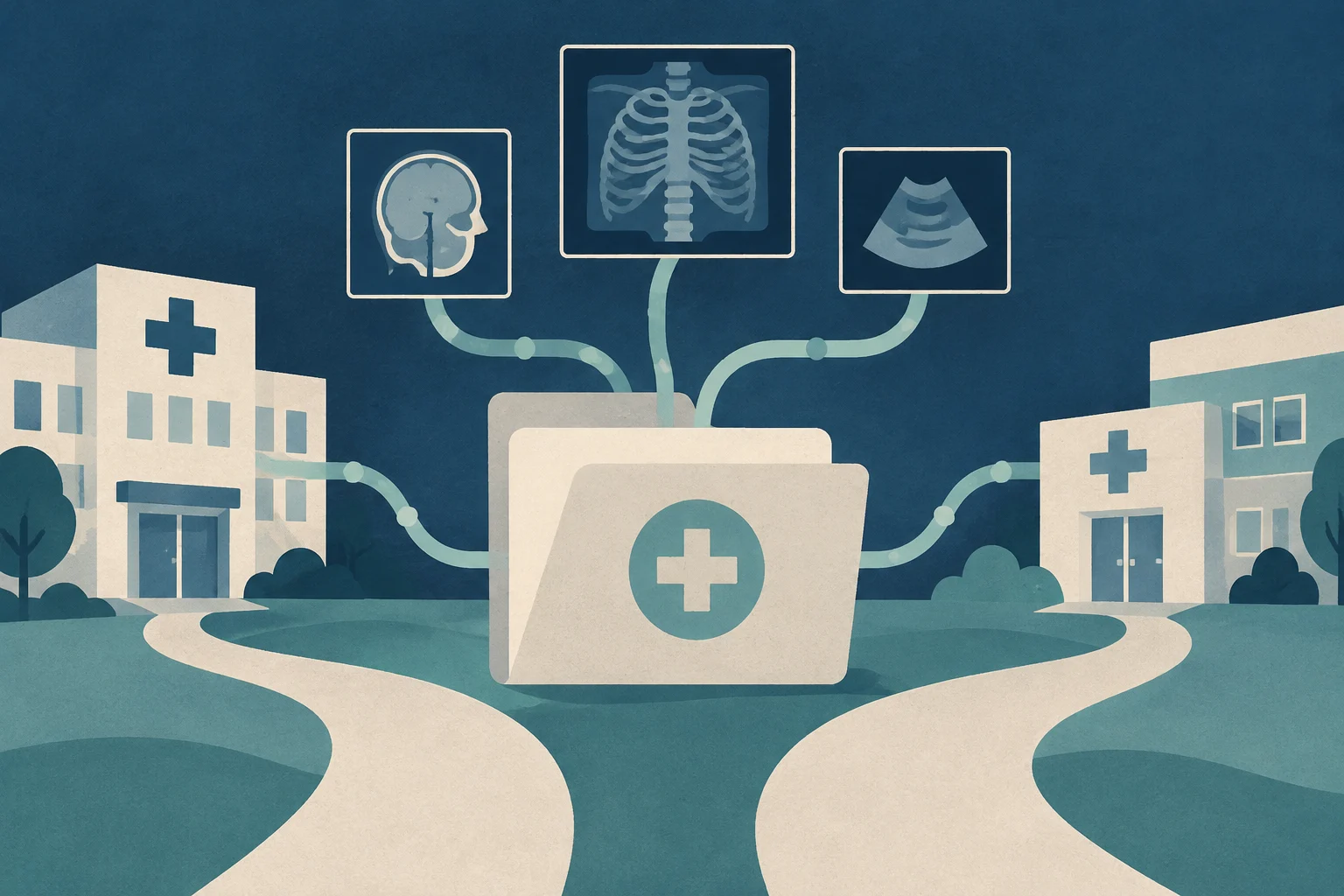
DICOM is a standard used to represent and communicate medical images and the information associated with them. Its presence may indicate that a system supports files or communications in this format, but it does not, on its own, confirm that studies are automatically archived or transferred.
PACS (picture archiving and communication system) is an infrastructure for storing and distributing imaging studies. It is useful to distinguish it from the format: DICOM defines how studies are structured and communicated; a PACS manages their archiving and access. To assess an operational workflow, the relevant question is whether the study reaches the patient record without manual uploading and which systems are involved.
Interoperability and a shared clinical language
Interoperability is the ability of different systems to exchange information and use it in a coordinated way. It is not enough for two applications to be able to connect: it also matters that they interpret the data with compatible meanings.
HL7 and FHIR are standards associated with the exchange of healthcare information. The available sources identify them as interoperability concepts, but do not detail their specifications or allow their functions to be compared. In a specific integration, it is therefore important to clarify what data are exchanged and how they are interpreted, rather than simply stating that a product “is compatible.”
ICD-10 is a disease classification. In the materials consulted, it appears as an example of a clinical catalogue that may form part of the technical vocabulary of a management system. The source does not specify which version or adaptation is used in each context, so those details should be checked in the documentation applicable to the relevant system or process.
Data protection and confidentiality
AEPD is the acronym for the Spanish Data Protection Agency, an organisation mentioned in the sources in connection with data protection. Its name appearing in a technical specification or contract does not, by itself, demonstrate that a particular data-processing activity meets all applicable obligations.
Pseudonymisation involves processing data so that they can no longer be attributed to a person without additional information, which must be kept separate and protected. It is not the same as anonymisation: if additional information exists that makes it possible to associate the data with a person again, the data remain personal data. The source consulted includes the term but does not set out its legal requirements; its application should be assessed in light of the circumstances of the processing and the legislation in force.
Coordination between doctors and pharmacists
The Classification of Pharmacotherapeutic Referrals (CDF), associated with the MEDAFAR project, is a taxonomy published in 2008 to organise referral situations between pharmacists and doctors relating to pharmacotherapy. It aims to provide professionals with a common language.
According to the available description, it organises referrals into four chapters: effectiveness or efficiency, information or health education, need and safety. The classification can help structure the reason for a consultation or referral; it does not replace professional judgement or determine the clinical response on its own. The source also indicates that it can be combined with classifications such as ATC, ICPC-2 or ICD-10 to provide greater specificity.
Mutual insurance companies collaborating with Social Security
In Spain, a mutual insurance company collaborating with Social Security is a private, non-profit entity that collaborates, within the relevant framework and under the corresponding supervision, in the management of public benefits assigned to it. Its remit includes occupational contingencies—work-related accidents and occupational diseases—for people covered by the associated companies.
Coverage may include other benefits under the terms set out in the legislation and depending on the selected coverage option. For this reason, the term “mutual insurance company” should not be interpreted as synonymous with general health insurance or as a sufficient description of all benefits available to a worker. The available information refers to Spanish regulations but does not detail the full regime or subsequent changes; for an administrative or employment-related decision, the legislation in force and the conditions applicable to the case should be checked.
What to clarify when documenting a process
When defining an integration, a referral or the management of benefits, it is useful to record what information is exchanged, who is involved, which system records it and which classification is used. For data protection or Social Security matters, the specific context must also be identified and checked against the applicable legislation: a glossary helps establish a shared vocabulary, but it does not replace technical documentation or the relevant legal review.