Local distributor or direct sales: how to compare entry models in a foreign market
The choice of international entry channel depends on the balance between control, investment, and local knowledge. Direct sales offer maximum control over brand and price but require high investment in structure and logistics management. Using sales agents (2-15% commission) allows testing the market with low risk and no stock, ideal for high-value products or B2B. Local distributors (30-60% margin) assume stock and logistics, accelerating penetration in markets with short delivery times, but reduce control over the customer experience and margin. A wholly-owned subsidiary maximizes control and long-term profitability but requires the highest investment and assumption of legal and tax risks. Before deciding, the SME must assess economic viability (cost breakdown), local regulatory compliance, and the partner's ability to cover the desired geographic area.
The decision on how to enter a foreign market is one of the most critical inflection points for an SME seeking to internationalize. It is not just about finding buyers, but about defining the commercial architecture that will sustain the relationship with the end customer. The choice between a local distributor and direct sales (or variants such as agency) determines the level of control over the brand, the cost structure, the speed of penetration, and exposure to legal and logistical risks.
The spectrum of control and investment
Entry models are not binary but form a continuum where control and investment move in opposite directions. According to the European Commission and the International Trade Administration, the main alternatives are classified by the degree of ownership and management assumed by the exporting company.
Direct sales and own export
In direct export, the company sells from its domestic market to customers abroad, managing the operation itself. This can be done through an in-house sales team or via export e-commerce.
Advantages: Maximum control over price, payment terms, customer service, and brand image. It allows capturing the entire commercial margin.
Disadvantages: Requires high investment in commercial structure, international logistics management, regulatory compliance, and cash flow. The company assumes the risk of collection and the administrative complexity of operating in two jurisdictions.
International sales agents
The sales agent is an intermediary who acts on behalf of the exporter without taking possession of the goods. They are usually independent professionals or small companies that charge a commission on sales made, which can range between 2% and 15% depending on the sector and product.
Advantages: Low initial financial risk, as no stock is required at the destination. Ideal for high-value products, B2B, or those requiring consultative sales. It allows "testing" the market before committing greater resources.
Disadvantages: The agent does not assume logistics or inventory risk. The company must manage shipping and delivery. Control over the final customer experience may be lower if the agent is not aligned with the brand's standards.
Local distributors
The international distributor is a company that buys products from the exporter and resells them in a specific geographic area. It assumes ownership of the goods, storage, local logistics, and often after-sales technical service. Its profit margin is usually between 30% and 60%, depending on the industry and product standardization.
Advantages: Accelerates penetration in markets where delivery times are critical. The distributor already has a network of customers, local reputation, and a professionalized structure (warehouse, marketing, sales). It reduces the operational and logistical burden on the exporter.
Disadvantages: Less control over the final price, customer experience, and local marketing strategy. The margin for the exporter is significantly reduced. There is a risk that the distributor prioritizes other brands or does not invest enough in product promotion.
Wholly-owned subsidiary
The creation of a commercial subsidiary or production facility in the destination country represents the maximum degree of integration. The company establishes a local legal entity to operate directly.
Advantages: Total control over the operation, brand, and long-term strategy. It allows capturing all market profitability and building local assets (team, knowledge, infrastructure).
Disadvantages: Requires the highest initial investment and assumes local legal, tax, and labor risks. Management complexity is high, and the return on investment can be slow.
Key factors for the decision
There is no "best" model in the abstract. The choice must be based on an analysis of four fundamental dimensions, according to international management literature and the guidelines of the Spanish Chamber of Commerce:
Nature of the product: Is it standardized or complex? Does it require technical service? Are delivery times critical? Technical products or those requiring local stock usually favor the distributor. High-value or B2B products can work well with agents.
SME resources and capacity: Is there capital for a subsidiary? Is there a sales team to manage direct sales? Can the cash flow risk of direct export be assumed?
Local knowledge and network of contacts: Does the company have access to a reliable network of customers or partners? A distributor with a consolidated network can be more efficient than a direct sales effort from scratch.
Strategic objective: Is the goal to test the market (low risk) or to consolidate a long-term position (high control)? Internationalization is usually a gradual process: many companies start with agents or direct export and evolve towards distributors or subsidiaries as they gain volume and knowledge.
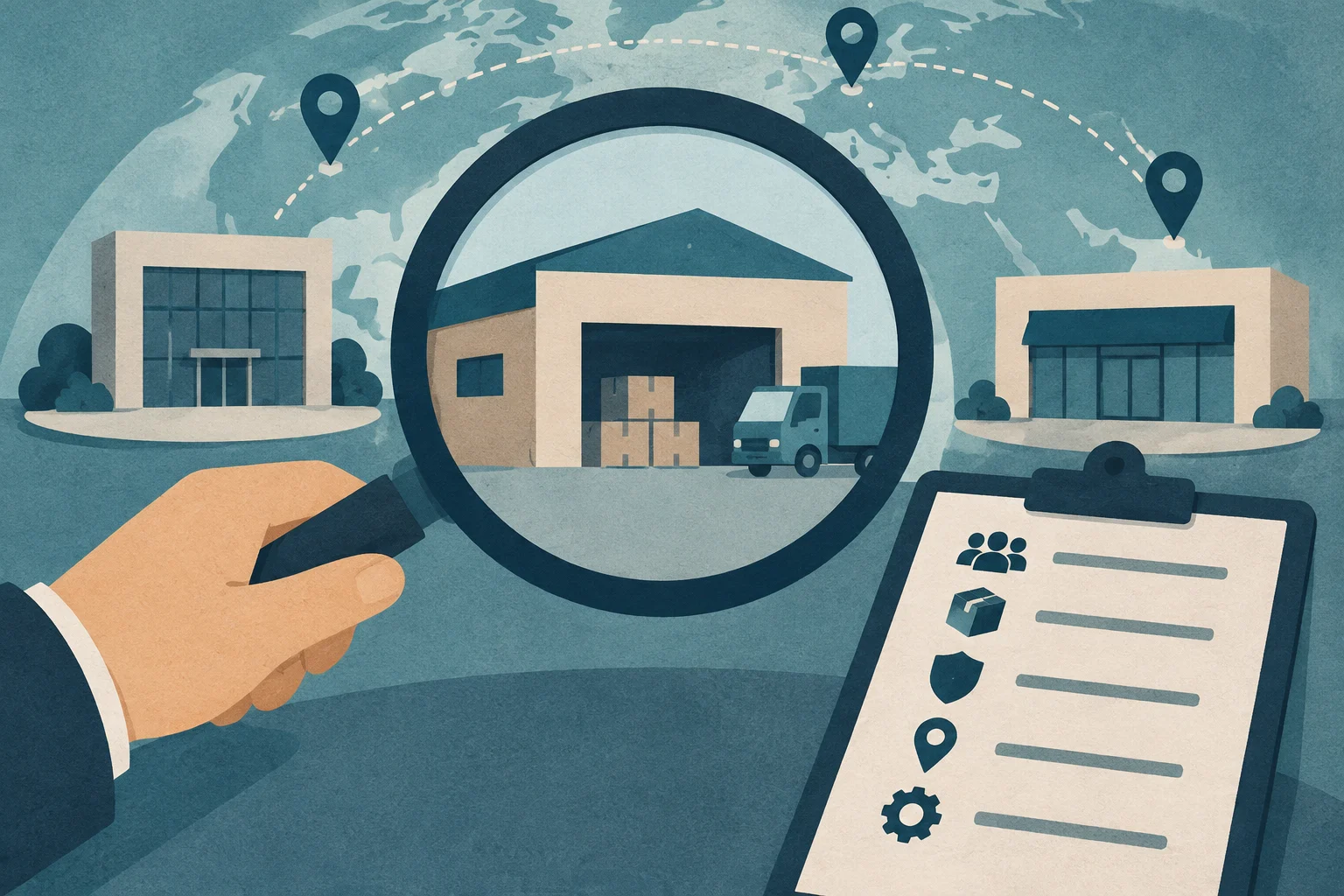
Editorial illustration · Edition Business
How to research and select the partner
If an intermediary (agent or distributor) is chosen, selection is crucial. The model from one country should not be extrapolated to another. For example, a fashion company using agents in Europe might need a distributor with a warehouse in the United States due to delivery times.
Sources for the search
General directories: Such as Kompass.
Sector associations: Lists of local members.
Sector trade fairs: Platforms for searching exhibitors and buyers.
Government reports: Local entities that publish data on distributors.
Competitor analysis: Reviewing the distribution networks of competitors already operating in the target market.
Digital tools: Advanced internet search, social networks, and databases from internationalization consultancies.
Evaluation criteria
Before signing a contract, the SME must evaluate:
Customer typology: Does the profile of their customers match the company's objective?
Logistical capacity: Do they have a warehouse, transport, and inventory management capacity?
Reputation and longevity: Is it an established and reliable company?
Geographic coverage: Can they effectively cover the desired area?
Service capacity: Do they offer technical support, installation, or after-sales service if the product requires it?
Economic viability and compliance
Regardless of the model chosen, the first step is to calculate the economic viability. This involves a detailed cost breakdown: destination price, transport, insurance, tariffs, commissions or intermediation margins, promotion, initial investment, and cash flow needs. The Spanish Chamber of Commerce recommends contrasting the potential of the product, the market, the segments, the channels, the competition, the destination price, and cash flow needs.
In addition, it is essential to verify local regulatory compliance: tariffs, rules of origin, taxes, technical certifications, intellectual property protection, and labeling requirements. Ignoring these aspects can generate unexpected costs or insurmountable entry barriers.
Conclusion
The choice between a local distributor and direct sales is not a static decision but a dynamic strategy. Many SMEs adopt a gradual approach: they start with a low-risk model (agent or direct export) to validate demand and the market, and then scale towards a higher-control model (exclusive distributor or subsidiary) as sales volume justifies the investment. The key is to align the entry model with available resources, the nature of the product, and long-term strategic objectives, always supported by a rigorous analysis of costs and risks.
Set up a business page, plan its first month, and follow visits through to inquiries and bookings. A practical checklist and a hypothetical example are included.
A practical guide to understanding the technical terms of digital advertising. Learn what DSP, SSP, RTB, CPM, and CTR are to evaluate supplier proposals and optimize your campaigns.
Review strategy, messaging, design, and contact details to check that your online and offline ads express the same brand, adapting to each channel without losing their identity.