Identify what is in dispute
Disagreement is not necessarily a problem: it can reveal risks, bring different perspectives, and improve a decision. The difficulty arises when tension persists, undermines collaboration, or prevents progress. To intervene effectively, first understand what is causing the conflict, rather than immediately attributing it to incompatible personalities.
Several sources of conflict commonly arise in teams: clashing priorities or goals, unclear or overlapping responsibilities, incomplete information, and differences in how work is organized. Interpersonal tensions can also arise. For example, an email interpreted in different ways may seem like a personal clash when the real problem is a lack of context or agreement on how to communicate.
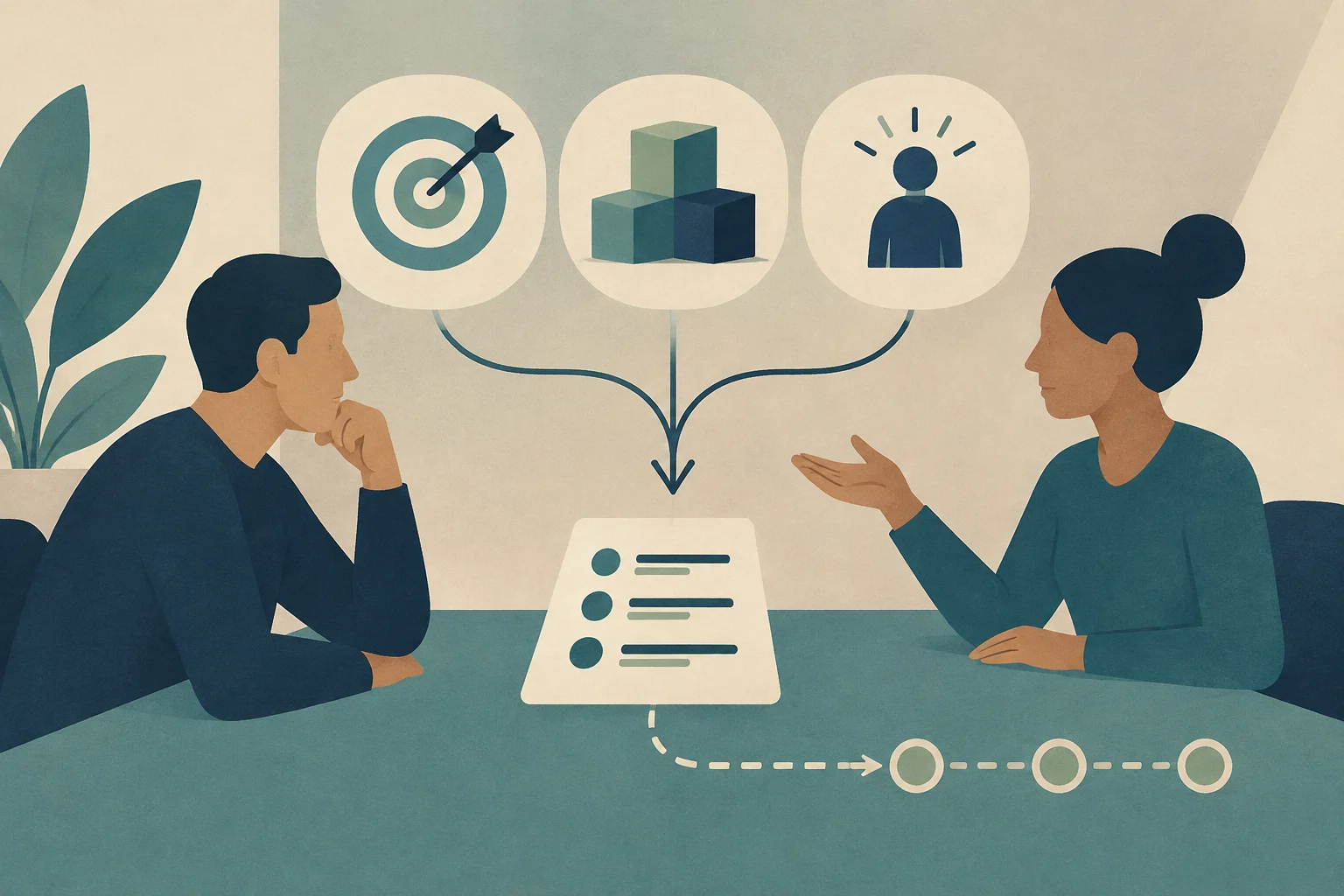
An initial diagnostic conversation can focus on three questions: What decision or task is blocked? What does each party need to move forward? And what information, responsibility, or priority is unclear? Separating observable facts from interpretations helps define a problem the team can solve.
Facilitate a balanced conversation
The person coordinating the team can create space for each party to explain their perspective without interruption. Active listening and impartiality do not mean accepting every claim as valid or avoiding decisions: they mean understanding what happened and what needs to be resolved before deciding.
To make the discussion useful:
- Keep the conversation focused on the task, process, or decision, rather than disparaging people.
- Ask for specific examples and distinguish facts from assumptions.
- Summarize what you have understood from each perspective and check with the parties that you have captured it accurately.
- Explore what goal they share, even if they disagree about the method or priorities.
- Agree on what needs to be resolved and who can decide it.
In remote or hybrid teams, written exchanges may be insufficient if tone or context is interpreted differently. A direct conversation—in person or by video call—can make it easier to clarify things. Afterwards, putting agreements in writing helps reduce further ambiguity.
Turn disagreement into an actionable decision
It is not enough for the parties to state their positions: the conversation should end with a verifiable next step. If the conflict stems from unclear roles, specify who carries out the work, who decides, and who must be consulted. If priorities clash, the person with the authority to decide should make the criteria for choosing between them explicit, such as the project goal or available resources.
A practical agreement identifies the decision, the people responsible, and the time for review. If consensus is not possible, the team can record the options considered and ask the person with the relevant responsibility to make a decision. This way, the disagreement does not remain open indefinitely, and lack of agreement is not mistaken for lack of progress.
Decide when to resolve the issue and when to escalate
Disagreements about organization, methods, or task allocation can usually be addressed within the team if the people involved can talk safely and the coordinator has the authority to agree on changes. If the cause is structural—for example, incompatible priorities between departments or responsibilities assigned by different managers—it may be necessary to involve someone who can resolve the contradiction.
It is also advisable to use the relevant internal channels when the situation exceeds the direct manager’s ability to mediate, reasonable attempts have not led to progress, or someone cannot participate freely in the conversation. Mediation by a neutral person can help when the parties need support understanding one another; formal procedures are for cases that must be handled under the organization’s policies. The appropriate response depends on the nature of the problem and the channels established by each company.
Escalating should not mean abandoning the conversation or prejudging who is right. It means taking the issue to the level that can act, providing the necessary context, and clarifying what decision or support is being requested. If there are indications of a situation that requires formal attention, it should not be treated merely as a difference in styles or priorities.
Reduce the likelihood of future roadblocks
Prevention starts with clear working conditions: shared goals, understandable roles, explicit expectations, and suitable channels for raising problems. Regular work reviews make it possible to identify early changes in workload, dependencies, or priorities that could cause friction.
Leadership also affects how differences are discussed. Setting an example of respectful communication, openness, and accountability makes it easier for people to raise concerns before they turn into resentment or delays. In digital environments, agreeing on when to use written messages and when to speak directly can prevent misunderstandings from piling up.
Resolving issues early does not mean forcing a quick solution at any cost. It means identifying the source of the disagreement, listening to the relevant perspectives, and bringing the decision to the level that can make it. With this approach, the team can preserve useful discussion without letting tension become a permanent roadblock.