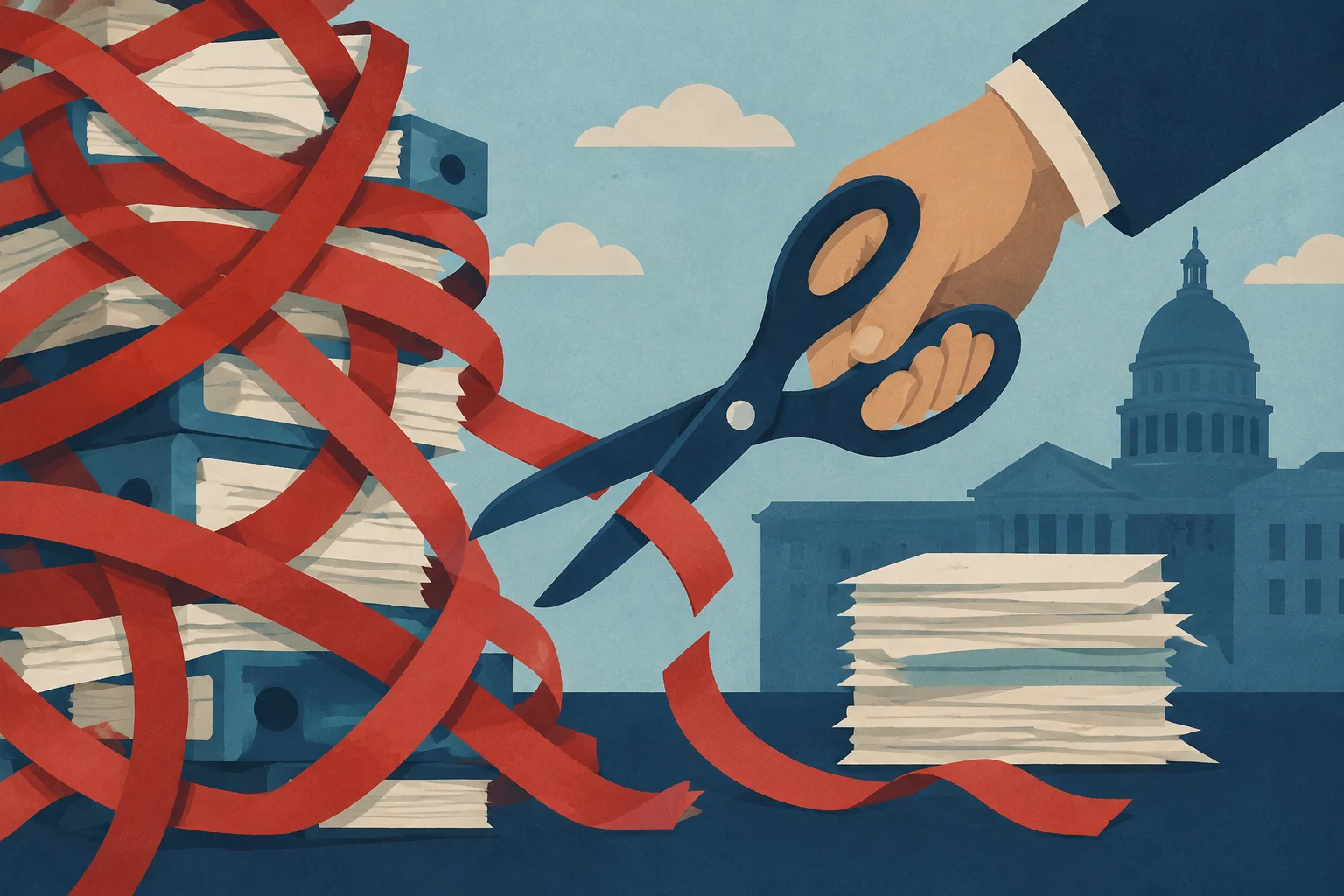
UK Government announces measures to cut bureaucracy and save businesses £800 million annually
Chancellor John Healey presented a package of regulatory and tariff reforms in October to reduce the administrative burden on British businesses, ahead of the Autumn Budget. The measures include simplifying corporate reporting and extending tariff suspensions, with the government aiming to cut the regulatory burden by 25% by the end of the current parliamentary term.
A package of reforms to ease the administrative burden
In October, ahead of the Autumn Budget, the UK Government announced a set of regulatory and tariff measures to reduce the administrative costs for businesses. Chancellor John Healey presented these initiatives as a way to provide businesses with "room to breathe." According to the UK Treasury, they will allow businesses to save up to £800 million a year in administration and tariff costs.
The reforms are part of a broader Executive objective: to reduce the regulatory burden by 25% by the end of the current parliamentary term. The Government estimates that achieving this goal will result in a saving of 280 million hours annually for businesses with employees.
Simplification of reporting and reduction of duplication
A fundamental part of the package focuses on simplifying corporate reporting requirements. The Treasury has detailed that streamlining these rules will allow businesses operating as part of a national group to save up to £20,000 a year.
Among the announced actions are:
Simplification of corporate account filing: The measure is designed to reduce the reporting burden on businesses, with an estimated saving of £290 million annually.
Reduction of duplicate burdens for asset managers: Redundant information requirements will be eliminated, generating a saving of £105 million a year.
Streamlining of real estate transactions: The process of buying and selling homes will be simplified, with a saving of £116 million annually for businesses in the transaction chain.
In addition, the Government accepted recommendations from the Small Business Taskforce to simplify public contract bidding, standardizing requirements in sectors such as construction. The "Tell Us Once" initiative will also be implemented, which includes the suspension, from April 2028, of the obligation to file profit and loss accounts at Companies House for the smallest businesses.
Extension of import tariff suspensions
To relieve pressure on production costs, the Government decided to extend import tariff suspensions for more than 250 products. The measure, following a public consultation, extends the exemption for goods whose tariffs were due to be reapplied on December 31 until December 2028.
Suspensions that were due to expire in June 2027 will also be extended by six months, until December 2027, while a formal review is carried out. The Treasury estimates that these extensions will maintain a saving of up to £155 million a year for businesses in sectors such as chemicals, plastics, hydrogen, automotive, and food.
Reactions from the business sector and the opposition
Prime Minister Andy Burnham and Trade Secretary Jonathan Reynolds met with business leaders at 10 Downing Street on the day of the announcement. Burnham stated that "it is not fair that meaningless bureaucracy gets in the way" of those building businesses. He added that the objective is to allow businesses to focus on serving their customers and creating jobs.
The Confederation of British Industry (CBI) welcomed the measures. Its chief executive, Rain Newton-Smith, pointed out that while adequate regulation protects consumers, unnecessary bureaucracy hinders investment and growth. She warned that "the test now is implementation" and that businesses will want to see how this ambition translates quickly into significant reductions in the burden they face.
For her part, Tina McKenzie, president of the Federation of Small Businesses (FSB), positively valued the collaboration between the Government and businesses, and described the pause in filing accounts at Companies House as "a big step in the right direction" for businesses with fewer resources.
In contrast, the Conservative opposition criticized the initiative. Shadow Chancellor Andrew Griffith argued that the Labour Party "has finally admitted that endless bureaucracy is hitting businesses," but claimed that the recent Employment Act has worsened the situation and created a "youth employment emergency." Griffith urged Healey to back the Conservative plans to cut social security spending and taxes to "put Britain back to work."
Effective September 7, 2026, and subject to the relevant approvals, the appointment puts Citi’s local leadership and corporate banking in Hungary under Schwardy’s responsibility. He has spent more than 25 years at the bank and most recently led its commercial banking business in the Middle East and Africa.
The range features a PDRN and collagen serum at 7 euros and a gel cream with niacinamide and collagen capsules at 6.50 euros. Its formats and active ingredients follow Korean cosmetics trends.
The Ministry of Agriculture opened a public consultation from October 7 to 30, 2026, to prepare a royal decree on the composition, production, and labeling of kefir. The initiative aims to clarify a designation that currently coexists with different production methods.