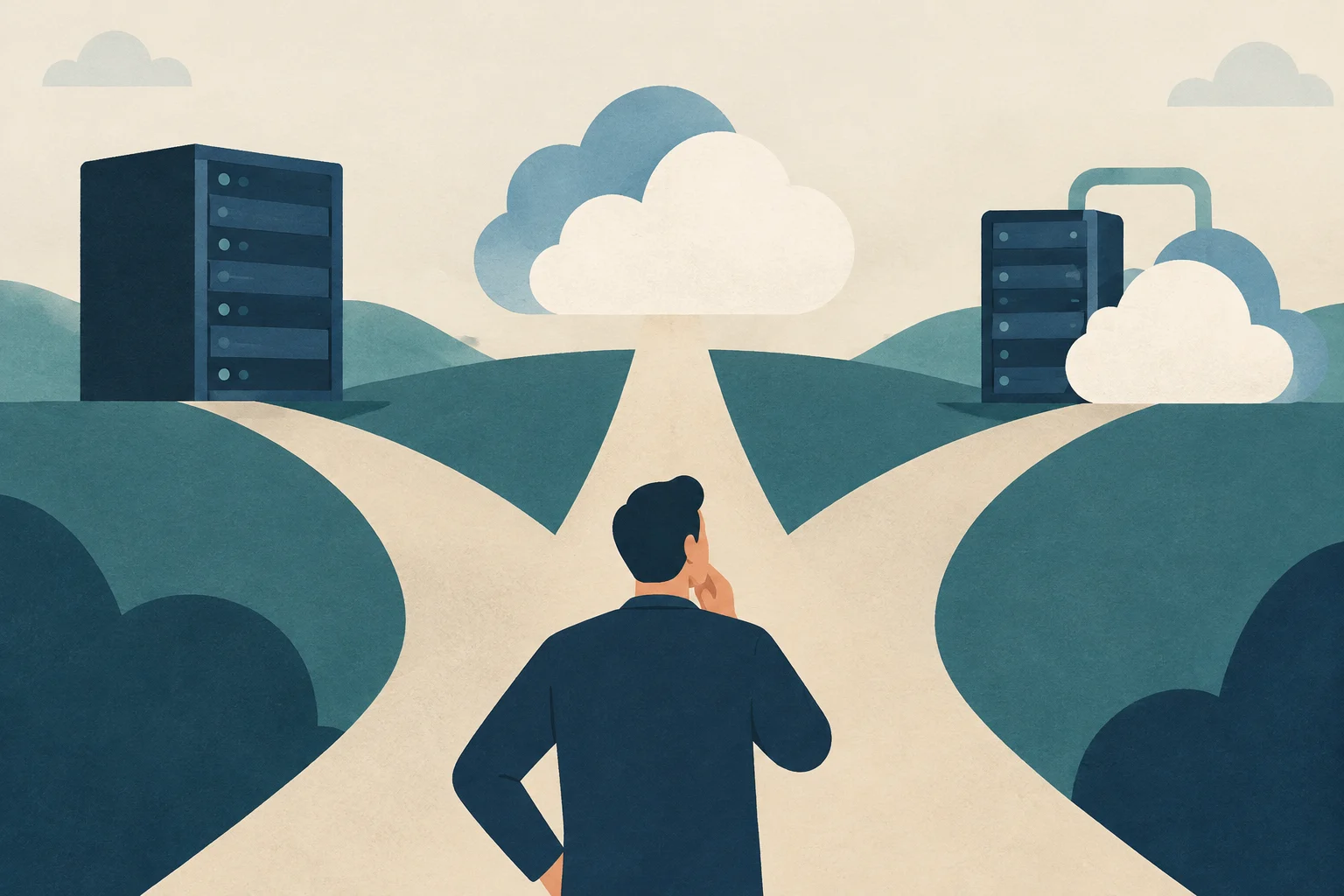
The end of the technological dichotomy
For years, digital transformation was framed as a binary decision: either maintain your own infrastructure (on-premise) or migrate everything to the cloud. However, the operational reality of many companies, especially SMEs, does not fit into either extreme. The current trend points towards models that combine the best of both worlds, but only if they are strategically designed and not the result of accidental system accumulation.
The key to making an informed decision is not technology fashion, but analyzing three fundamental pillars: the nature of the workload, the regulatory compliance requirements, and the internal management capacity of the organization.
On-premise: total control and low latency
The on-premise model involves physically installing the entire IT environment within the company's facilities. This option remains relevant for organizations that require absolute control over hardware and software, as well as complete customization of the configuration.
Main advantages
- Connectivity independence: It does not rely on an Internet connection for basic operation, avoiding interruptions caused by external network failures.
- Security and privacy: Data remains in the hands of the company, which is crucial for sectors with strict regulations or highly sensitive data.
- Low latency: Ideal for real-time industrial processes or applications that require immediate responses near the point of use.
Limitations and risks
- High initial investment: It requires the purchase of hardware, physical space, and licenses, generating significant capital expenditure.
- Dedicated technical team: It requires specialized personnel for management, maintenance, updates, and backups, increasing recurring operational costs.
- Limited scalability: Expanding capacity requires new physical investments and installation times, making it difficult to respond to seasonal demand peaks.
Public cloud: scalability and pay-as-you-go
Public cloud infrastructure (providers such as AWS, Azure, or Google Cloud) has experienced notable growth by offering elasticity and global accessibility. This model allows scaling resources up or down in minutes, paying only for what is used.
Main advantages
- Reduced capital costs: It eliminates the need to purchase initial hardware, converting the investment into predictable operational expenditure.
- Immediate scalability: It allows absorbing demand peaks without over-dimensioning your own infrastructure year-round.
- Resilience and continuity: It facilitates the implementation of backups and disaster recovery in different geographic locations.
Limitations and risks
- Connectivity dependence: Access to services requires a stable Internet connection; any network failure can interrupt the business.
- High recurring costs: In the long term, intensive use of cloud resources can be more expensive than maintaining own infrastructure, especially if consumption is not optimized.
- Less physical control: Security largely depends on the provider's policies, which can be a point of friction for certain compliance requirements.
The hybrid model: strategic optimization
Hybrid architecture combines local environments and public (or private) clouds to create a single, managed infrastructure. According to IBM, this model is critical for digital transformation, as it allows modernizing legacy applications and running workloads in multiple environments flexibly.
When a hybrid approach is advisable
- Regulatory compliance: Keep sensitive data locally and use the cloud for less critical services.
- Demand peaks: Use the cloud as temporary reinforcement without investing in permanent hardware.
- Business continuity: Replicate critical data in the cloud to guarantee recovery from local failures.
- Development and testing: Create temporary environments in the cloud without affecting the local production infrastructure.
The risk of accidental hybridization
A frequent error in SMEs is ending up with a hybrid scheme without having decided on it. This happens when workloads are hosted in the cloud as needs arise, while other applications are left on legacy on-premise systems. The result is a set of incompatible solutions, with different security protocols and complex, costly management.
Decision criteria for SMEs
To choose the right model, companies must evaluate the following factors:
| Criterion |
On-premise |
Public Cloud |
Hybrid |
| Data control |
High |
Low/Medium (depends on provider) |
High (selection by workload) |
| Initial cost |
High |
Low |
Medium |
| Scalability |
Low (requires investment) |
High (immediate) |
High (flexible) |
| Network dependence |
Low |
High |
Medium |
| Regulatory compliance |
Easy (if localization is required) |
Variable (depending on region/provider) |
Adapted (sensitive data locally) |
| Internal management |
Requires dedicated team |
Lower internal load |
Requires complex orchestration |
Conclusion
There is no universally superior option. On-premise infrastructure offers control and low latency, public cloud provides agility and reduced capital costs, and the hybrid model allows optimizing both according to the specific needs of each workload. The decision should be based on a rigorous analysis of security, performance, and compliance requirements, avoiding the accidental accumulation of systems that hinders management and increases long-term costs.