Hong Kong integrates the Pinglu Canal into its strategy to reactivate its port
The Hong Kong government announced on October 7, 2026, that it will leverage the opening of the Pinglu Canal to expand its cargo catchment area towards southwestern China. The measure aims to strengthen its role as a regional transshipment hub and transform its port into a high-value center, combining the new waterway with existing intermodal services.
The government of Hong Kong announced on October 7, 2026, that it will integrate the recent inauguration of the Pinglu Canal into its strategy to counteract the decrease in cargo volumes at its port. The initiative seeks to extend the catchment area for goods towards the inland provinces of southwestern China, specifically Guangxi, Guizhou, Sichuan, and Yunnan, and to consolidate the city's position as a regional transshipment center.
Chan Mei-po, Secretary for Transport and Logistics of Hong Kong, stated before the Legislative Council that the administration "will seize the opportunity presented by the opening of the Pinglu Canal in Guangxi." This statement marks a strategic shift: instead of relying exclusively on its traditional role as a high-volume container gateway, the government seeks to transform the port into a "value port", with a greater emphasis on logistics, maritime services, finance, and digitalization.
The Pinglu Canal: key infrastructure for southwestern China
The Pinglu Canal, officially inaugurated on September 16, 2026, is the first river-sea navigation waterway built in China under national coordination since 1949. With a length of 134.2 kilometers, it connects the inland river network of Guangxi with the Beibu Gulf (also known as the Gulf of Tonkin), offering a direct sea outlet for goods from one of the main industrial regions of inland China.
The project has required an investment of 72.7 billion yuan (approximately 9.4 billion euros) and four years of construction. Its relevance lies in the geography: until now, goods from provinces such as Sichuan, Chongqing, Guizhou, or Yunnan had to move eastward through the Xijiang river system to the Pearl River Delta and coastal ports, such as Guangzhou. The new canal opens a route to the south that allows:
Shortening distances: Reduces some logistics routes by more than 560 kilometers.
Reducing costs: Decreases overall logistics costs by between 18% and 30%.
Economic savings: Generates potential savings of over 5 billion yuan (approximately 650 million euros) per year.
The infrastructure accommodates vessels of up to 5,000 tons and features three large lock complexes (Madao, Qishi, and Qingnian) designed to overcome a cumulative elevation difference of 65 meters. Chinese authorities estimate a useful life of nearly 100 years and a cargo target of 5 million tons in the first year, with a long-term ambition to exceed 100 million tons annually by 2035.
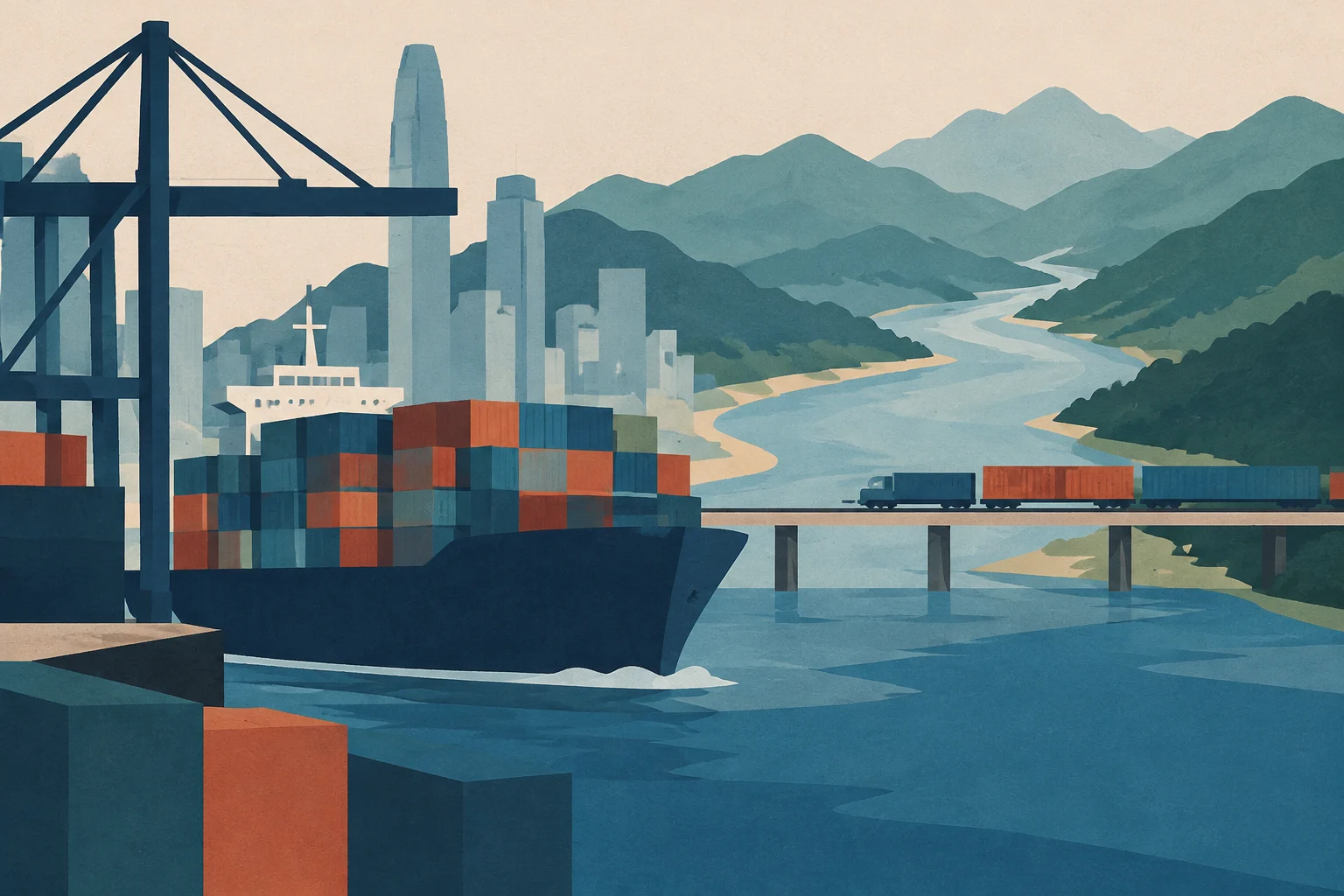
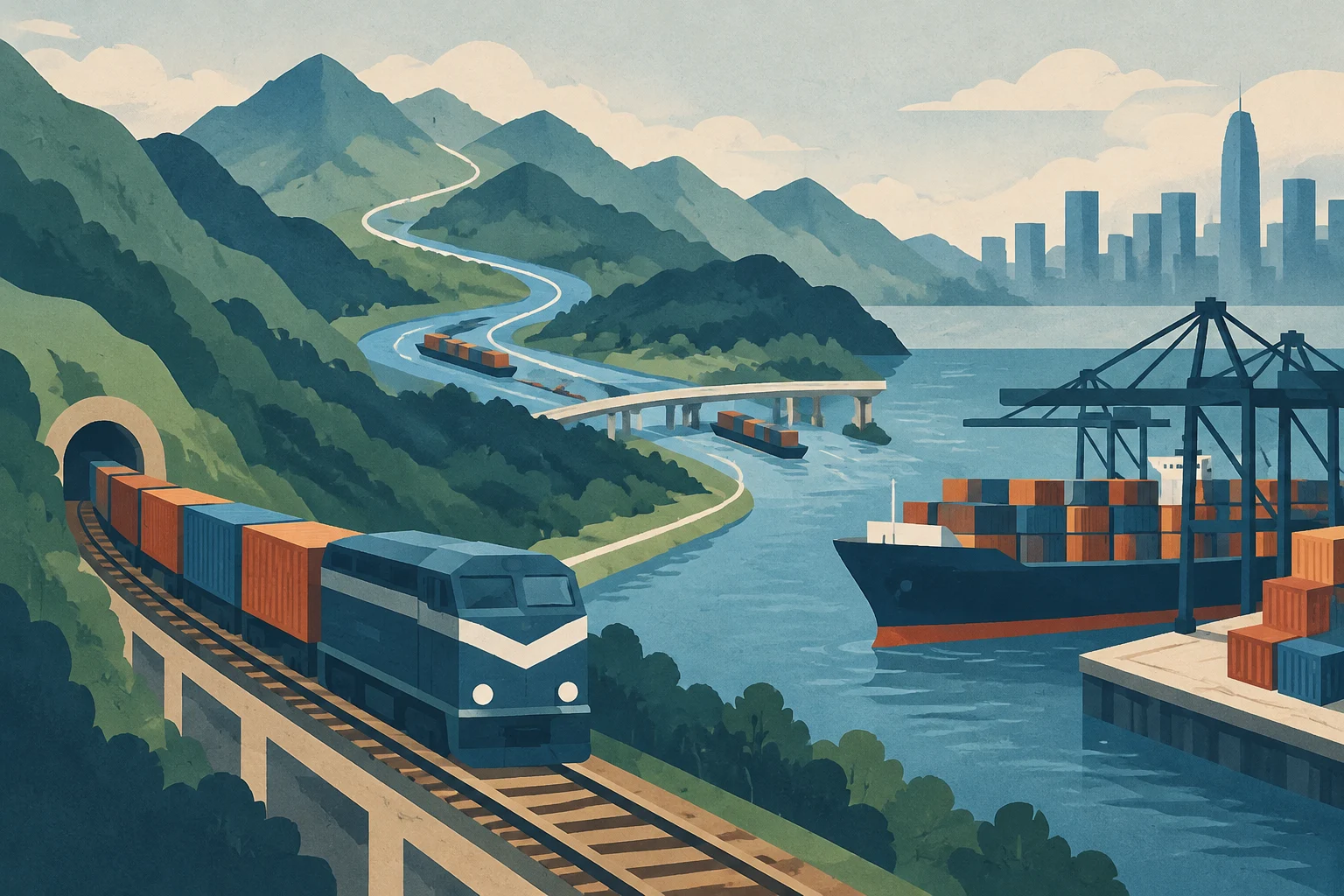
Editorial illustration · Edition Business
Hong Kong's strategy: combining routes and services
Hong Kong's strategy is not limited to the construction of the infrastructure, but to the integration of this new route with its existing operational capabilities. The government seeks to combine the Pinglu Canal with established intermodal services to create an efficient logistics corridor:
Daily Hong Kong-Guizhou service: A direct land and sea connection.
Chongqing-Qinzhou-Hong Kong sea-rail intermodal service: A route that connects the interior with the coast and then with Hong Kong.
Preliminary data supports the viability of this strategy. Container traffic between Guangxi and Hong Kong reached 160,000 TEU in the first half of 2026, representing a 22% year-on-year growth. This trend suggests that companies are already beginning to explore the advantages of the new connection.
Competitive context and challenges
Hong Kong's initiative is set against a backdrop of intense competition. Decades ago, Hong Kong competed with Singapore and Rotterdam as the world's busiest port. However, in recent years, mainland Chinese ports have taken the top spots due to increased exports and improved port infrastructure. In 2025, Hong Kong ranked 12th among the busiest ports, with a 6% drop in volumes, to 12.91 million TEU.
The Hong Kong government maintains that the port retains significant operational advantages, such as speed in container handling. For example, the Kwai Tsing Container Terminal has recently handled more than 8,300 container moves on a vessel with a capacity of over 23,000 TEU. Additionally, "smart transformation" measures are being implemented, including the development of shore power and potential discounts on port fees to attract more calls from regular shipping lines.
However, experts warn that completed infrastructure is only the first step. Lei Xiaohua, a researcher at the Guangxi Academy of Social Sciences, noted that bulk goods will be the "litmus test" for cost reduction. Companies will compare the total door-to-door price, including transshipments, storage, and cargo dwell time. The biggest risk in the early months is that cargo volume, land connections, and port services do not advance at the same pace, which could increase unit costs if ships operate half-empty or frequencies are irregular.
Implications for businesses
For companies operating in the region, the integration of the Pinglu Canal into Hong Kong's strategy offers new logistics opportunities:
Inland Chinese exporters: Manufactures from Sichuan, Chongqing, Guizhou, and Yunnan can access international markets, especially in Southeast Asia, with lower costs and transit times.
ASEAN companies: Companies from the Association of Southeast Asian Nations that export minerals, agricultural products, and seafood to southwestern China, or import Chinese manufactures, benefit from a more direct and efficient route.
Logistics service providers: The transformation of Hong Kong into a "value port" opens opportunities for trade finance services, supply chain digitalization, and high value-added logistics.
Trade between China and ASEAN reached 4.34 trillion yuan in the first half of 2026, an 18.2% year-on-year increase, which reinforces the relevance of this new connection. Hong Kong's strategy seeks to capitalize on this commercial growth, positioning itself as an essential node in regional supply chains.
A Rio de Janeiro Civil Police investigation points to the use of electronic devices to inflate fares and a network directing passengers, especially tourists, to taxis not authorized to operate at the airport.
The new Moroccan Executive, led by Fatima Ezzahra El Mansouri, has approved and presented the 2027 finance law bill. The text mobilizes 62 billion dirhams for social measures, tax exemptions and territorial development, keeping the deficit at 3%.
The bank allows parents and guardians to hire digital investment fund portfolios for their children, with an initial minimum of 10,000 euros and contributions starting from 100 euros, aimed at long-term goals such as education or housing.