Definition and strategic value of service productization
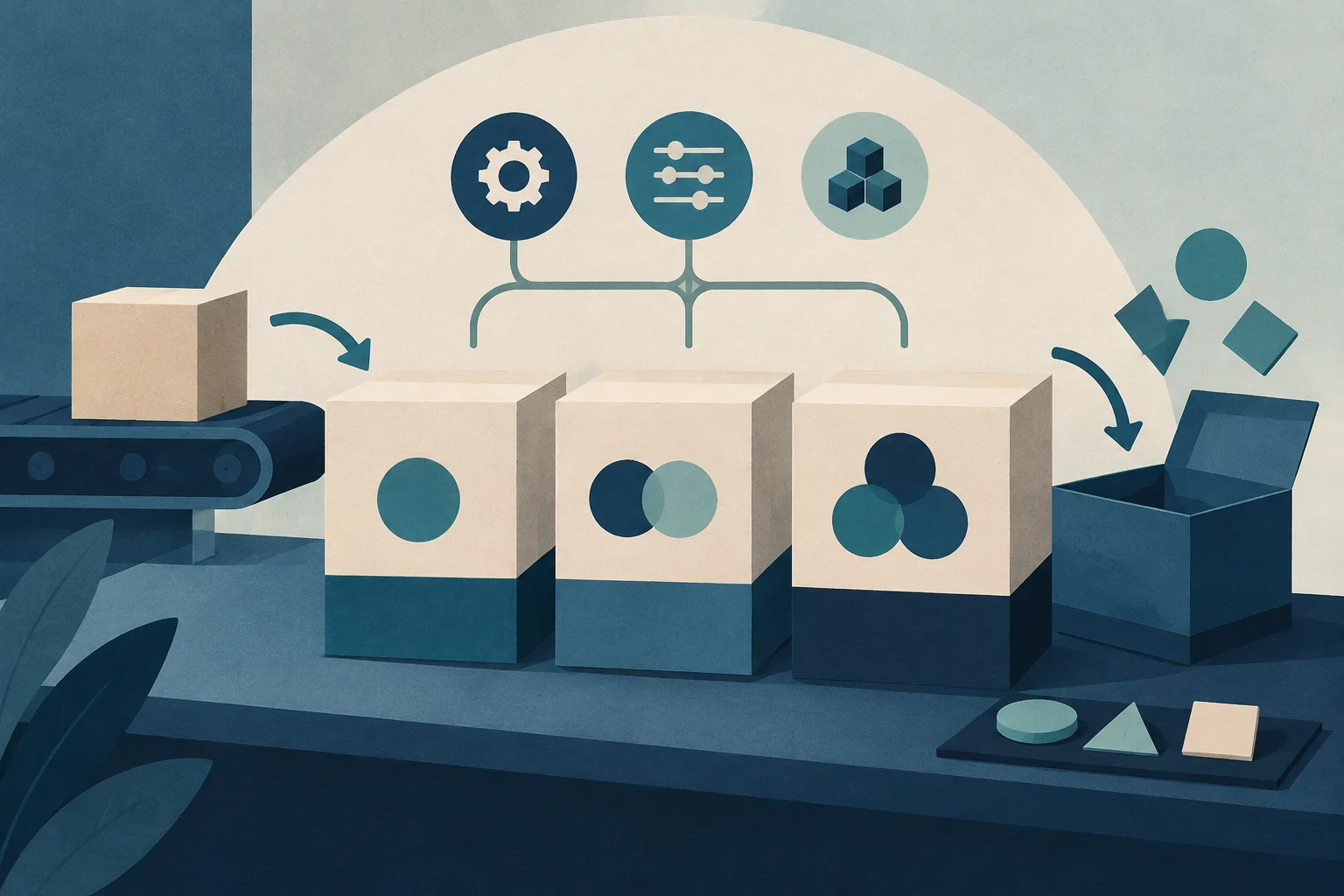
A productized service is a standardized offering sold like a product: with a fixed scope, a defined price, and a repeatable process. Unlike custom work, where each project requires a new proposal and negotiation, productization makes it possible to deliver the same solution to multiple clients without redesigning the process from scratch.
This strategy is not about eliminating personalization, but about standardizing what is repeatable and preserving flexibility where it adds real value. The goal is to decouple revenue growth from a linear investment of time, enabling service businesses to scale without proportionally increasing operating costs.
Key differences between custom and productized services
Choosing between the two models affects sales, delivery, and how clients perceive the service. While custom services can justify higher fees and attract sophisticated clients, productized services simplify the sales cycle and reduce uncertainty.
| Criterion |
Custom service |
Productized service |
| Delivery model |
Customized, labor-intensive |
Standardized, repeatable, often automated |
| Pricing |
Hourly or per project, variable |
Fixed price, per package or subscription |
| Scalability |
Limited by the team’s time |
High; allows more clients to be served simultaneously |
| Client interaction |
High, ongoing, and specific |
Defined, structured, and often self-service |
| Revenue |
Irregular, dependent on closing new deals |
Predictable, often recurring |
Criteria for selecting suitable services
Not all services are good candidates for productization. For the model to work, the offering must meet certain requirements that ensure efficiency and quality.
- Repeatable processes: The task must be possible to complete using the same steps regardless of the client. If every project requires a unique strategy from scratch, productization will be difficult.
- Clear deliverables: The final result must be tangible and definable (for example, a report, a website, or a campaign). Ambiguous outcomes make standardization difficult.
- Predictable workload: The time and resources required to complete the service should be consistent. This makes it possible to calculate margins accurately.
- Defined boundaries: It must be possible to clearly establish what is and is not included. If the scope is inherently open-ended, the risk of scope creep is high.
Structuring the offering: tiers and add-ons
To preserve flexibility without compromising the package structure, businesses can use service tiers and add-ons. This strategy makes it possible to address specific needs without breaking the standardized model.
Service tiers
Offering three tiers (for example, Basic, Pro, and Premium) makes it possible to segment the market and attract clients with different needs and budgets. Each tier should have a clearly differentiated scope, not just a different price. For example, the basic tier might include 3 design concepts, while the premium tier includes 5 concepts and additional strategy sessions.
Add-ons
Add-ons are additional services clients can purchase if they need something outside the standard scope. They protect the base package’s margin and make it possible to monetize specific needs. It is important to define and price add-ons separately to avoid ad hoc negotiations that erode profitability.
Protecting margins through documentation
Profitability in productized services depends not only on pricing, but also on operational efficiency. Process documentation is the main tool for achieving it.
Standard Operating Procedures (SOPs)
Documenting each step of the service in Standard Operating Procedures (SOPs) makes it possible to:
- Reduce delivery time: Teams know exactly what to do and how to do it, minimizing errors and rework.
- Make delegation easier: New team members can learn the process quickly, reducing dependence on the founder or lead expert.
- Maintain quality: Standardization ensures every client receives the same quality of service, regardless of who carries it out.
Clarity about exclusions
It is just as important to define what is not included as it is to specify what is. Ambiguity in scope is the leading cause of scope creep and margin erosion. A clear list of exclusions protects the team’s time and prevents conflicts with clients.
Validation and launch
Before investing significant resources in productization, it is advisable to validate the offering with existing clients or through a pilot. This makes it possible to adjust the scope, price, and process before launching the offering to the wider market.
- Select a repeatable service: Choose an offering that is already delivered frequently and meets the productization criteria.
- Define the scope and price: Clearly establish what the package includes and how much it costs.
- Document the process: Create SOPs for each stage of delivery.
- Sell to existing clients: Offer the package to current clients to gather feedback and refine the offering.
- Launch to the market: Once validated, present the offering as a standard option on the website and in marketing communications.
Conclusion
Service productization is a powerful strategy for improving profitability, scalability, and revenue predictability. By standardizing scope, pricing, and processes, service businesses can reduce uncertainty and scope creep while maintaining the flexibility needed to meet their clients’ specific needs. The key is to select the right services, structure the offering with tiers and add-ons, and document processes to protect margins and ensure quality.