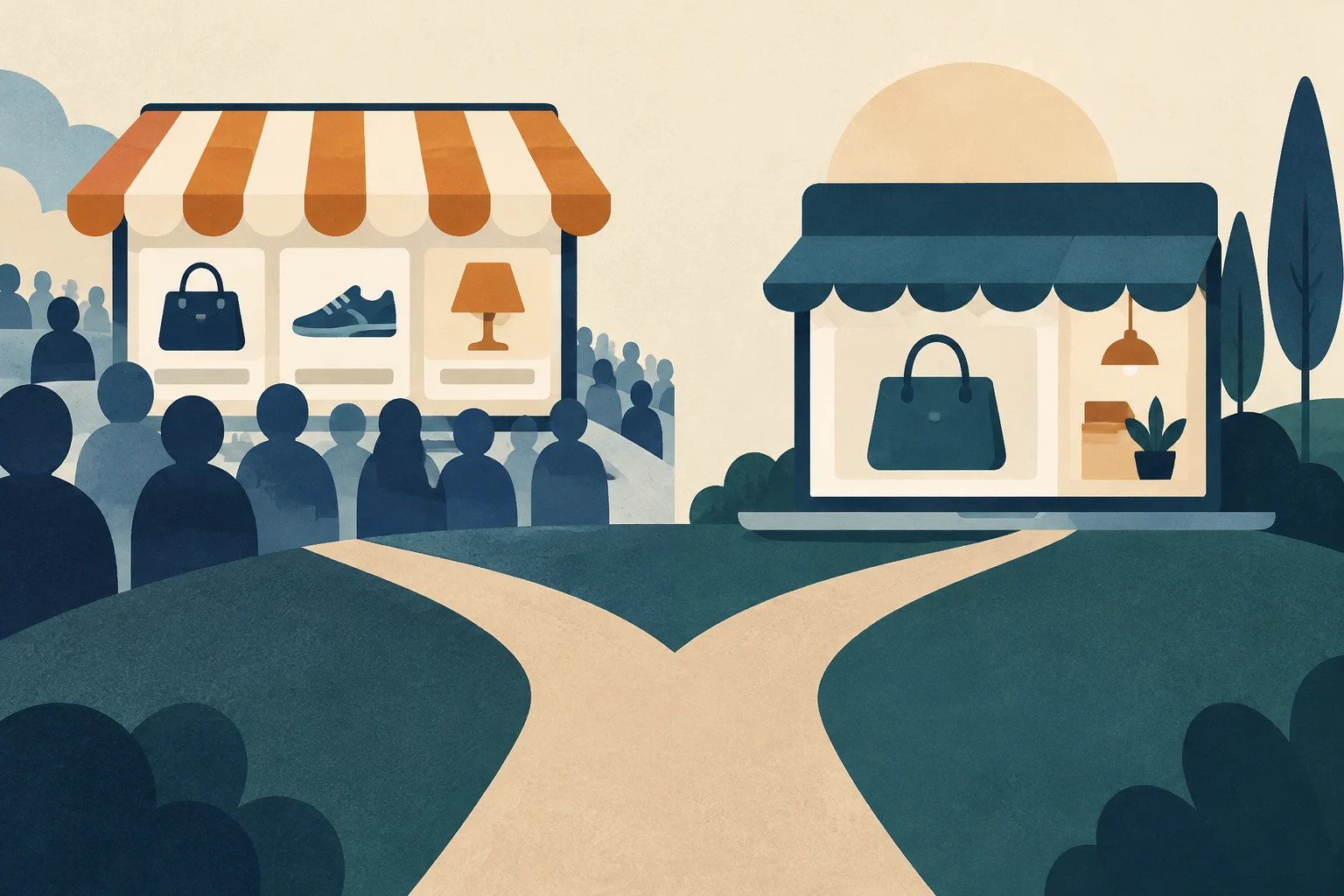
The decision between selling on a marketplace or an own online store is one of the most frequent strategic dilemmas for companies operating in digital commerce. It is not about choosing the "best" channel in the abstract, but about determining which one fits the current stage of the business, the type of product, and long-term brand objectives. The context is clear: e-commerce in Spain reached €25.752 billion in the first quarter of 2025, a year-on-year growth of 18.2% according to the CNMC. In this environment, operating with criteria is a competitive advantage.
The marketplace as a demand accelerator
A marketplace is a digital platform where multiple sellers offer their products under the same roof, such as Amazon, eBay, or Mercado Libre. Its main advantage is immediate access to a massive audience with high purchase intent. This drastically reduces the initial Customer Acquisition Cost (CAC), as the platform manages traffic, consumer trust, and, in many cases, logistics.
However, this model has hidden costs. Sales commissions reduce profit margins, and the seller competes directly on price and reviews, which can dilute the brand's unique value proposition. Furthermore, customer loyalty is usually directed toward the platform, not the brand, and access to customer data is restricted or non-existent, limiting loyalty strategies.
The own store as an asset builder
An own online store (ecommerce) is a website fully controlled by the company, where it sells directly to the consumer without intermediaries. Platforms like Shopify, WooCommerce, or PrestaShop allow setting it up without developing technology from scratch, although the responsibility for traffic acquisition, logistics, and customer service lies with the seller.
The main advantage is total control over the user experience, brand identity, and, most importantly, customer data. This allows building a long-term digital asset, optimizing Lifetime Value (LTV), and personalizing communication. The disadvantage is the initial investment in development, hosting, and digital marketing (SEO, SEM, social networks) to generate traffic from scratch, which implies a steeper learning curve.
Key differences between both models
The following table summarizes the most relevant strategic dimensions for decision-making:
| Dimension |
Own Online Store |
Marketplace |
| Initial investment |
Medium-high (development, marketing) |
Low (registration and commissions) |
| Traffic acquisition |
Own (SEO, SEM, social) |
Organic within the platform |
| Brand control |
Total |
Limited by platform rules |
| Margin per sale |
Higher (no third-party commissions) |
Reduced (variable commissions) |
| Customer data |
Full access |
Restricted or non-existent |
| Scalability |
Slower at the beginning |
Fast, but dependent on the platform |
The mixed strategy: complementarity instead of exclusion
The analyzed sources agree that the question is not "which is better," but "in what sequence and with what purpose." The recommended strategy is an omnichannel or mixed approach:
- Marketplace for acquisition and validation: Use the platform to capture initial demand, test products, and clear stock. It is ideal for generic products or saturated categories where visibility is critical.
- Own store for retention and profitability: Redirect customers to the own channel to maximize margin, build the brand relationship, and access data for future loyalty campaigns.
Factors to decide the appropriate model
The choice depends on four main variables:
- The type of product: Generic or low-ticket products usually work better in marketplaces. Branded, exclusive, or high-value-added products benefit from the control of the own store.
- The business stage: Startups can use the marketplace to validate their value proposition. Consolidated companies should prioritize the own store to protect their margin.
- The available resources: The ability to invest in digital marketing and own logistics determines the viability of the online store.
- Long-term brand objectives: If the objective is to build a brand asset, dependence on a marketplace can be a strategic risk.
Frequently asked questions
Is it cheaper to sell on a marketplace?
In the short term, yes, because there is no initial investment in development. In the long term, accumulated commissions can reduce profitability more than the fixed costs of a well-managed own store.
Can I use both channels at the same time?
Yes, and it is the recommended strategy. The marketplace serves as an acquisition channel and the own store as a retention and margin maximization channel.
What happens if the marketplace changes its policies?
Dependence on a single platform is a risk. Having an own store acts as insurance against rule changes, account suspensions, or commission increases.