Operatives Glossary: SKU, Picking, Putaway and Cross-Docking for SMEs
The unification of language between management and warehouse is key to efficiency. This glossary precisely defines the essential concepts of inventory management and order preparation, differentiating consecutive processes and types of picking to optimize the supply chain.
Warehouse management in SMEs often faces a linguistic barrier: the management team talks about profitability and service levels, while operational staff handle technical terms such as picking, SKU or putaway. This disconnection can generate inefficiencies, errors in order preparation and a lack of visibility regarding operational bottlenecks. This glossary aims to unify the vocabulary so that all company actors understand the flow of goods, from receipt to dispatch.
Fundamental concepts of inventory and location
Before discussing movements, it is necessary to understand how goods are identified and located. The basis of any warehouse management system is the precise identification of each unit.
SKU: The minimum unit of management
The SKU (Stock Keeping Unit) is the minimum unit of inventory. It is not simply a product, but a specific variant. For example, a blue T-shirt in size M and a blue T-shirt in size L are two different SKUs, although they belong to the same base product. In practice, each SKU has a unique reference that allows the system to know exactly what it is, where it is and how many units are available. Confusing a SKU with a generic product is one of the most common errors that leads to stock discrepancies.
Putaway: Strategic location after receipt
Putaway is the process of placing goods in their designated location within the warehouse immediately after receipt. It is not a random act; it is a strategic decision. Good putaway considers product rotation (those that move faster should be closer to the preparation area), weight, size and compatibility with other items. Inefficient putaway forces operators to walk longer or search for products in inappropriate places, increasing operational costs.
WMS: The digital brain of the warehouse
The WMS (Warehouse Management System) is the software that manages all warehouse operations. It acts as the brain that coordinates putaway, picking, inventory control and the generation of shipping documents. Without a WMS, management is based on paper or memory, which limits scalability and increases the probability of errors. For SMEs, the implementation of a WMS is the critical step to move from reactive to proactive management.
The order preparation process: Picking and Packing
Once the goods are located, the central process is order preparation. This is where precision and speed determine the customer experience.
Picking: Selection and collection
Picking is the operation of locating, collecting and combining the specific items that make up an order. It is the most labor-intensive and costly phase of the warehouse; according to various industry studies, it can represent more than 50% of total operational costs. Picking begins when the order is received and ends when the items are in the consolidation area. Its optimization is key to reducing delivery times and minimizing errors.
There are different picking methods depending on volume and the nature of the products:
Discrete picking: A complete order is prepared at a time. It is suitable for large orders with few items.
Batch picking: Several orders are grouped into a single collection process. The operator collects all items from several orders at once and then separates them. It increases efficiency in warehouses with many small orders.
Voice picking: Operators receive instructions through headphones, freeing their hands and eyes to focus on the task. It reduces errors and increases speed.
Pick-to-light: Light indicators guide the operator to the correct location and the quantity to collect. It is ideal for high-turnover environments and small products.
Packing: Packaging and protection
Packing is the process following picking. It consists of selecting the appropriate packaging, protecting the products, labeling them and preparing them for transport. Unlike picking, which focuses on the precision of selection, packing focuses on the physical integrity of the goods. Efficient packing minimizes material use, reduces shipment weight and ensures the product arrives in perfect condition. Coordination between picking and packing is vital: if picking is fast but packing is slow, bottlenecks are generated in the exit area.
Redaktionelle Illustration · Edition Business
Flow strategies and logistics models
Beyond daily operations, there are strategic models that define how goods flow through the supply chain.
Cross-docking: Direct transfer
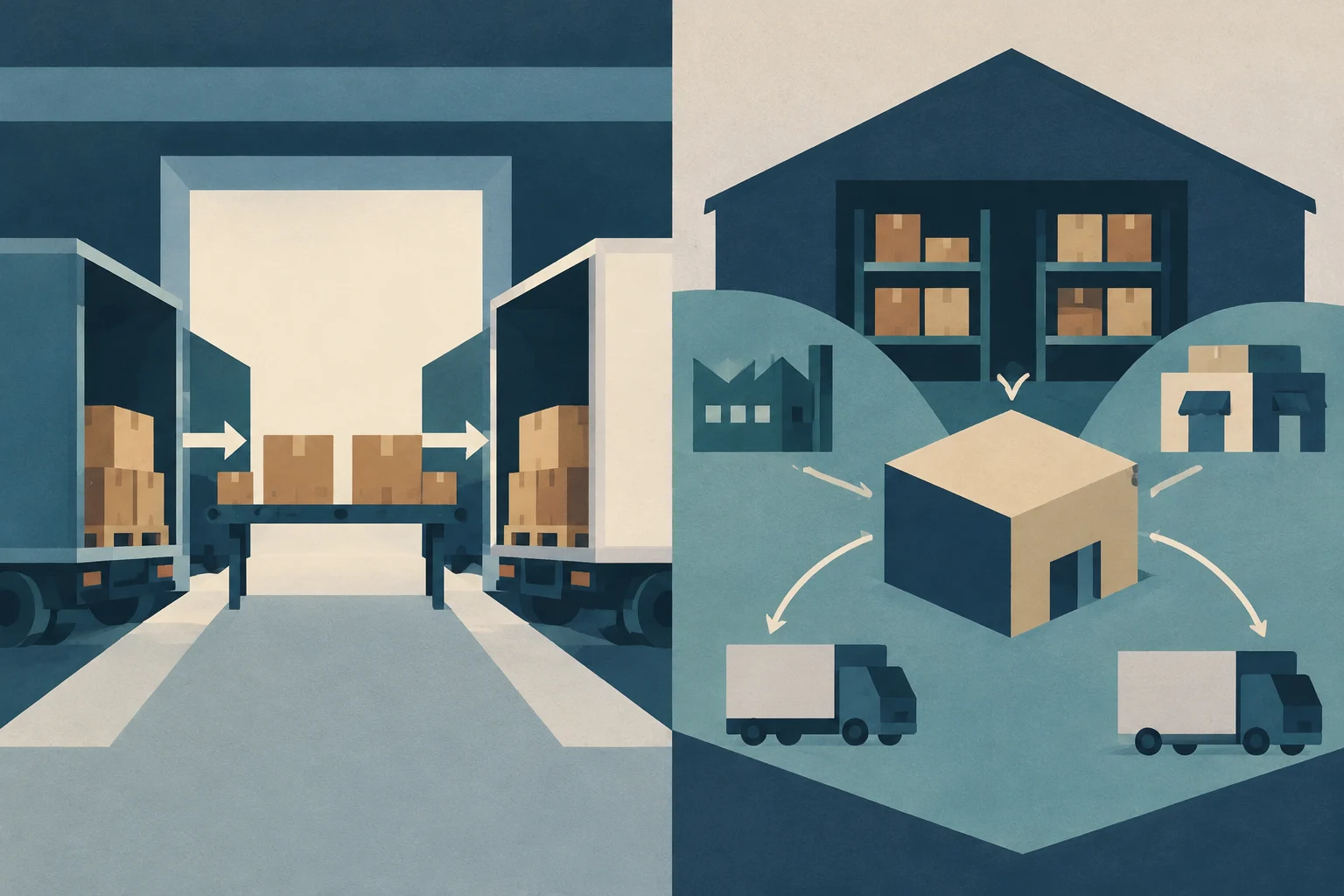
Cross-docking is a strategy in which goods are transferred directly from receipt to dispatch, without passing through storage. Products arrive in inbound trucks and leave in outbound trucks in a very short time, often within hours. This model drastically reduces storage costs and the risk of obsolescence, but requires perfect coordination between suppliers and customers. It is ideal for high-turnover or perishable products.
3PL: Logistics outsourcing
A 3PL (Third-Party Logistics) is an external company that manages the logistics of another company, either totally or partially. This includes storage, picking, packing and shipping. For SMEs, hiring a 3PL allows scaling without investing in own infrastructure, personnel or technology. The 3PL becomes the operational partner that executes the processes defined by the company, freeing management to focus on commercial growth.
Key differences between consecutive processes
It is common to confuse terms that describe different phases of the flow. Clarifying these differences is essential for internal communication.
Process
Main objective
Moment in the flow
Common error
Putaway
Locate the goods
After receipt
Placing products without rotation criteria
Picking
Select items
After order
Confusing SKU or quantity
Packing
Protect and pack
After picking
Using inadequate or excessive packaging
Cross-docking
Transfer without storing
Between receipt and dispatch
Not coordinating time windows
Frequently asked questions
What is the difference between picking and packing?
Picking is the selection and collection of the correct items for an order. Packing is the packaging and protection of those items for transport. They are consecutive processes: first items are collected (picking), then they are packed (packing).
What is a SKU and why is it important?
A SKU is the minimum unit of inventory, identified by a unique reference. It is important because it allows the system to manage each product variant separately, ensuring accuracy in stock and order preparation.
When is it advisable to use cross-docking?
Cross-docking is advisable when there is a high product turnover, close coordination with suppliers and customers, and a desire to minimize storage costs. It is not suitable for low-turnover products or those requiring detailed inspection before shipping.
What role does the WMS play in warehouse management?
The WMS is the system that coordinates all operations: putaway, picking, packing and inventory control. It provides real-time visibility, reduces errors and optimizes resources. It is the fundamental tool to scale the logistics operation.
Ein Leitfaden zur Interpretation von Latenz, Fehlern, CPU, Speicher, Sättigung, Durchsatz und Verfügbarkeit sowie zur Verknüpfung dieser Signale mit Kapazität, Skalierung und Serviceverpflichtungen.
Ein schrittweises Verfahren, mit dem KMU das anwendbare Rechtsregime identifizieren, harmonisierte Normen von allgemeinen technischen Normen unterscheiden und die Konformitätsbewertung, die technische Dokumentation und die CE-Kennzeichnung vor der Vermarktung in der Europäischen Union verwalten können.
Klare Definitionen der AfCFTA, der Regionalen Wirtschaftsgemeinschaften (RECs) und der Ursprungsregeln, damit KMU den regulatorischen Rahmen verstehen und ihren Markteintritt in Afrika planen können.